 Sudden Valley Siding
 Two Products That Get Compared a Lot
If you've started researching new siding for a home in Sudden Valley, you've probably run into two names over and over: James Hardie fiber cement and LP SmartSide engineered wood. Both are marketed as upgrades over vinyl. Both claim to hold paint well, resist damage, and last decades. And both show up on plenty of reputable contractors' trucks around Whatcom County.
We get asked about this comparison often enough that we wanted to put our reasoning in writing, plainly, rather than leave homeowners to piece it together from sales brochures. We install only James Hardie fiber cement siding. We do not install engineered wood products. This page explains what each material actually is, where engineered wood genuinely performs well, and why our own trade-offs analysis for this specific climate landed on fiber cement every time.
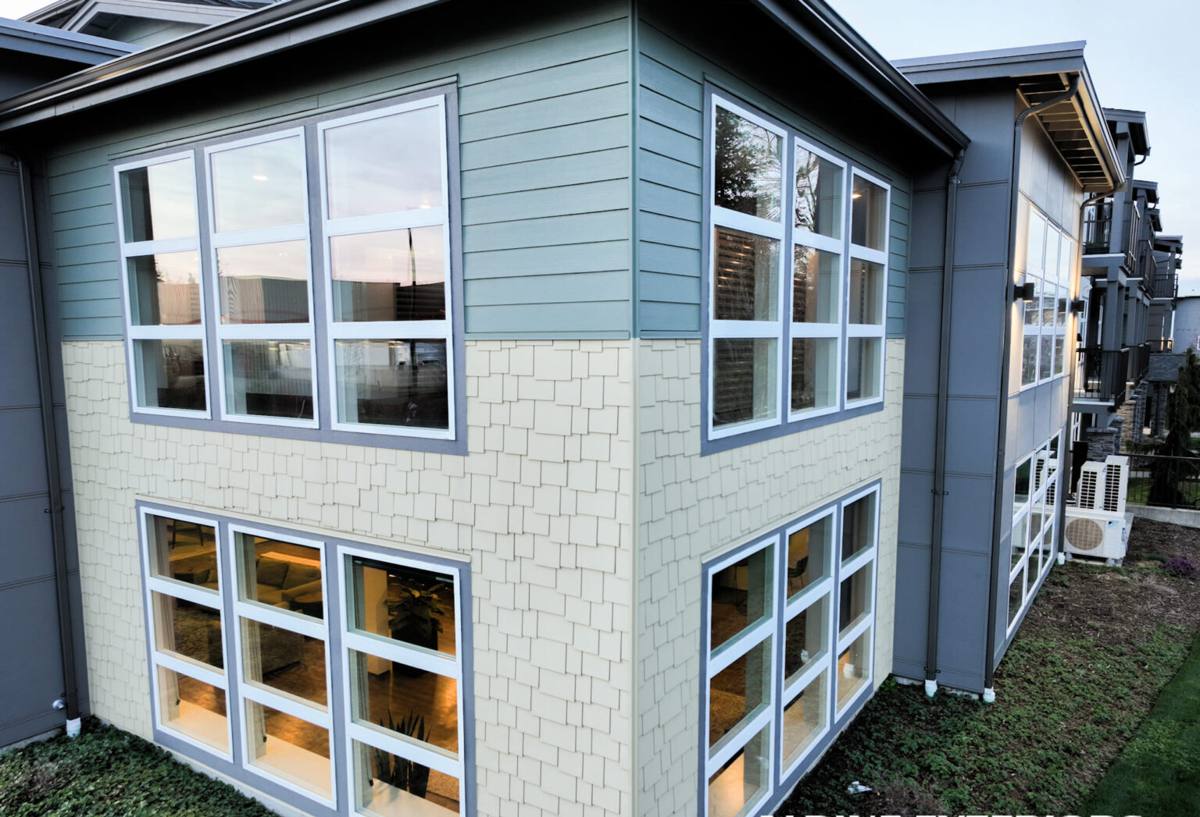
What Engineered Wood Siding Actually Is
LP SmartSide and similar engineered wood products are made from wood strands or fibers, bonded with resins under heat and pressure, then treated with a zinc-borate compound for insect and fungal resistance and finished with a primed or pre-coated surface. It's a genuine improvement over old-style solid wood or hardboard siding from decades past — it's more dimensionally stable, the treatment process does real work against rot and pests, and it's noticeably lighter than fiber cement, which can make installation faster and less physically demanding.
It also takes fasteners and cuts more like traditional lumber, which some carpentry crews prefer working with. For dry climates, or homes with generous roof overhangs and good grade drainage, engineered wood siding has a legitimate track record.
Where the Trade-Off Shows Up
The core of engineered wood is still wood fiber. Zinc-borate treatment and factory coatings protect it, but that protection is a barrier, not a material change — the wood beneath is still capable of absorbing moisture if that barrier is compromised at a cut edge, a fastener puncture, a seam, or a spot where caulking fails years down the road. Once moisture gets past the coating and into the substrate, the same swelling, delamination, and edge softening that affects any wood product can begin, just on a longer timeline than old-school hardboard.
What Fiber Cement Actually Is
James Hardie fiber cement siding is made from Portland cement, sand, and cellulose fiber, cured into a dense, non-combustible board. There's no wood fiber for moisture to work into over time, because there's no wood in it at all. The cellulose is there for reinforcement and workability, fully encapsulated in the cement matrix — it doesn't behave like exposed wood grain.
Hardie's ColorPlus factory finish is baked on in a controlled environment, which produces a harder, more consistent finish than field-applied paint and comes with its own finish warranty. Hardie also makes climate-specific HZ product lines engineered for different moisture and temperature conditions, which matters in a region like ours where damp weather isn't occasional — it's most of the year.
What It Doesn't Get Right Automatically
Fiber cement is heavier and more brittle to cut than engineered wood, which means installation quality matters more, not less. Improper fastening, missed flashing details, or skipped caulking joints can cause problems on any siding — Hardie is not magic immune to bad installation. The difference is what happens after a small installation gap or maintenance lapse occurs, which we get into below.
Side-by-Side: What Actually Matters
| Factor | Engineered Wood (LP SmartSide) | Fiber Cement (James Hardie) |
|---|---|---|
| Base material | Wood strand/fiber composite | Cement, sand, cellulose fiber |
| Combustibility | Combustible (wood-based) | Non-combustible |
| Moisture behavior if barrier fails | Can absorb, swell, delaminate at exposed points | Does not swell or rot; can absorb surface moisture but doesn't structurally degrade the same way |
| Factory finish | Primed or pre-finished, field touch-up common | ColorPlus baked-on finish with separate finish warranty |
| Weight / installation feel | Lighter, cuts like lumber | Heavier, requires fiber-cement-rated blades and tools |
| Pest resistance | Treated against insects and fungus | Naturally not a food source for insects or fungus |
| Typical repaint/recoat interval | Shorter, depends on coating condition | Longer with ColorPlus finish; longer still than field-painted options |
| Moss/algae resistance | Coating-dependent, can stain if not maintained | Coating-dependent, but cement substrate underneath is unaffected by moss contact |
Why the Whatcom County Climate Changes the Math
Sudden Valley sits in a part of the state where siding doesn't get an easy life. The moisture-laden air moving in off Bellingham Bay and Lake Whatcom, the driving rain that comes sideways in winter storms, and a moss season that can stretch for months rather than weeks — all of that adds up to siding that stays damp longer than it would in a drier region. That's the environment any exterior product has to survive, year after year, not just the day it's installed.
Why This Matters for Wood-Based Products Specifically
In a drier climate, small maintenance lapses — a hairline gap at a butt joint, a spot where caulk has started to crack, a corner that catches more runoff than the rest of the wall — might sit for a season without consequence. In our climate, those same small lapses get tested by moisture almost continuously. For a wood-based substrate, that's the exact condition where absorption and swelling risk goes up. For fiber cement, the same lapse is still worth fixing, but the consequence if it's missed for a while is meaningfully different because there's no wood fiber underneath to swell.
Moss and Algae
Moss and algae growth is a fact of life on north-facing and shaded walls in Whatcom County, on any siding material. It's mostly a surface and coating issue, not a structural one, on both products — but on a wood-based substrate, prolonged moss contact holding moisture against the surface adds one more moisture pathway to a material that's already more moisture-sensitive underneath.
Installation Sensitivity Is the Real Variable
We want to be fair here: a well-installed engineered wood siding job, with correct flashing, properly caulked joints, adequate roof overhangs, and diligent long-term maintenance, can perform well for a long time. A poorly installed fiber cement job can fail early too. Installation quality is the single biggest variable in how any siding performs in our climate, more than brand alone.
Where fiber cement earns its reputation is in what happens when installation and maintenance aren't perfect — which, realistically, describes most homes over a 20-30 year ownership period. Caulk gets missed during a repaint. A gutter overflows onto a wall section for a season before anyone notices. A tree branch rubs a corner. Fiber cement's tolerance for those real-world imperfections, given what it's made of, is why we've standardized on it rather than trying to install engineered wood correctly enough to compensate for its material sensitivity.
Maintenance Over the Life of the Siding
Neither product is maintenance-free. Both need periodic inspection of caulked joints, both benefit from keeping gutters and downspouts functioning so water isn't dumped against a wall section, and both should be checked after major storms for any physical damage. Where they diverge is in what a missed maintenance cycle costs you.
- Inspect caulked joints and trim intersections annually, ideally before the fall rains set in
- Keep gutters clear so overflow doesn't run down wall sections repeatedly
- Trim back vegetation and tree limbs that keep a wall section shaded and damp
- Address moss or algae buildup with a gentle wash rather than pressure that can drive water behind boards
- Have any impact damage — from hail, debris, or equipment — assessed promptly rather than left through a wet season
- Repaint or recoat on the manufacturer's recommended schedule, not just when it looks worn
Warranty Structure
Warranty terms matter as much as the marketing headline number. James Hardie's warranty on their fiber cement products is transferable to a new owner if the home is sold within the coverage period, which is a real factor in resale conversations. It also separates substrate coverage from the ColorPlus finish warranty, so homeowners know what's covered and for how long on each front. We'd encourage any homeowner comparing products to read the actual warranty document for whatever siding they're considering, not just the summary on a sales sheet — the fine print on labor coverage, prorating, and transferability varies more than people expect between brands.
Why We Standardized on James Hardie
We made a decision, as a company, to install only James Hardie fiber cement. Not because engineered wood is a bad product in the abstract, but because for the climate we actually work in — the sustained damp, the driving rain, the long moss season here in Whatcom County — we didn't want to be in the position of telling a homeowner their siding's long-term performance depends on flawless caulk maintenance for three decades straight. Fiber cement's non-combustible, moisture-stable composition gives us a product we can install to spec and stand behind, on homes that are going to spend most of the year wet whether anyone's thinking about it or not.
That's the honest version of "why Hardie." It's not that the other product is junk. It's that we'd rather build our business around a material whose worst-case tolerance in this specific climate is better, and let the installation and maintenance advice we give homeowners be about keeping a good product great, rather than about compensating for a material limitation.
Questions to Ask Before You Decide
- What is the base material, and how does it behave if moisture gets past the surface coating?
- Is the product rated or engineered for a wet, moss-prone climate, or a general national spec?
- What does the warranty actually cover — substrate, finish, labor — and is it transferable?
- What ongoing maintenance does the manufacturer require to keep the warranty valid?
- Has the installer been trained and certified specifically on this product, not just siding in general?
If you're weighing your options for a home in Sudden Valley or elsewhere in Whatcom County, we're happy to walk your property, look at your exposure and drainage situation, and give you a straight answer on what we'd recommend — no pressure, no sales script. Reach out for a free estimate using the form below.