 Sudden Valley Siding
 Living Around Lake Whatcom Means Living With Moisture
Homes around Lake Whatcom sit in one of the wetter, greener pockets of Whatcom County, and that's exactly why exterior materials here take more abuse than they would in a drier climate. Between the tree canopy that rings much of the lake, the driving rain that blows in off the water during fall and winter storms, and the moisture-laden air that moves through this part of the Pacific Northwest much of the year, siding, trim, and roofing are under near-constant pressure. Add in a moss season that can stretch from late fall well into spring, and you have a set of conditions that separates exterior materials that hold up from ones that quietly fail behind a coat of paint.
We work on homes throughout Sudden Valley and the surrounding Lake Whatcom area regularly, and the pattern is consistent: houses on shaded, north-facing lots or tucked under fir and cedar cover show moss and algae staining faster, while homes with more open southern exposure deal more with UV fading and thermal cycling. Either way, the underlying lesson is the same — this is not a climate where you can install exterior products meant for milder or drier regions and expect them to perform the way the manufacturer's brochure promises.
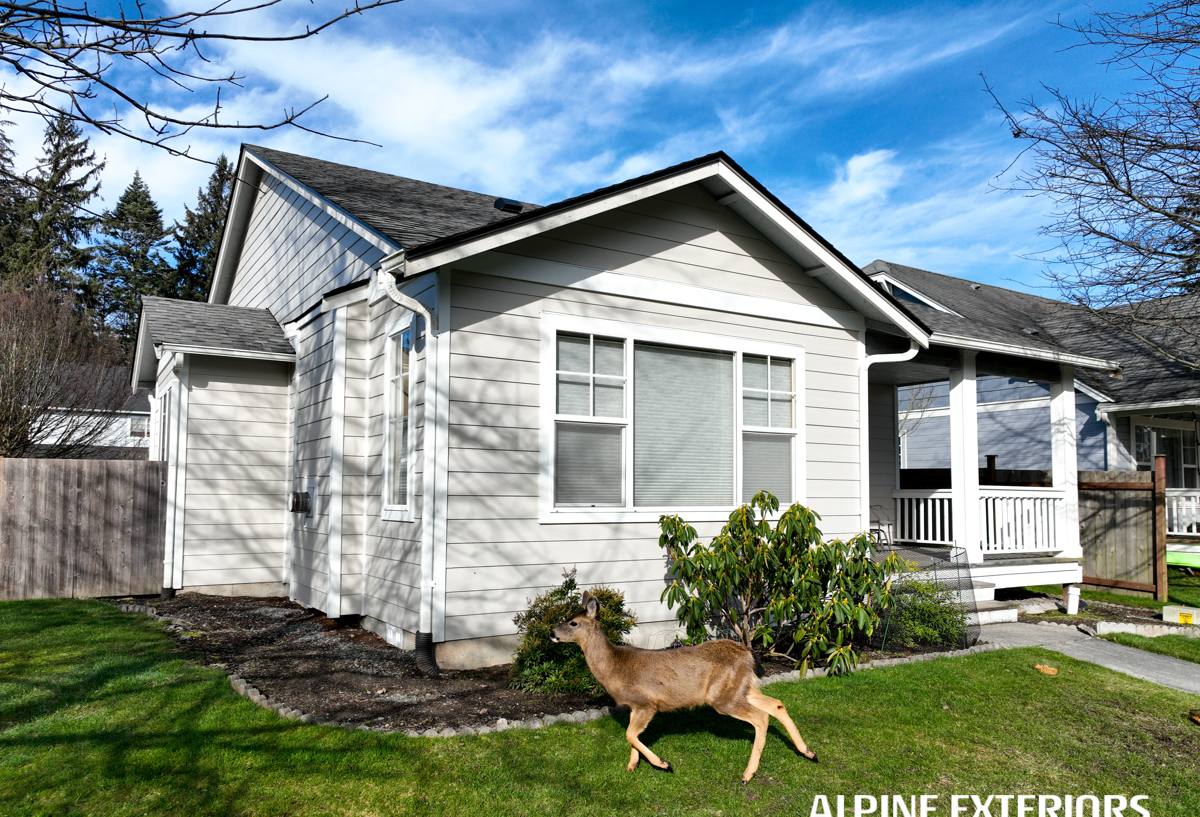
What Driving Rain and Moss Season Actually Do to a House
Moss and Algae Growth
Moss doesn't just grow on roofs. Given persistent shade and moisture, it establishes on siding surfaces, in butt joints, around window trim, and anywhere water sits or drains slowly. On some materials this is cosmetic. On others — particularly wood-based products — trapped moisture under moss and algae growth becomes a pathway for rot, because the organic growth holds water against the surface far longer than open air-drying allows.
Wood Rot and Hidden Moisture Damage
Driving rain doesn't fall straight down here — wind pushes it sideways into wall assemblies, especially at corners, window heads, and anywhere flashing details are marginal. Wood and wood-composite siding products are vulnerable to swelling, delamination, and rot at these exact stress points. The damage is frequently invisible from the ground until paint starts failing or a soft spot shows up under a hand press.
UV and Weathering on Sun-Exposed Walls
It's not all shade and moss around the lake. South- and west-facing walls get real sun exposure in summer, and materials with painted or laminate finishes are prone to fading, chalking, and finish breakdown on those elevations, which shows up as an uneven, patchy appearance across the house within a handful of years.
Why We Standardized on James Hardie Fiber Cement
We install James Hardie fiber cement siding exclusively. That's not a marketing angle — it's a decision made after years of seeing how different siding products actually perform in Whatcom County conditions, not just how they perform in a showroom or a warmer, drier market.
What We Don't Install, and Why
We don't install vinyl, LP SmartSide, Cemplank, Allura, or primed spruce or cedar siding, and we're upfront about why:
- Vinyl siding can warp and buckle under thermal stress, and its seams and panel joints give driving rain more opportunities to work behind the cladding over time.
- LP SmartSide and similar engineered wood products are wood-strand composites with a resin binder — better than raw wood in some respects, but still an organic substrate that depends on flawless caulking, flashing, and paint maintenance to keep moisture out. In a high-rain, high-moss environment, that maintenance margin is thin.
- Cemplank and Allura are also fiber cement, and fiber cement as a category is the right call for this climate — but we've standardized on one manufacturer's system, factory finish, and warranty rather than mixing product lines, so every job we do carries the same accountability and the same documented performance record.
- Primed spruce or cedar siding is a beautiful, traditional look, but it is real wood, and real wood in a climate with this much sustained moisture requires a maintenance commitment — recoating, caulk inspection, moss removal — that most homeowners underestimate until they're a decade in and facing board replacement.
None of these products are junk. They're reasonable choices in the right climate and with the right maintenance plan. Our position is narrower than that: for the specific combination of rain, shade, moss, and moisture that Lake Whatcom and greater Whatcom County deliver year after year, we think fiber cement — specifically James Hardie's system — gives homeowners the best long-term outcome with the least ongoing burden.
The James Hardie System Built for This Climate
ColorPlus Technology
James Hardie's ColorPlus finish is baked on at the factory in a controlled process, rather than field-painted on site. That matters here specifically because field-applied paint is only as good as the weather window it's applied in and the surface prep underneath it — both of which are harder to control on a job squeezed between rain systems. A factory finish removes that variable and comes with its own finish warranty.
Engineered Product Lines
James Hardie manufactures siding in climate-specific formulations, engineered for regional moisture and temperature patterns rather than a single one-size-fits-all product. Fiber cement itself is non-combustible, dimensionally stable, and doesn't support rot the way wood-based products can, which is exactly the profile you want on a wall that spends half the year damp.
Transferable Warranty
James Hardie backs its siding with a strong, transferable product warranty — a real asset if you ever sell, since it hands off the coverage rather than resetting to zero for the next owner.
Roofing, Windows, and Decks Around Lake Whatcom
Siding is only one piece of a home's exterior envelope, and we handle the rest of it too, because a house's weather protection has to work as a system.
- Roofing — the roof takes the brunt of driving rain and moss growth first. Proper underlayment, flashing, and ventilation matter as much as the roofing material itself in a climate that stays wet this long.
- Windows — window flashing and integration with the siding plane is one of the most common failure points we find on older homes in this area. Replacement windows installed without correct flashing detail become a moisture entry point no matter how good the siding is.
- Decks — outdoor living space around Lake Whatcom means decks are exposed to the same rain and shade cycles as the siding. Ledger board flashing and proper drainage are the details that separate a deck that lasts from one that needs early repair.
Because we handle all four trades, we can look at a house as one connected system rather than treating siding, roofing, windows, and decks as unrelated projects — which matters most exactly at the transitions between them, where most real-world leaks start.
What Correct Installation Looks Like in This Region
James Hardie siding performs the way it's designed to only when it's installed to the manufacturer's specification, and in a high-moisture climate the installation details matter more than the product choice itself. That includes correct fastener placement and spacing, proper clearance between the siding and grade, deck surfaces, and roof lines, a fully integrated water-resistive barrier and flashing system behind the cladding, and correctly caulked and sealed joints, corners, and penetrations. Skipping any one of these steps can undermine even the best siding material, which is why installation quality — not just brand — is the real variable in how a siding job performs over 20 or 30 years.
Cost Factors for Lake Whatcom Siding Projects
Every home is different, but the factors that move a siding project's scope and cost around the lake tend to fall into a consistent set of categories:
| Factor | Why It Matters Here |
|---|---|
| Home size and wall complexity | More corners, gables, and dormers mean more cutting, flashing, and labor time |
| Existing siding removal | Tear-off of failing wood, vinyl, or composite siding adds disposal and prep labor |
| Water damage repair | Rot found during tear-off (common on shaded, moss-prone walls) requires sheathing or framing repair before new siding goes on |
| Trim and accessory work | Window and door trim, corner boards, and soffit detail affect both cost and long-term weather performance |
| Access and site conditions | Steep lots, tree cover, and lake-adjacent properties can affect staging and equipment access |
| Product line and color | James Hardie's various siding lines and ColorPlus color options carry different material costs |
Choosing a Local Contractor for Lake Whatcom
Hiring the right crew matters as much as choosing the right material. A few things worth checking before you sign a contract:
- Confirm the contractor is licensed and insured in Washington State, and ask to see current documentation rather than taking it on faith.
- Ask specifically about their James Hardie installation experience and whether they follow the manufacturer's written installation instructions, not just general best practices.
- Ask how they handle water-resistive barrier and flashing detail — this is where most long-term failures originate, and a contractor who can explain their approach clearly is usually one who takes it seriously.
- Get a written scope that specifies tear-off, any sheathing repair contingency, trim work, and cleanup, so there's no ambiguity if hidden damage turns up mid-project.
- Ask for references from other jobs in the same general area — a crew with local experience will already understand how this climate behaves.
Maintenance Expectations After Installation
Fiber cement siding is low-maintenance compared to wood or vinyl, but "low-maintenance" doesn't mean "no maintenance" anywhere near this much shade and rainfall. Plan on periodically rinsing off accumulated moss, pollen, or algae, especially on north-facing and heavily shaded walls, and doing a visual walk-around once or twice a year to check caulking at joints and penetrations. Because James Hardie's ColorPlus finish is factory-applied and warrantied, you're not looking at a repaint cycle the way you would with field-painted wood siding — that alone removes one of the biggest recurring costs homeowners in this area deal with on older siding.
If you're weighing a siding, roofing, window, or deck project on your Lake Whatcom or Sudden Valley home, we're happy to take a look and talk through what your house actually needs — no pressure, no obligation. Use the form below to request a free estimate.