 Sudden Valley Siding
 Siding Built for Bellingham's Coastal Climate
Bellingham sits in a tough spot for exterior materials. You've got Bellingham Bay and the Salish Sea pushing salt-laden air inland, weather systems rolling off the Pacific that dump rain for months at a stretch, and a shoulder season on either side of winter where everything north-facing and shaded stays damp long enough to grow moss, algae, and mildew. Add in the wind that funnels through the bay and up into the surrounding hills, and you have a climate that is genuinely hard on wood, vinyl, and lower-grade siding products.
We're a Sudden Valley-based crew that works throughout Whatcom County, and Bellingham is one of the areas we're in constantly — from the older neighborhoods near downtown with original wood siding long overdue for replacement, to newer construction on the hillsides that's already showing UV fading or moisture stains after just a few Pacific Northwest winters. The pattern we see is consistent: houses here don't fail because of one bad storm, they fail slowly, from repeated cycles of saturation and drying, salt exposure, and shade-driven moss growth that traps moisture against the wall.
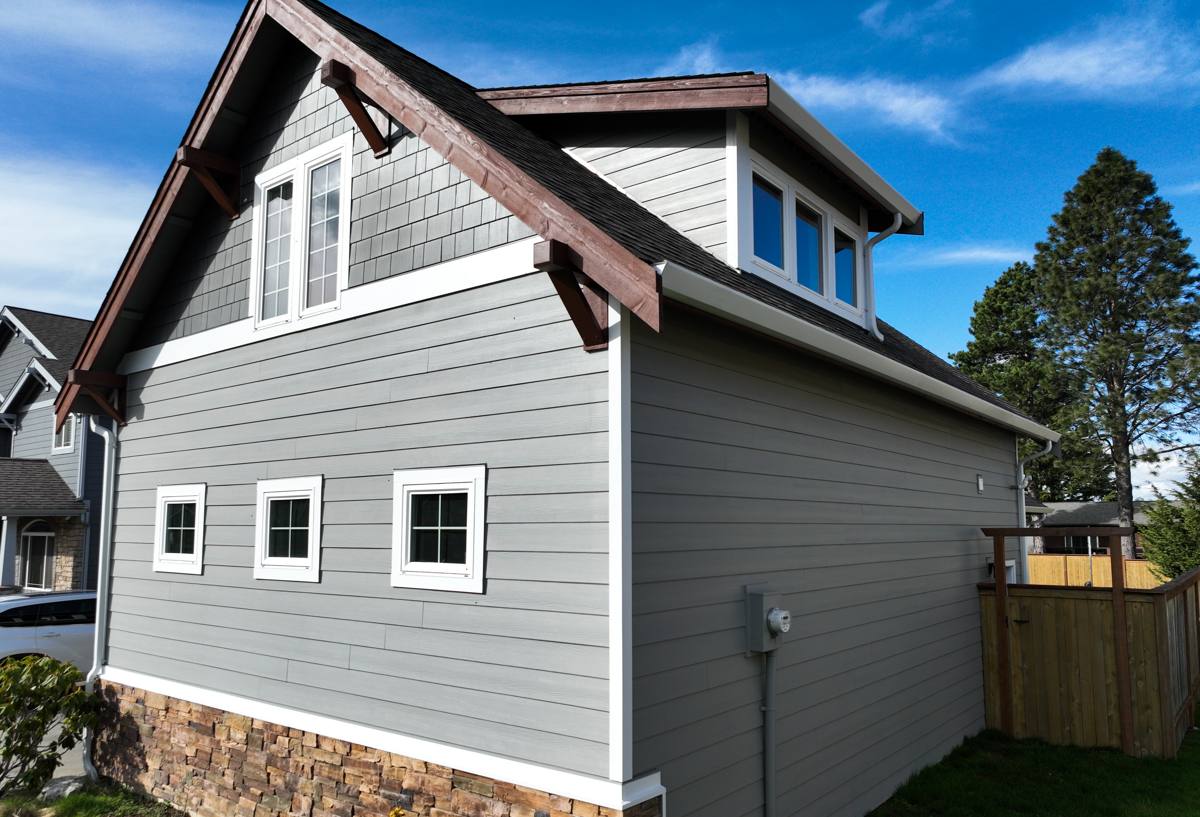
Why We Only Install James Hardie Fiber Cement
We made a decision a while back to standardize on one siding system rather than offer a menu of products with different failure modes and different warranty fine print. That system is James Hardie fiber cement. It's not the cheapest option on paper, and we're upfront about that. But for a climate like Bellingham's, the trade-offs matter more than the sticker price.
What We're Not Installing, and Why
We don't install vinyl siding, LP SmartSide, Cemplank, Allura, or primed spruce or cedar. Each of those products has a legitimate place in the market, and none of them are "bad" in a blanket sense — but each has a specific vulnerability that shows up faster in this region than it would somewhere drier or milder:
- Vinyl expands and contracts with temperature swings, can crack in cold snaps, and doesn't hold up well against sustained wind-driven rain at seams and corners.
- LP SmartSide and other engineered wood products are wood-strand composites — well-engineered, but any wood-based product is more sensitive to the kind of prolonged moisture exposure and moss contact that's common on shaded Bellingham lots.
- Cemplank and Allura are also fiber cement, and reasonable products, but they don't carry the same factory-applied finish system, product lines engineered for specific climate zones, or the transferable warranty structure that James Hardie offers.
- Primed spruce or cedar looks great on day one, but bare or primed wood requires a maintenance schedule — recaulking, repainting, spot-treating — that most homeowners underestimate, and in a wet climate that maintenance window shrinks fast.
What Hardie Gets Right
James Hardie fiber cement is non-combustible, dimensionally stable (it doesn't swell and shrink the way wood does), and comes with a factory-baked ColorPlus finish that's substantially more durable than field-applied paint. Hardie also engineers specific product lines — the HZ5 line, for example — for climates like ours, with formulations tuned for moisture and freeze-thaw cycling rather than a one-size-fits-all approach. The warranty is transferable to a new owner if you sell the house, which matters in a market like Bellingham's where homes change hands regularly.
What Salt Air and Driving Rain Actually Do to Siding
Salt air is corrosive to exposed metal fasteners and flashing, and it accelerates the breakdown of lower-grade paint finishes over time. Driving rain — rain pushed sideways by wind rather than falling straight down — finds every gap in lap siding, every under-caulked seam, and every spot where flashing was installed as an afterthought instead of as part of the water management plan. On a west- or south-facing wall that catches wind off the bay, that's not an occasional event, it's a regular occurrence for a good chunk of the year.
This is why installation quality matters as much as the product itself. Fiber cement siding installed without proper flashing, without the right nailing pattern, or with panels butted too tightly can trap moisture behind the cladding regardless of how good the material is. We follow James Hardie's published installation specifications closely — correct clearances, proper flashing at every penetration and transition, and factory-finished cut edges sealed in the field — because that's what actually keeps water out, not the brand name alone.
Moss, Algae, and the Long Wet Season
Whatcom County's moss season isn't really a season — it's most of the year on shaded or north-facing walls. Moss holds moisture against whatever it's growing on, and on wood-based siding that constant dampness is exactly what accelerates rot at seams, butt joints, and anywhere caulking has started to fail. Fiber cement doesn't feed moss growth the way wood or wood-composite siding can, and it doesn't absorb water into the substrate the same way, which is one of the more practical reasons it holds up better on Bellingham's shadier lots.
That said, no siding material stops moss from growing on its surface if conditions favor it — moss will grow on almost anything given enough shade and moisture. The difference with fiber cement is that surface growth stays a cosmetic issue you can wash off, rather than a structural one that's slowly rotting the panel underneath.
Comparing Siding Options for a Bellingham Home
| Factor | James Hardie Fiber Cement | Vinyl | Wood / Engineered Wood |
|---|---|---|---|
| Moisture resistance | Strong; non-organic, engineered for climate zone | Water-resistant but seam-dependent | Vulnerable to prolonged wet exposure |
| Wind-driven rain performance | Strong with correct flashing/installation | Moderate; gaps at seams and corners | Depends heavily on maintenance state |
| Moss/algae impact | Cosmetic only | Cosmetic only | Can contribute to rot over time |
| Finish durability | Factory-baked ColorPlus, long repaint interval | Color molded in, can fade/chalk | Field-applied paint, shorter repaint cycle |
| Fire rating | Non-combustible | Combustible | Combustible |
| Ongoing maintenance | Periodic wash, inspect caulking | Periodic wash | Regular painting, caulking, spot repair |
Beyond Siding: How Roofing, Windows, and Decks Fit Together
Siding doesn't work in isolation — it's one part of a home's overall water management system. We also handle roofing, windows, and decks, and on a lot of Bellingham projects we're addressing more than one of these at once, because they're connected. A roof with poor drainage or damaged flashing will send water down onto siding it was never meant to handle. Windows with failed flashing or worn caulking are one of the most common points where water actually gets behind siding, no matter how good the siding itself is. And decks — especially ones attached to the house — need their own flashing and ledger board detailing so they're not funneling water into the wall assembly.
When we quote a siding project, we're looking at the whole envelope, not just the wall cladding, because fixing siding while ignoring a leaking window or a poorly flashed deck ledger just relocates the problem.
What to Expect From a Local Crew
There's a real difference between a contractor who works this region regularly and one who doesn't. A local crew already knows which walls in Bellingham catch the worst of the wind off the bay, which neighborhoods sit in enough shade to need extra attention to moss and drainage, and how the freeze-thaw pattern here differs from, say, eastern Washington. That knowledge shows up in small decisions — where to add extra flashing, how tight to run panel gaps, which side of the house needs the most attention to ventilation — that don't show up on a spec sheet.
It also matters for follow-up. A crew based in Sudden Valley isn't driving hours to handle a warranty question or a minor touch-up a year after installation.
Questions Worth Asking Any Siding Contractor
- Are you a certified installer for the specific product you're proposing, and can you show proof?
- What's your approach to flashing at windows, doors, and roof-to-wall transitions?
- Is the warranty on materials and labor transferable if I sell the home?
- How do you handle existing moisture damage or rot found once old siding comes off?
- Can you walk me through why you're recommending this specific product for this specific wall or exposure?
What a Bellingham Siding Project Typically Involves
Every home is different, but a typical replacement on a Bellingham property generally includes an assessment of the existing siding and sheathing condition, removal of the old material, repair of any water-damaged sheathing or framing found underneath, installation of a weather-resistant barrier, and then the Hardie panels or planks installed to spec with correct flashing at every penetration. Trim, corners, and paint or factory finish touch-up happen last. Timeline depends on the size of the home, the weather window, and whether hidden damage turns up once the old siding is off — which, on older Bellingham homes especially, is common enough that we build it into the conversation upfront rather than treating it as a surprise change order.
Get a Straightforward Estimate
If your Bellingham home's siding is showing its age — fading, soft spots, persistent moss, or paint that won't hold anymore — we're happy to come take a look and give you an honest assessment of what's going on and what it would take to fix it right. There's no pressure and no obligation. Use the form below to request a free estimate.