 Sudden Valley Siding
 Why Decks Near Bellingham Wear Out Faster Than the Manual Says
Every decking product sold in this region comes with a service-life estimate that assumes reasonably dry, moderate conditions. Bellingham doesn't give a deck those conditions. Between salt-laden air moving in off the water, months of driving rain, and a moss season that can stretch from October well into spring, the wood and hardware under a deck are under near-constant moisture load for most of the year. That's not a defect in any particular board or fastener — it's just what this climate does to anything installed outdoors, and it's why a deck that would last 20 years in a drier inland town can start showing real trouble here in 10 to 12 if it wasn't built with that reality in mind.
The damage rarely shows up where you'd expect first. Homeowners tend to watch the decking boards for splintering or graying, but the parts that actually fail a deck — ledger boards, joist hangers, post bases, and the fasteners holding it all together — are hidden underneath. By the time surface boards look bad enough to worry about, the structure below has often been absorbing moisture for years.
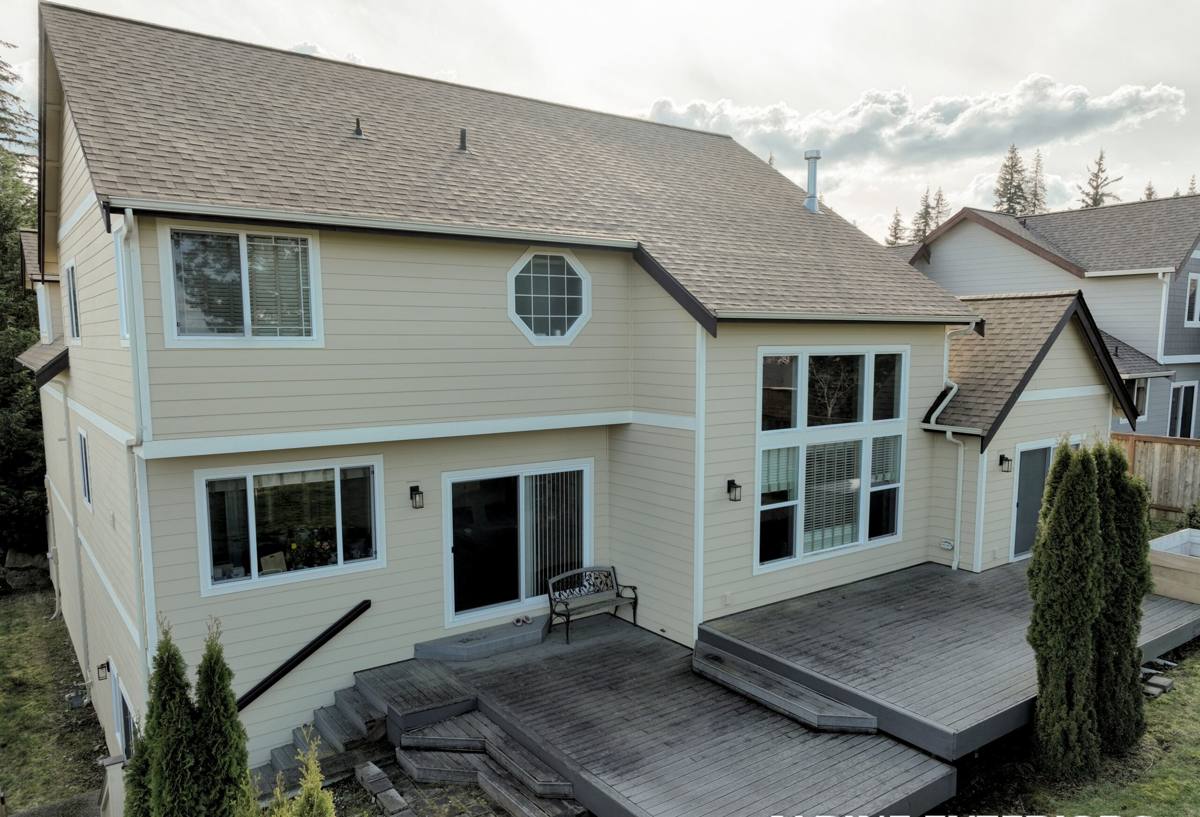
What "Correct" Actually Means for a Local Deck Replacement
A deck replacement done right for this area isn't just new boards on an old frame. It's an opportunity to fix the moisture pathways that caused the original deck to fail in the first place. That means paying real attention to a handful of details that are easy to skip and hard to see once the project is finished:
Ledger Board and House Connection
Where the deck attaches to the house is the single most common failure point we find on tear-outs in this area. Without proper flashing that sheds water away from the ledger and the wall sheathing behind it, water gets trapped against the house every time it rains — which, here, is most of the year. We flash this connection so water is directed out and down, not into the framing.
Joists, Beams, and Fastener Choice
Standard hot-dip galvanized or stainless fasteners matter more here than in drier climates, because coastal salt air accelerates corrosion in anything under-rated for it. We match hardware and fastener coatings to the treated lumber or composite substructure being used, so the connectors don't become the weak point a few years down the road.
Footings and Post Bases
Wood posts set directly in or against concrete hold moisture at the base longer than post bases that keep the wood elevated and ventilated. Given how long the ground stays saturated here through fall and winter, that detail alone has a real effect on how long the structural posts last.
Drainage and Airflow Underneath
Moss and mildew take hold fastest in low-airflow, shaded, damp spots — which describes the underside of most decks around here for a good chunk of the year. Proper joist spacing, grading under the deck, and gaps between boards for drainage all reduce how long that space stays wet after a storm.
Decking Material Options: What Actually Holds Up Here
There's no single "best" decking material — there's a best material for your budget, your maintenance appetite, and how much sun versus shade your deck gets. Here's how the common options actually perform in a wet, salt-air, moss-prone climate:
| Material | How It Handles Local Climate | Maintenance Reality |
|---|---|---|
| Pressure-treated wood | Handles moisture fine when properly sealed and maintained; most affordable upfront | Needs re-sealing every 1-2 years or moss and graying set in fast |
| Cedar | Naturally rot-resistant and handles our humidity well; softer, so it dents and scratches easier | Needs regular staining/sealing to keep its color and resist moss |
| Composite decking | Doesn't absorb water like wood, so it resists rot and warping through wet seasons | Low maintenance, but can still grow surface moss/mildew in shaded, low-airflow spots — needs occasional washing |
| PVC decking | Fully synthetic, essentially immune to moisture damage and rot | Least maintenance of the group; highest upfront material cost |
For decks with heavy shade or limited airflow underneath — common with homes built into wooded lots around here — composite or PVC generally pays for itself in avoided maintenance. For decks that get good sun and airflow, a well-maintained wood deck can perform well and costs less to start.
Repair or Replace? How to Tell
Not every tired-looking deck needs a full replacement, but plenty of decks that look repairable on the surface actually aren't once you get underneath. A few honest checks:
- Push a screwdriver or awl into the ledger board and any post bases near ground level — if it sinks in easily, that's rot, not just surface weathering.
- Check for soft, spongy spots when walking the deck, especially near the house connection and stair stringers.
- Look at joist hangers and fasteners for heavy rust or corrosion — compromised hardware is a structural issue, not a cosmetic one.
- Bounce-test the railings; if they flex more than a small amount, the posts or blocking behind them may have failed.
- If the deck was built without visible ledger flashing, assume moisture has been getting behind it regardless of how the boards look.
If the problems are limited to surface boards and the frame underneath is sound, a partial repair or resurfacing can make sense. If the structure itself — ledger, joists, or posts — shows rot or corrosion, replacement is the honest recommendation, because patching boards on top of a failing frame just delays a bigger problem.
Our Deck Replacement Process
- On-site assessment. We check the structure from the ground up, not just the decking surface — ledger connection, framing, footings, and drainage.
- Straight recommendation. We tell you what actually needs replacing versus what can be left alone, and walk through material options against your budget and how the deck is used.
- Permitting. Deck replacements of most sizes require a permit through the county or city depending on where the property sits — we handle that paperwork so it's not on you.
- Demolition and disposal. Full removal of the old structure, checking the house connection point for hidden damage once the old ledger is off.
- Framing rebuild. New ledger flashing, joists, hardware rated for coastal conditions, and footings/post bases set up for drainage.
- Decking, railings, and stairs. Installed to code, with attention to board spacing and airflow underneath.
- Final walkthrough. We go over the finished deck with you, including what maintenance it needs and when.
Permits, Code, and Guardrails
Whatcom County and the local building department set requirements around guardrail height, baluster spacing, footing depth, and ledger attachment for a reason — these are the details that keep a deck safe under real weight and real weather. A replacement is also the right time to bring an older deck up to current code, particularly on guardrails and stair railings, since older decks are frequently found without proper spacing or attachment once they're opened up. We pull the required permits and build to current code as a matter of course, not as an upsell.
Keeping a New Deck Ahead of the Climate
Even a correctly built deck needs some upkeep in this area — the climate doesn't let anything outdoors coast on "low maintenance" claims alone. A short, realistic checklist:
- Sweep leaves and debris off regularly, especially in fall — trapped organic matter is what feeds moss growth.
- Rinse or lightly scrub composite and PVC surfaces once or twice a year to keep mildew from taking hold in shaded areas.
- Re-seal or re-stain wood decking on the schedule the product calls for — skipping a cycle in a wet year does more damage here than it would in a drier climate.
- Keep gutters and downspouts clear so runoff isn't dumping extra water directly onto or under the deck.
- Check underneath once a year for standing water, moss buildup, or soft framing — catching it early is far cheaper than a second replacement.
Cost Factors to Expect
Every deck is different, but the main variables that move the price are consistent. This isn't a quote — it's what to think about before you get one:
| Factor | Why It Matters |
|---|---|
| Deck size and height | Larger decks and multi-level or elevated decks need more framing, more footings, and more labor |
| Decking material | Pressure-treated wood costs least upfront; composite and PVC cost more but need less upkeep over time |
| Structural condition | Rotted ledger, joists, or footings add rebuild scope beyond just surface decking |
| Railing and stair complexity | Custom railings, multiple stair runs, or built-in benches/planters add material and labor |
| Permit requirements | Larger or elevated decks may require engineering review, which adds time and cost |
Why It Matters That We Already Work in This Area
A deck built for a different climate zone, or by a crew that doesn't regularly work in coastal Whatcom County conditions, tends to miss the details that matter most here — the ledger flashing, the fastener grade, the drainage under the frame. We work on homes in and around Sudden Valley and Bellingham regularly enough to know which failure points show up again and again on tear-outs in this specific climate, and we build new decks to avoid repeating them. That's the difference between a deck that needs replacing again in a decade and one that's still solid well past that.
If you're dealing with a deck that's showing its age, or you just want a straight opinion on whether it needs repair or full replacement, we're glad to take a look. Fill out the form below for a free, no-pressure estimate.