 Sudden Valley Siding
 Why Siding Problems Sneak Up on Sudden Valley Homes
Siding rarely fails all at once. It fails in inches — a hairline crack behind a shrub, a soft spot under a downspout, a seam that's been letting water in for two winters before anyone notices a stain on the drywall inside. That slow-motion pattern is exactly what makes Whatcom County's climate hard on exterior walls. Sudden Valley sits close enough to Lake Whatcom and the Salish Sea corridor that homes take on a steady diet of salt-laden air, wind-driven rain that hits walls sideways instead of straight down, and a moss season that can run eight months out of the year in shaded, tree-covered lots.
None of that is dramatic on its own. But add it up over a decade and it's the difference between siding that's still doing its job and siding that's quietly failing behind a coat of paint that still looks fine from the driveway. This page walks through the specific warning signs worth checking for, what they usually mean, and when they're serious enough to call a contractor rather than just watch.
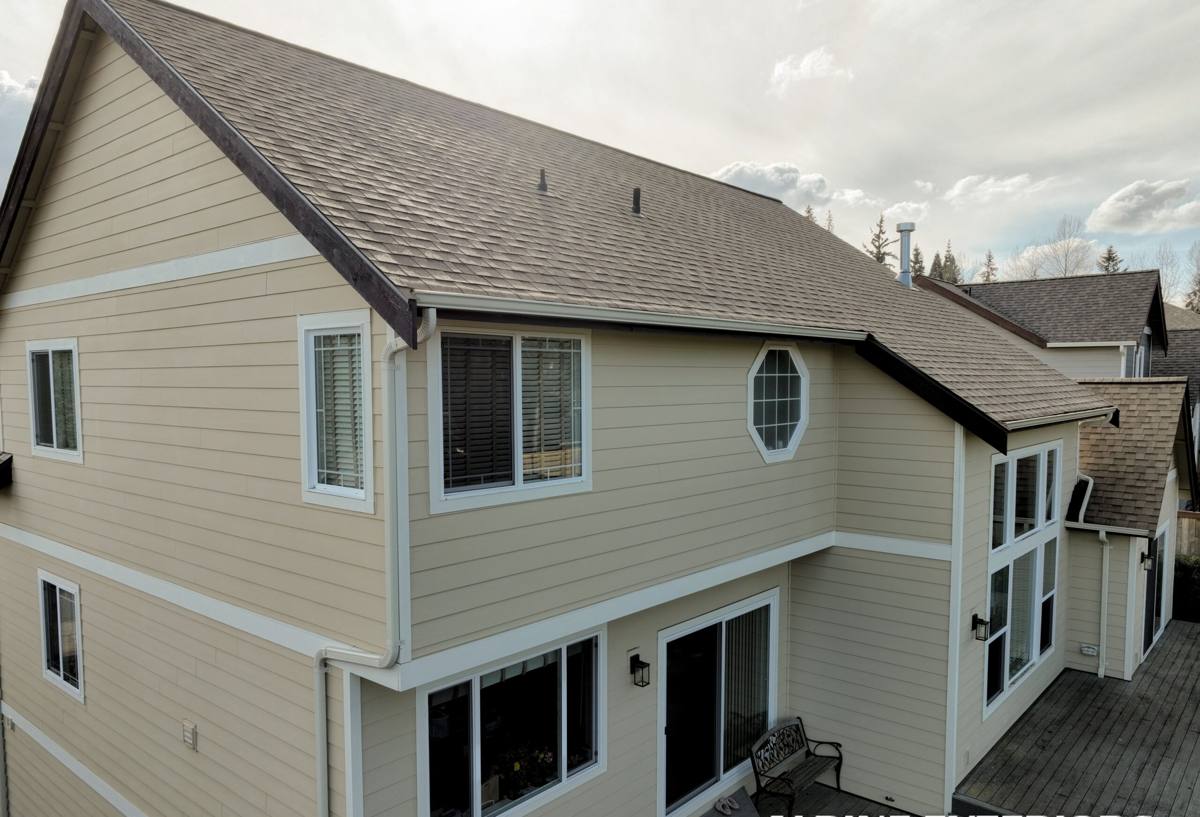
The Warning Signs You Can See From the Ground
Cracking, Warping, and Bowing
Wood-based siding products — cedar, primed spruce, and engineered wood panels alike — move with moisture. They swell when wet and shrink when they dry out, and after enough cycles that movement shows up as cracks along the grain, panels that bow away from the wall, or edges that curl. On composite and engineered products, swelling at cut edges and panel bottoms is often the first sign of trouble, especially where a panel wasn't field-sealed correctly during installation.
Peeling or Bubbling Paint
Paint failure on siding almost never means the paint itself was bad. It means moisture is trying to get out from behind the siding and taking the paint film with it. If you're repainting the same section of wall every few years while the rest of the house holds its finish fine, that's a localized moisture problem, not a paint problem.
Dark Streaking and Discoloration
Streaking below seams, nail heads, or trim joints usually traces back to water finding a path it shouldn't have. It's worth noting where the streaking starts, since that location often points straight at the failure point — a gap in caulking, a missing flashing, or a fastener that's backed out.
Trouble at the Seams, Corners, and Trim
Seams and trim are where siding installations succeed or fail. The flat field of a wall sheds water easily; it's the transitions — window and door trim, outside corners, butt joints between panels — that do the real work of keeping water out, and they're the first places to show wear.
- Caulk that's cracked, shrunk, or pulled away from the joint it was sealing
- Gaps opening up at butt joints where panels meet end to end
- Trim boards that have separated slightly from the wall or from the siding they border
- Nail heads that have backed out or left rust streaks below them
- Corner boards that feel soft when pressed, even if they look fine
Any one of these by itself might be minor. Several of them clustered around the same window or corner usually means water has been getting behind the siding at that spot for a while.
Moss, Mildew, and the Green Film Every Sudden Valley Homeowner Recognizes
On the shaded, tree-lined lots common around Lake Whatcom, a green or black film on north-facing walls is close to unavoidable — it's a function of shade, humidity, and how slowly those walls dry out between the region's frequent rain events. On its own, surface growth is mostly cosmetic and can often be cleaned. The warning sign isn't the moss itself; it's what's happening underneath it.
Moss and mildew hold moisture against the siding surface far longer than open air would, which accelerates whatever the siding material is already prone to — rot in untreated wood, delamination in some engineered panels, or coating breakdown on any painted surface. If moss keeps returning to the same spot within a season or two of cleaning, that's usually a sign the wall isn't drying out properly, often because of poor sun exposure, tight landscaping against the wall, or a gutter that's dumping water onto that section.
Soft Spots, Sagging, and What They Mean Underneath
This is the check most homeowners skip, and it's the most important one. Press firmly on siding near the bottom of walls, below windows, and around any spot where you've noticed staining or paint failure. Siding that flexes, feels spongy, or gives more than the surrounding wall is telling you the substrate behind it — the sheathing, the framing, or the siding material itself — has absorbed water and started to break down.
Sagging siding, panels that have pulled away from the wall plane, or a section that looks slightly wavy when you sight down the wall are further along the same problem. By the time siding is visibly sagging, the damage typically extends past the siding itself and into the wall assembly behind it.
Interior Clues: Signs the Damage Has Already Reached Inside
Some of the clearest warning signs don't show up outside at all. Because exterior wall problems take time to travel from the siding to the inside of the house, interior symptoms usually mean the issue has been developing for a while.
- Musty smell near exterior walls that doesn't clear with ventilation
- Discoloration or soft drywall near window and door frames
- Baseboards or trim near exterior walls that feel damp or have started to warp
- Peeling interior paint or wallpaper on an exterior wall
- Noticeably higher heating bills without another explanation, which can point to wet, compressed insulation losing its R-value
Any of these warrant pulling the siding in that specific area to look at the sheathing directly, rather than assuming it's an interior humidity issue.
How Urgent Is It? A Quick Reference
Not every warning sign needs a same-week response, but some do. This table is a general guide to how seriously to treat what you're seeing — it's not a substitute for an actual inspection, but it's a reasonable starting point for deciding whether to keep an eye on something or get someone out to look at it soon.
| What You're Seeing | Likely Cause | How Urgent |
|---|---|---|
| Surface moss or mildew film | Shade, slow-drying wall, normal Whatcom County humidity | Low — clean and monitor |
| Recurring paint failure in one area | Trapped moisture behind that section | Moderate — worth an inspection |
| Cracked or shrunken caulk at seams and trim | Normal aging of sealant, needs renewal | Moderate — reseal before wet season |
| Soft or spongy spots when pressed | Water intrusion into siding or substrate | High — schedule an inspection soon |
| Visible sagging, bowing, or panel separation | Advanced substrate damage | High — address before next storm season |
| Musty smell or damp trim inside the house | Water has reached the wall interior | Urgent — investigate immediately |
A Practical Checklist for a Homeowner Walk-Around
Twice a year — once before the wet season ramps up in fall and once in spring after it's eased off — it's worth doing a slow walk around the full perimeter of the house. Here's what to look for:
- Sight down each wall from an angle to check for waviness, bowing, or panels sitting proud of the surface
- Press on siding near grade level, below windows, and near downspouts
- Check caulk lines at every window, door, and outside corner for cracking or gaps
- Look behind shrubs and vegetation growing close to the house — these areas trap moisture and are often skipped
- Check under eaves and around any roof-to-wall transitions, where flashing does most of the work
- Note any spot where moss or mildew keeps returning shortly after cleaning
- Walk the interior perimeter checking for musty smells, soft trim, or discoloration on exterior walls
Why the Siding Material Itself Changes How Early You'll Catch Problems
Not all of these warning signs show up equally fast on every material. Untreated or primed wood siding is the most reactive to moisture — it swells, cracks, and rots on a timeline of years, not decades, especially in a climate that stays damp as long as this one does. Vinyl siding tends to hide substrate problems rather than reveal them, since it's not the panel itself that fails first — it's the wall behind it, out of sight, while the vinyl looks unchanged. Engineered wood products are sensitive to how well cut edges and seams were sealed during installation, and a missed detail there can take years to surface as a problem.
This is a large part of why our company standardized on James Hardie fiber cement for every install we do. It's non-combustible, doesn't swell and split the way wood-based products do, and its factory-applied ColorPlus finish holds up to sun and salt air without the repaint cycle that drives a lot of the paint-failure warning signs above. That doesn't mean Hardie is maintenance-free — caulking still ages, seams still need attention — but it removes several of the failure modes that show up earliest and most often on the other materials common in this area.
When to Watch and When to Call Someone
A single instance of surface moss, one cracked caulk line, or slightly faded paint doesn't mean the siding is failing — it means it's aging normally and could use routine upkeep. What changes the calculus is clustering: several warning signs in the same area, signs that keep recurring after cleaning or resealing, or anything that shows up on the interior side of a wall. At that point, a proper inspection — including pulling a section of siding if needed to look at the sheathing directly — is worth the time before the next wet season turns a contained problem into a widespread one.
If you're noticing any of the signs on this page around your home, we're happy to take a look, walk the exterior with you, and give you a straight answer about what's normal wear and what needs attention. Reach out for a free, no-pressure estimate using the form below.