 Sudden Valley Siding
 The Damage You See Is Rarely Where It Started
By the time a homeowner in Sudden Valley notices a soft spot near a window trim, a bulge along a wall seam, or paint that keeps bubbling no matter how many times it's redone, the actual problem has usually been developing for years, hidden behind the siding itself. Siding is a system, not a single layer. What you see on the outside is the last line of defense. What matters most is what's happening on the other side of it, against the sheathing, the framing, and the insulation, where water that gets past the surface has nowhere good to go.
Understanding what's really going on behind failing siding helps homeowners make better decisions, both about repairs and about what to install next. This isn't about scaring anyone into a premature replacement. It's about knowing what questions to ask and what to look for before a manageable problem turns into a structural one.
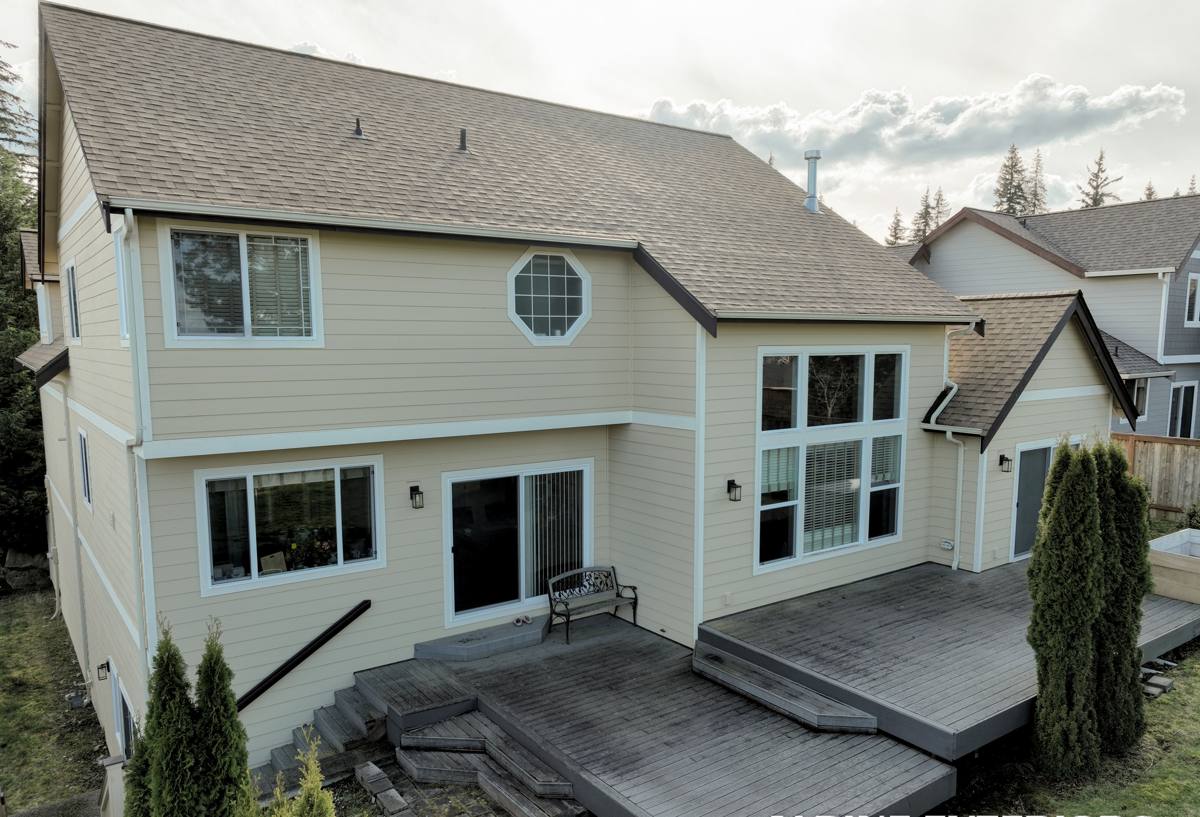
How Water Actually Gets Behind Siding
Almost no siding product is designed to be 100% waterproof on its face. Every exterior cladding system, wood, vinyl, fiber cement, or engineered wood, is built on the assumption that some moisture will get past the surface eventually, whether through a nail hole, a hairline crack, a failed caulk joint, or wind-driven rain forced sideways into a seam. What separates a wall that stays healthy for decades from one that rots out in ten years is what happens after that moisture gets in.
The Usual Entry Points
- Caulk joints around windows, doors, and trim that have shrunk, cracked, or pulled away
- Butt joints between siding boards that weren't properly flashed or gapped
- Nail and fastener penetrations that were never sealed or were over-driven, crushing the material around them
- Missing or undersized flashing above windows, doors, and horizontal trim boards
- Poor grade clearance, where soil, mulch, or hardscaping holds moisture against the bottom of the siding
- Roof-to-wall intersections and deck ledger connections where two systems meet and flashing details get skipped
None of these entry points are visible from the street. A wall can look perfectly fine while water has been finding its way behind it for years through one or more of these paths.
What Happens Once Moisture Gets Behind the Wall
Once water is behind the cladding, the outcome depends almost entirely on whether the wall assembly can dry out. A wall that can breathe and shed trapped moisture, through proper drainage planes, house wrap, and in the best systems a ventilated rainscreen gap, can tolerate incidental water intrusion without much damage. A wall that traps moisture against the sheathing cannot.
Trapped moisture against wood-based sheathing (OSB or plywood) leads to a fairly predictable sequence: the sheathing darkens and softens, fasteners start to lose their grip, mold and fungal growth take hold, and eventually the wood loses structural integrity. Wet fiberglass insulation loses most of its R-value and can hold moisture against the wall cavity even longer. Wood framing members exposed to sustained dampness are vulnerable to rot fungi, which need moisture, oxygen, and a food source (the wood itself) to spread. Once established, rot doesn't stay put. It follows the moisture path, which is often much larger than the original point of entry.
This is why a small stain or soft spot on the exterior can correspond to several feet of compromised sheathing behind it. The visible symptom is the tip of the problem, not the whole of it.
Why This Is a Bigger Issue in Whatcom County
Sudden Valley's location puts homes here under more moisture stress than a lot of the country ever deals with. Salt air off the Sound accelerates the breakdown of caulking, sealants, and unprotected fasteners, and it's harder on any exposed metal flashing. Long stretches of driving rain, especially in fall and winter, push water sideways into every seam and joint, which is a much tougher test than rain falling straight down. And the extended moss season that comes with our damp, mild climate means organic growth on siding, trim, and roof-to-wall transitions isn't just cosmetic. Moss holds moisture directly against the surface it's growing on, which keeps that section of wall wet far longer than it would otherwise be, even after the rain stops.
Put those three factors together and you get a climate that's genuinely rough on siding, regardless of the brand or material a home was built with. Homes in Whatcom County need cladding and installation practices that account for sustained, repeated wetting, not just occasional exposure.
Not All Siding Materials Handle Moisture the Same Way
Every siding material has a different relationship with water. Some absorb it and try to release it; some shed it and rely entirely on the installation to keep it out; some are essentially unaffected by it as long as the product itself stays intact. Understanding those differences matters when you're deciding what to put back on a wall.
| Material | Moisture Behavior | Main Vulnerability |
|---|---|---|
| Primed wood / spruce lap | Absorbs and releases moisture readily | Swelling, cupping, and rot if paint film fails or joints open up |
| Engineered wood (LP-type products) | Wood-based core with a resin/wax treatment | Edge and cut-end swelling if factory seal is compromised or cuts aren't field-treated |
| Vinyl | Doesn't absorb water, but isn't a true water barrier by itself | Panels can trap moisture behind them; relies heavily on the underlying weather barrier |
| Fiber cement (cement board generally) | Dimensionally stable, doesn't rot, but raw cut edges and poor sealing can still allow water uptake | Performance depends heavily on correct fastening, sealing, and finish quality |
| James Hardie fiber cement, factory ColorPlus finish | Engineered for the Pacific Northwest's wet climate (HZ5 product line), factory-sealed finish reduces field vulnerability | Still requires correct installation, gapping, and flashing to perform as designed |
The takeaway isn't that any one material is immune to moisture problems. It's that the material's tolerance for real-world moisture exposure, and how forgiving it is when installation details aren't perfect, varies a lot. That's a meaningful difference in a climate like ours.
Warning Signs Worth Checking Around Your Own Home
Most siding failures give some warning before they become expensive. The signs are often subtle enough that homeowners walk past them for a season or two before connecting the dots. It's worth doing a walk-around a couple of times a year, especially after the wet season, and checking for the following:
- Soft or spongy spots when you press on siding near the bottom of walls, under windows, or near deck and porch attachments
- Paint that blisters, peels, or bubbles repeatedly in the same spot, even after repainting
- Visible gaps, cracks, or missing caulk around trim, windows, and doors
- Dark staining, streaking, or a musty smell near an exterior wall on the interior side
- Moss or persistent green growth sitting directly on siding or trim rather than just on the roof
- Warping, buckling, or boards that no longer sit flat against the wall
- Insects (carpenter ants, in particular) showing up near exterior walls, which often signal softened wood
Any one of these on its own might be minor. Two or three together, especially in the same area, are worth having looked at before the next wet season.
What Correct Installation Actually Prevents
A huge share of the siding failures we get called out to inspect trace back not to the material itself but to how it was installed years earlier. Installation details that seem minor at the time make an outsized difference over a 15 to 30 year service life.
The details that matter most
Proper flashing above every window, door, and horizontal trim transition directs water outward instead of letting it collect. A drainage plane or rainscreen gap behind the siding gives incidental moisture a path to escape rather than sit against the sheathing. Correct fastener placement, and pattern, keeps the material from cracking or losing its grip over time. Field-cut ends need to be sealed, not left raw, especially on any wood-based product. And keeping the bottom edge of siding clear of soil, mulch, and hardscaping (generally 6 inches minimum) keeps splashback and ground moisture away from the most vulnerable part of the wall.
None of this is exotic. It's standard trade practice. But it's also the first thing that gets skipped when a job is priced and scheduled to move fast, and it's invisible once the siding goes up, which is exactly why so many failures don't show up until years later.
Why We Only Install James Hardie
We made the decision to install exclusively James Hardie fiber cement siding, and not LP SmartSide, vinyl, Cemplank, Allura, primed spruce, or cedar, because of how it performs specifically in this climate over the long run. Hardie's HZ5 product line is engineered for regions with sustained damp weather like ours. It's non-combustible, dimensionally stable so it doesn't swell or cup the way wood-based products can, and it comes with a factory-applied ColorPlus finish that holds up to salt air and repeated wetting far better than field-applied paint on raw material. It also carries a strong transferable warranty, which matters to a lot of homeowners planning to sell down the road.
That said, Hardie siding installed poorly will still fail in the ways described above. The material doesn't replace correct flashing, gapping, sealing, and fastening; it just gives those details more room for error, and it doesn't come with the added vulnerability of an absorptive wood-based core. We treat installation quality as inseparable from the product choice, because in this climate, one without the other doesn't hold up.
When to Bring in a Professional
Not every siding concern needs a full inspection, but a few situations warrant one sooner rather than later: any soft spot you can press your thumb into, staining on interior walls near an exterior corner, siding that's more than 20 years old and showing multiple warning signs at once, or any area where you can see daylight or feel airflow through a gap. A professional assessment at that stage usually means a repair. Waiting until boards are visibly falling off usually means a much larger scope of replacement, because the damage has had time to spread through the sheathing and framing behind it.
If you're seeing any of the signs described here, or you'd just like an honest look at how your current siding and its installation are holding up, we're happy to come take a look. We offer free, no-pressure estimates and will tell you plainly what we find, whether that's a small repair, a bigger issue worth addressing, or nothing to worry about yet.