 Sudden Valley Siding
 Roof Repair Built for Happy Valley's Weather, Not a Generic Climate
Happy Valley sits inside the same wet, mossy, wind-driven weather pattern that defines roofing work across Sudden Valley and the rest of Whatcom County. A roof repair that works fine in a dry climate can fail here in a season or two if it isn't detailed for what this area actually throws at a house: long stretches of driving rain, salt-laden air moving in off the water, and a moss season that runs longer than most homeowners realize. We repair roofs in this specific area often enough to know which failure points show up again and again, and we build every repair to hold against the next wet season, not just to look fixed on the day we leave.
This page covers roof repair specifically — not full replacement, not siding, not gutters as a standalone job. If your roof has isolated damage, active leaks, or wear that hasn't yet compromised the whole system, repair is usually the right call, and doing it correctly matters more here than in drier parts of the state.
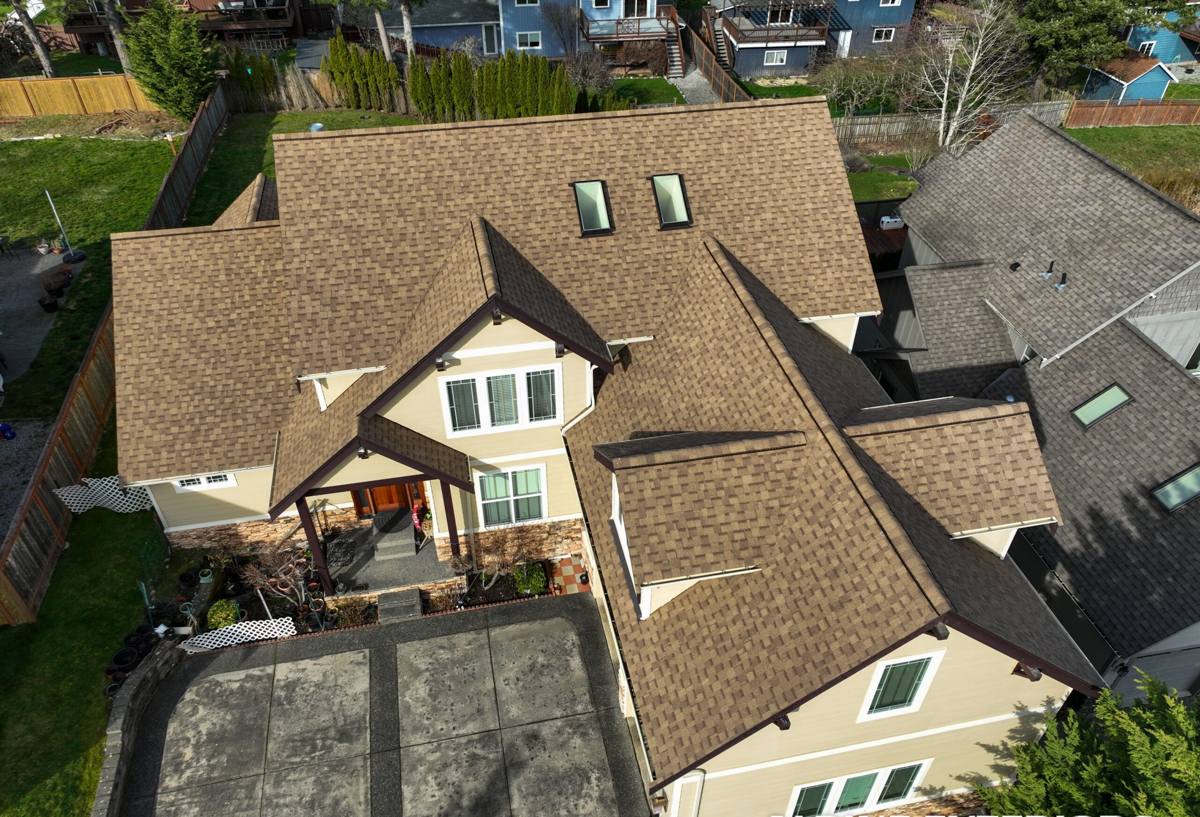
Why Local Climate Drives How a Repair Should Be Done
Driving Rain and Wind-Driven Water
Rain in this part of Washington rarely falls straight down. Wind pushes it sideways and up under laps, flashing edges, and fastener lines that would stay dry in calmer conditions. A repair that only addresses the visible hole or missing shingle, without checking the underlayment and flashing detail around it, often leaks again the next time wind and rain line up together. Correct repair work here means checking water's actual path, not just patching where it surfaced inside the house.
Salt Air and Metal Fatigue
Homes in this area take on salt-carrying air more than most homeowners expect from an inland-feeling neighborhood. Salt air accelerates corrosion on exposed fasteners, flashing, and any unpainted or thin-gauge metal. A repair that reuses corroded flashing or drives new fasteners into already-weakened metal is a repair that fails early. We replace compromised metal rather than work around it.
A Moss Season That Runs Longer Than People Think
Shade, moisture, and mild temperatures give moss a long window to establish itself on north-facing slopes and anywhere debris collects. Moss doesn't just sit on the surface — its root structure lifts shingle edges and holds moisture against the roof deck, which is how a "just cosmetic" moss patch turns into a leak. Any real repair in this area has to include moss and debris removal as part of the job, not as an optional add-on.
What a Correct Roof Repair Actually Involves
A roof repair is more than swapping a shingle or smearing sealant over a stain. Done right, it follows a diagnostic order:
- Identify the true entry point of water, which is often several feet from where the stain or drip shows up inside
- Inspect flashing at every penetration nearby — chimneys, vents, skylights, valleys — since a single repair rarely happens in isolation from surrounding flashing condition
- Check underlayment and decking condition where the covering was removed; soft or delaminated decking has to be addressed, not covered over
- Replace damaged materials with matching or compatible product, properly lapped and fastened for wind-driven rain
- Clear moss, moss stains, and debris from the repair area and the drainage path leading away from it
Skipping any of these steps is how a homeowner ends up paying for the same repair twice.
Common Repair Situations We See in This Area
| Symptom | Likely Cause Locally | What the Repair Requires |
|---|---|---|
| Ceiling stain near an exterior wall | Wind-driven rain forced under a lap or flashing edge | Trace water path, replace flashing detail, not just the stain area |
| Dark streaking or thick moss patches | Long moss season on shaded, north-facing slopes | Manual removal, treatment, and inspection for lifted shingle edges underneath |
| Granule loss / bald patches on shingles | Age combined with sustained wind and rain exposure | Localized shingle replacement matched as closely as possible to existing material |
| Rusted or lifting flashing | Salt-air corrosion on fasteners and thin metal | Full flashing replacement at that penetration, not a sealant patch |
| Leak around a vent or skylight | Failed sealant or corroded boot after years of wet cycles | New boot/flashing kit properly integrated with surrounding shingles |
Repair or Replace: How We Help You Decide
Not every damaged roof needs full replacement, and we don't push that direction just because it's a bigger job. The honest factors that actually decide it:
| Factor | Leans Toward Repair | Leans Toward Replacement |
|---|---|---|
| Age of roof covering | Under roughly 12-15 years, isolated wear | Near or past manufacturer's expected service life |
| Extent of damage | Localized to one section, slope, or penetration | Multiple areas failing independently across the roof |
| Decking condition | Solid decking found once covering is pulled back | Soft, delaminated, or repeatedly wet decking |
| Moss and moisture history | First real moss problem, caught early | Chronic moss return despite repeated treatment |
| Material availability | Close match to existing shingle still obtainable | Discontinued product with no reasonable match |
When a roof is borderline, we'll say so plainly and explain the trade-offs rather than defaulting to the more expensive option.
Our Process for Happy Valley Repair Calls
Inspection First
We start on the roof and in the attic, not just at the stain on the ceiling. Attic-side inspection catches moisture trails that haven't shown up as visible damage yet, which matters in a climate where slow leaks can run for a full wet season before they're noticed indoors.
A Written Scope Before Any Work Starts
You get a clear explanation of what's actually wrong, what the repair covers, and a straightforward cost range before anything is opened up. No surprise add-ons discovered mid-job without a conversation first.
Repair Timed Around Weather Windows
Roof repair in this region has to work around rain, not against it. We schedule repairs for dry windows when possible and use proper temporary protection if weather moves in mid-job, so an open roof section is never left exposed overnight.
Cleanup That Includes the Drainage Path
Removed moss, granules, and old material get cleared from gutters and downspouts near the repair, not just off the roof slope. A repair that leaves debris clogging drainage right next to it sets up the next problem.
Why a Crew Already Working This Area Is Worth Choosing
Roofing crews that only pass through occasionally don't carry the pattern recognition that comes from repeated repair calls in the same neighborhoods. A crew that already works Sudden Valley and the surrounding Whatcom County area knows which roof orientations hold moss longest, which flashing details tend to fail first under local wind-driven rain, and what a normal versus abnormal amount of salt-air corrosion looks like on metal of a given age. That local pattern knowledge shortens diagnosis time and reduces the chance of a repair that misses a related problem sitting just out of view.
It also means straightforward accountability. A local crew has a reputation in the immediate area to stand behind, and a callback for a repair that didn't hold isn't a cross-region trip — it's a normal part of doing business where we actually live and work.
Homeowner Checklist: Signs a Roof Repair Shouldn't Wait
- Ceiling or wall stains that appear or darken during heavy rain, even if they dry out between storms
- Visible moss buildup thicker than a light green film, especially on shaded or north-facing slopes
- Shingle edges that look lifted, curled, or granule-bare in patches
- Rust streaks running down from flashing, vents, or a chimney
- Daylight visible through the roof deck from inside the attic
- Sagging or soft spots felt underfoot near a valley or penetration
- Debris or moss consistently backing up in gutters directly below a roof section
Any one of these is worth a look before the next storm cycle, not after.
Materials and Workmanship Standards We Hold To
For repair work, matching existing material as closely as possible matters for both appearance and performance — mismatched shingle profiles can create their own water-shedding problems at the seam. Where an exact match isn't available due to a discontinued product line, we'll explain the closest reasonable option and how it integrates, rather than forcing a mismatch and hoping it blends in. Flashing and fasteners are never simply reused if they show corrosion consistent with salt-air exposure; replacing them at the time of repair costs less than a callback once they fail on their own.
If you're seeing signs of trouble on a roof in the Happy Valley area, we're happy to take a look and give you a straight answer — repair, monitor, or replace — with no pressure either way. Reach out through the form below for a free estimate.