 Sudden Valley Siding
 Exterior Homes Take a Beating in Edgemoor and Sudden Valley
Homes around Edgemoor and Sudden Valley sit in one of the more demanding exterior environments in Whatcom County. Between proximity to open water, the long wet season that defines Western Washington, and the shade cover that comes with mature evergreen trees, siding, trim, roofing, and decking here work harder than they do almost anywhere else in the state. If you've owned a home in this area for more than a few years, you've probably already noticed it: paint that fails early, trim that softens at the corners, or a green-black film that creeps across north-facing walls no matter how often you scrub it off.
None of that is bad luck. It's the predictable result of salt-influenced air, driving rain that gets pushed sideways by wind off the water, and a moss season that can run eight months or longer in shaded, low-airflow spots. Exterior materials that perform fine in drier parts of the state often fall short here. That's the reason we've built our business around products and installation practices that are actually suited to this climate, not just marketed as "weather resistant" on a spec sheet.
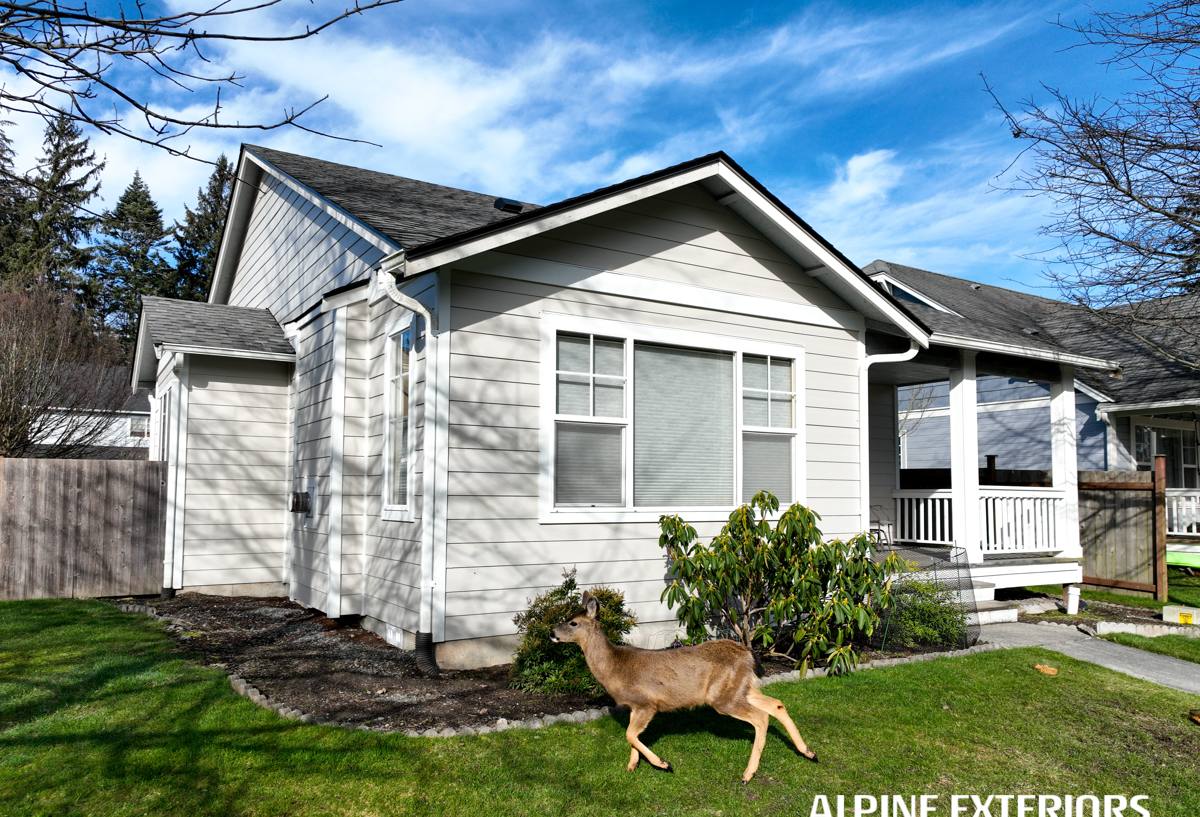
What This Climate Actually Does to Siding
Salt-Influenced Air
Homes closer to the water deal with airborne salt and moisture that settles on exterior surfaces even on dry days. Over time, this accelerates corrosion of exposed fasteners, breaks down lower-grade paint films faster than manufacturers' timelines suggest, and can quietly work into seams and end-cuts on materials that aren't dense or well-sealed.
Driving, Wind-Blown Rain
Whatcom County doesn't just get a lot of rain — it gets rain pushed horizontally by wind coming off the water, which finds its way into laps, joints, and fastener penetrations that would stay dry in a calmer climate. Siding that relies on face-nailing, loose lap tolerances, or absorbent substrates is far more likely to take on moisture over years of this kind of exposure.
Moss, Algae, and Shade
Tree cover is part of what makes this area beautiful, and it's also what keeps north- and east-facing walls damp and shaded for long stretches of the year. That combination is exactly what moss and algae need to take hold. Wood-based and wood-adjacent products are especially vulnerable, since organic growth can work into the surface itself, not just sit on top of it.
Why We Install Only James Hardie Fiber Cement
We made a deliberate decision as a company to install James Hardie siding exclusively — not vinyl, not LP SmartSide, not Cemplank or Allura, not primed spruce or cedar. That's not a marketing gimmick. It's a standard we hold because of what we've seen play out on homes in exactly this kind of climate.
James Hardie fiber cement is non-combustible, dimensionally stable, and formulated with cellulose fiber, sand, and cement rather than wood fiber or wood veneer — which means there's no organic wood substrate for moisture and moss to break down over time the way there is with wood-based siding products. Hardie's HZ5 product line is specifically engineered for the kind of cold, wet, high-moisture climate that defines the Pacific Northwest, with formulation adjustments aimed at freeze-thaw cycling and sustained moisture exposure. The factory-applied ColorPlus finish is baked on under controlled conditions, which gives it more consistent adhesion and UV resistance than field-applied paint — a real advantage in an area where a poor paint job shows its age within a few seasons, not a decade.
We're not going to tell you every other siding product is worthless — that wouldn't be honest, and it isn't our call to make about someone else's material. Vinyl is inexpensive and low-maintenance in mild climates, but it can warp under heat and doesn't hold paint if you ever want to change color. LP SmartSide and other engineered wood products have improved a lot over the years, but they're still wood-based, which means end-cuts, seams, and long-term moisture exposure are permanent points of vulnerability in a climate that rarely lets a wall fully dry out. Cedar is genuinely beautiful and has real fans, but it demands a maintenance schedule most homeowners underestimate — refinishing, caulking, and moisture monitoring on a recurring basis. Given what this specific climate does to exteriors, we decided fiber cement with a factory finish was the standard we're willing to put our name behind, and Hardie is the manufacturer we trust to deliver it.
More Than Siding: A Full Exterior Approach
Siding doesn't work in isolation. Roofing, windows, decks, and siding all interact at flashing points, transitions, and penetrations, and a weakness in one system tends to show up as damage in another. We handle all four because it lets us think about your home's exterior as one connected system rather than a patchwork of separate contractors who never talk to each other.
- Siding: James Hardie lap, shingle, and panel systems, installed to manufacturer spec with correct flashing and clearances
- Roofing: Roof systems that shed the heavy, sustained rain typical of this area and tie in cleanly with siding and trim
- Windows: Window replacement with attention to flashing and weatherproofing at the rough opening, not just the unit itself
- Decks: Deck materials and fastening chosen for constant moisture exposure and shaded, slow-drying conditions
Why Correct Installation Matters More Here Than Elsewhere
Fiber cement siding is only as good as its installation. Even the right product, installed with the wrong details, will fail early in a climate like this one. The things that matter most in Edgemoor and Sudden Valley specifically:
Flashing and Water Management
Every window, door, deck ledger, and roof-to-wall transition needs flashing detailed to shed water outward, not just caulked and hoped for. Caulk is a backup, not a primary water barrier — it degrades faster than the siding around it, especially with the UV and moisture cycling common here.
Clearances and Gaps
Hardie siding needs proper clearance from grade, roofing, decks, and other siding terminations. Skipping these clearances is one of the most common installation shortcuts we see on homes that develop moisture problems years down the road — it's invisible until it isn't.
Fastener Choice
Corrosion-resistant fasteners matter everywhere, but they matter more within reach of salt-influenced air. We use fasteners rated for the exposure level of the specific home, not a one-size-fits-all approach.
What It Costs: Factors That Actually Move the Number
Every home is different, and we won't quote a number without seeing your house, but these are the factors that most affect the cost of an exterior project in this area:
| Factor | Why It Matters |
|---|---|
| Home size and wall complexity | More corners, gables, and transitions mean more cutting, flashing, and labor time |
| Current siding removal | Tear-off and disposal of old wood or vinyl siding adds cost versus a bare or already-stripped wall |
| Substrate condition | Rot or water damage found underneath existing siding needs repair before new siding goes on |
| Product line and profile | Hardie's lap, shingle, and panel lines, plus trim and accent choices, vary in material cost |
| Site access | Steep lots, limited driveway access, or waterfront setbacks common in this area can affect staging and labor |
| Scope beyond siding | Bundling roofing, windows, or deck work with siding can improve overall efficiency versus separate projects |
Why a Local Crew Matters Here
A contractor who mainly works in drier or more sheltered parts of Washington won't have the same instinct for how this climate behaves. Knowing which walls in this area take the worst of the wind-driven rain, which orientations need extra attention to moss and algae, and how salt-influenced air affects fastener and finish choices over the long term isn't something you can pick up from a spec sheet. It comes from working on homes in this specific environment, season after season, and seeing what holds up and what doesn't.
A local crew is also easier to hold accountable. If a warranty question comes up five or ten years from now, you want a company that's still local, still reachable, and still standing behind the same installation standards it used the day your project was finished.
Maintenance: What to Actually Watch For
Even the right siding benefits from a little homeowner attention. In this climate, we recommend keeping an eye on:
- Moss or algae buildup on shaded, north-facing walls — address it before it spreads, using gentle methods that won't damage the finish
- Caulking at trim joints, window edges, and penetrations — inspect annually, since UV and moisture cycling degrade sealant faster here than in drier climates
- Gutter and downspout function — clogged gutters during heavy rain events push water directly onto siding and trim
- Grade and landscaping near the foundation — soil, mulch, or plantings piled against siding trap moisture against the bottom courses
- Deck ledger and flashing connections — a common point where water intrusion starts and often goes unnoticed until it reaches the siding
Let's Take a Look at Your Home
Every property around Edgemoor and Sudden Valley faces this climate a little differently depending on tree cover, sun exposure, and proximity to the water. We're happy to come take a look at your home, walk you through what we're seeing, and put together a straightforward, no-pressure estimate — no invented urgency, just an honest read on where your exterior stands and what it would take to get it right. Fill out the form below to get started.