 Sudden Valley Siding
 Exterior Work in Sunnyland: What the Climate Actually Does to a House
Sunnyland sits in the part of Whatcom County where marine air off the Salish Sea meets the wetter, greener interior around Lake Whatcom and Sudden Valley. That mix is part of what makes the neighborhood pleasant to live in, and it's also exactly what wears down the outside of a house. Homes here deal with three things at once, year after year: salt-laden air that corrodes metal and degrades some coatings faster than inland areas, long stretches of driving rain that finds every gap in flashing and trim, and a moss season that can run eight or nine months out of the year on north-facing walls and anything shaded by fir and cedar trees.
None of that is unusual for western Washington. What matters is how a house is built and maintained to handle it. We've worked on homes across Whatcom County long enough to see which materials and installation habits hold up under these specific conditions, and which ones quietly fail behind a coat of fresh paint.
Why Siding Choice Matters More Here Than in Drier Climates
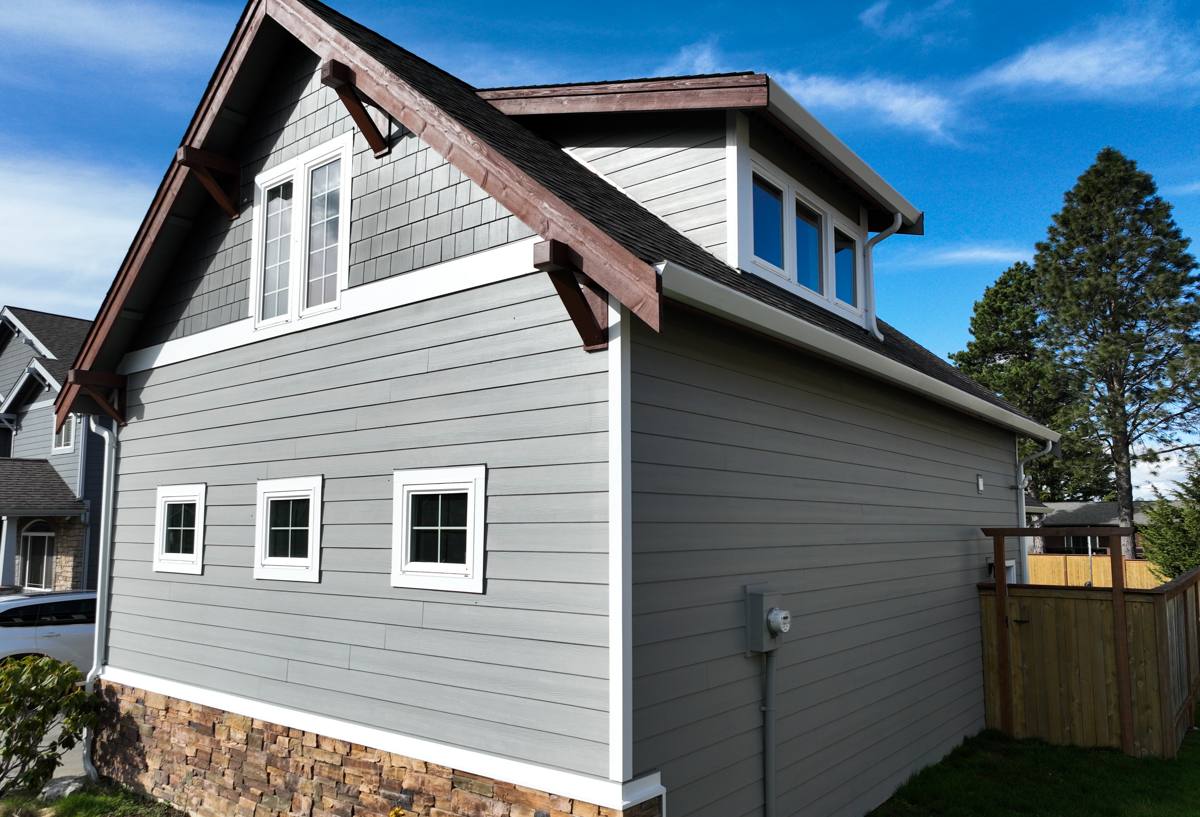
In a dry climate, siding material choice is mostly about looks and budget. In Sunnyland, it's a durability question first. Constant moisture exposure, freeze-thaw cycling in winter, and salt-air corrosion all accelerate whatever weaknesses a siding product already has. That's why we standardized on James Hardie fiber cement siding and no longer install vinyl, LP SmartSide, Cemplank, Allura, or bare wood siding like primed spruce or cedar.
What We Stopped Installing, and Why
- Vinyl siding: It sheds water fine on the surface, but it flexes, gaps, and can warp or crack in cold snaps. Seams and J-channels give driving rain a path behind the panel, and once moisture gets behind vinyl it has nowhere good to go.
- LP SmartSide and other wood-strand products: These are engineered wood, which means they're still wood at the core. Edge swelling at cut ends and butt joints is a known failure point if caulking and paint maintenance ever slip, and in a climate this wet, that maintenance window is unforgiving.
- Cemplank and Allura (other fiber cements): These are reasonable products in general, but we've standardized on one manufacturer's system so our crews install one product to one spec, with one warranty structure, rather than mixing lines with different install requirements.
- Primed spruce and raw cedar: Beautiful when new, but they demand a repainting and caulking schedule that most homeowners can't keep up with, especially on a home shaded by evergreens where moss and mildew get a head start every year.
We're not saying every home with these products is failing. We're saying that after years of repair calls and tear-offs, we decided our crews would install one system we trust to perform in this specific climate, and stand behind it without hedging.
James Hardie Fiber Cement: The System We Install
James Hardie siding is fiber cement: sand, cement, and cellulose fiber, cured into boards that don't feed mold, don't rot, and won't ignite. That non-combustible quality matters in Washington's wildfire-exposed summers, but for Sunnyland the bigger day-to-day advantage is moisture behavior. Fiber cement doesn't swell, delaminate, or warp the way wood-based products can when it takes on repeated wetting from driving rain.
HZ5 Climate Engineering
Hardie engineers its boards in different formulations for different climate zones. Western Washington falls into the HZ5 zone, engineered for moisture-heavy, moderate-freeze climates rather than the hot, dry HZ10 formulation used in the Southwest. That distinction isn't marketing; it affects how the board is formulated to handle sustained damp exposure, which is the exact condition a Sunnyland exterior lives in for much of the year.
ColorPlus Factory Finish
Most of the siding we install uses Hardie's ColorPlus finish, which is baked on at the factory under controlled conditions rather than field-applied paint. It resists fading and holds up to UV and moisture exposure longer than a job-site paint job, and it comes with its own finish warranty separate from the product warranty. For a homeowner, that means fewer repaint cycles over the life of the siding, which matters when the local weather doesn't give paint much of a break to cure and dry between rain events.
Moss, Shade, and North-Facing Walls
Sunnyland's tree cover is part of its character, but shaded, damp walls are where we see the most siding and trim damage. Moss holds moisture against a surface far longer than open air would, and on wood-based siding that sustained dampness is what starts rot at seams and fastener points. Fiber cement doesn't feed moss growth the way wood does, and it doesn't break down from the moisture moss traps against it. That doesn't mean moss won't grow on the surface at all, it means the surface underneath isn't degrading because of it.
Practical Steps We Recommend Regardless of Siding Material
- Keep tree branches and shrubs trimmed back from exterior walls to let surfaces dry between rain events.
- Clean gutters at least twice a year; overflow during heavy rain is one of the most common causes of hidden water damage behind siding and trim.
- Have caulking and flashing at windows, doors, and trim boards inspected every few years, since failure points there cause more damage than the field of the siding itself.
- Address any soft or discolored siding early. On wood-based products, small soft spots often mean rot has already started underneath.
Roofing, Windows, and Decks: The Rest of the Envelope
Siding doesn't work in isolation. We handle roofing, windows, and decks because a house's exterior only performs as well as its weakest connection point. A roof with degraded flashing sends water down behind siding it never should have reached. Aging windows leak air and moisture at the frame, which shows up later as staining or rot on the siding around them. Decks exposed to the same driving rain and moss conditions need the same kind of climate-appropriate material decisions siding does.
How the Trades Connect
| Exterior Component | Common Sunnyland-Area Issue | How It's Addressed |
|---|---|---|
| Roofing | Moss buildup and flashing wear from constant moisture | Proper flashing details and moss-resistant roofing choices at install |
| Windows | Frame seals failing under sustained rain exposure | Correctly flashed window replacement tied into the siding plane |
| Siding | Wood-based products absorbing moisture at seams | James Hardie fiber cement with factory-finished ColorPlus |
| Decks | Moss and slip risk, fastener corrosion from salt air | Corrosion-resistant fasteners and materials suited to sustained dampness |
What a Siding Project Actually Involves
A full siding replacement isn't just swapping old panels for new ones. On most homes in this area, it includes checking the house wrap and water-resistive barrier underneath, correcting flashing at windows, doors, and rooflines, and replacing any sheathing that's already taken on rot from prior moisture intrusion. Skipping that step and just re-siding over existing problems is how a home ends up with the same failure a few years later, regardless of how good the new siding material is.
General Cost Factors
Every home is different, but the main variables that drive cost on a Sunnyland-area project are typically:
- Square footage and the complexity of the home's shape (gables, dormers, multiple stories)
- Condition of the sheathing and framing underneath the existing siding
- Amount of trim, fascia, and detail work involved
- Whether windows or roofing are being addressed at the same time, which can improve efficiency and reduce total disruption
We give straightforward, written estimates rather than vague ranges, because a homeowner planning a project deserves to know what they're actually paying for.
Why a Local Crew Matters
Whatcom County's exterior work isn't the same as work in Spokane or Eastern Washington, and it isn't quite the same as coastal Puget Sound either. A crew that works this specific stretch of climate regularly knows how much rain exposure a wall actually sees before the next dry spell, how aggressive moss growth gets under the tree cover common around Lake Whatcom and Sudden Valley, and how salt air factors into fastener and flashing choices. That local pattern recognition is what keeps a project from being generic siding work dropped onto a house that needs something more specific.
Our Approach on Sunnyland Projects
When we look at a home in this area, we're checking the same things every time: how much moisture exposure the walls actually get based on tree cover and orientation, whether existing trim and flashing are doing their job, and what condition the sheathing is in underneath the current siding. From there we recommend what the house actually needs, not a one-size-fits-all package. That might mean full siding replacement, it might mean targeted roofing and trim repair paired with new windows, or it might mean a smaller scope than a homeowner expected.
If you're weighing a siding, roofing, window, or deck project for a home in Sunnyland, we're happy to take a look and walk you through what we see, honestly. Reach out for a free, no-pressure estimate using the form below.