 Sudden Valley Siding
 Why Bellingham-Area Siding Wears Out Faster Than the Manufacturer's Warranty Suggests
Homes around Bellingham and the Sudden Valley area sit in one of the more demanding exterior environments in Western Washington. You've got proximity to salt air moving in off the Sound, long stretches of driving rain that hit siding sideways rather than straight down, and a moss and algae season that can run eight or nine months out of the year in the shaded, north-facing spots common on lots backed up against timber. None of that is unusual for Whatcom County. But it does mean siding here ages differently than it would in a drier inland climate, and a lot of the siding failures we get called out to inspect are less about the product being bad and more about the product being wrong for this specific combination of moisture, salt, and shade.
Wood-based products swell and check where rain drives into seams. Vinyl can warp or fade faster under repeated wet-dry cycling and coastal humidity. Anything with a field-applied paint finish needs recoating on a schedule most homeowners don't stick to, and once that finish starts failing, moisture gets behind the cladding and the clock starts on rot, whether or not it's visible from the ground.
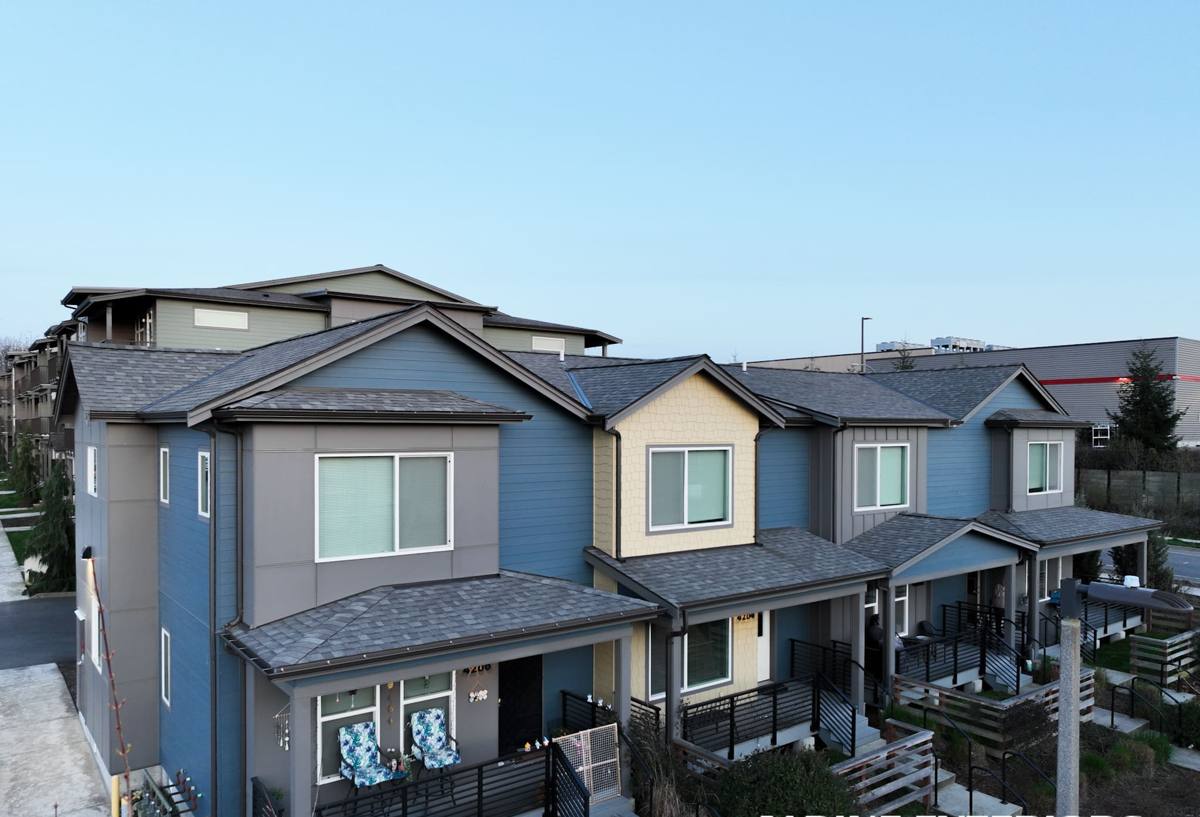
Signs a Bellingham Home Actually Needs Siding Replacement (Not Just a Patch)
Not every siding problem means a full tear-off. But there's a point where patching stops being cost-effective and starts being a way to spend money without fixing anything. Here's what tells us a home needs full replacement rather than repair:
- Soft or spongy spots when you press on the siding, especially near the bottom courses and around window trim
- Persistent moss or dark streaking that comes back within weeks of cleaning, which usually means the surface is staying damp longer than it should
- Visible gaps, cupping, or delamination at panel seams and butt joints
- Paint or finish that's failing across large sections rather than one or two boards
- Bubbling, staining, or a musty smell on interior walls that back up to exterior siding
- Siding installed more than 20-25 years ago with no documented history of proper flashing or moisture barrier work
If you're only seeing one or two of these in isolated spots, targeted repair may still make sense. Once several of these show up together, the underlying wall assembly is usually compromised enough that replacement is the honest recommendation, not the upsell.
What a Correct Siding Replacement Actually Involves
The visible siding is the last thing installed, not the first thing that matters. A replacement that's going to hold up to Bellingham's rain and salt exposure has to get the layers underneath right, or the new siding will fail on the same timeline as the old siding did.
Tear-Off and Sheathing Inspection
Full removal of the old cladding lets us actually see the sheathing underneath instead of guessing. This is where hidden rot, soft OSB, or failed old flashing gets found and fixed before anything new goes on. Skipping this step and re-siding over a compromised wall is one of the most common corner-cuts in this trade.
Water-Resistive Barrier and Flashing
In a climate with sustained driving rain, the weather-resistive barrier and the flashing details around windows, doors, and penetrations matter more than the siding material itself. Properly lapped house wrap, correctly integrated window and door flashing, and kick-out flashing at roof-to-wall intersections are what actually keep bulk water out of the wall assembly. The siding is the second line of defense, not the first.
Fastening and Clearances
Fiber cement in particular needs to be fastened to the manufacturer's engineering spec — correct nail type, spacing, and penetration into framing — and held with proper clearance off decks, roofs, and grade so water can drain and the material can dry. Getting this wrong doesn't usually show up for a few years, which is exactly why it gets skipped by crews trying to move fast.
Trim, Caulking, and Finish Work
The last step is where a job either looks finished or looks like a patch job — tight trim reveals, correctly caulked joints (only where the manufacturer calls for caulk, not everywhere), and touch-up of any factory finish that got scuffed during install.
Why We Install Only James Hardie Fiber Cement
We made a decision to standardize on James Hardie fiber cement siding and not install vinyl, LP SmartSide, or primed wood products, and it's worth explaining why rather than just stating it. Fiber cement is non-combustible, which matters in a region where wildfire smoke seasons have gotten longer even if direct fire risk is lower here than east of the Cascades. It doesn't swell, rot, or attract the wood-boring insects that wood-based and engineered-wood products can be vulnerable to. And Hardie's ColorPlus factory finish is baked on under controlled conditions rather than applied on-site or left to a homeowner's repainting schedule, which is a real advantage in a climate where moss, algae, and constant moisture cycling are hard on field-applied paint.
Hardie also engineers specific product lines (their HZ5 formulation, for example) for regions with more moisture exposure, which lines up with what Whatcom County homes actually deal with. That's not marketing — it's a material science difference in how the board is formulated to handle freeze-thaw and moisture cycling. Combined with a strong transferable warranty, it's the product we're comfortable standing behind after installation, which is why it's the only siding system we put on homes.
Our Process From Estimate to Cleanup
- On-site assessment — we look at the current siding, sheathing condition where accessible, and trouble spots like north-facing walls and roof-to-wall transitions
- Written estimate — a clear scope covering tear-off, sheathing repair allowances, flashing details, and the Hardie product and color you've chosen
- Tear-off and inspection — old siding removed, sheathing checked and repaired as needed before anything new goes up
- Weather barrier and flashing installation — the moisture-management layer that actually protects the wall long-term
- Hardie siding installation — installed to manufacturer fastening and clearance specifications
- Trim, caulking, and final finish — detail work that determines how the job looks and performs at seams and penetrations
- Walkthrough and cleanup — site cleared of debris and nails, final walkthrough before we consider the job done
Cost Factors for Siding Replacement in Bellingham
Every home is different, but the variables that move the price on a Bellingham siding replacement tend to be the same handful of factors:
| Factor | How It Affects Cost |
|---|---|
| Sheathing condition | Hidden rot found during tear-off adds repair scope you can't fully price until walls are opened |
| Home height and access | Multi-story walls, steep grades, or limited equipment access increase labor time |
| Trim complexity | Homes with lots of dormers, gables, and window trim take more detail labor than simple rectangular walls |
| Product profile and color | Hardie offers multiple plank widths, textures, and ColorPlus colors; some are priced differently than others |
| Existing moisture damage | Homes showing rot or long-term water intrusion need more sheathing and framing repair before siding goes on |
We won't quote a firm number without seeing the home, and we're upfront when a low estimate from somewhere else likely means skipped tear-off, skipped flashing work, or a cheaper substrate than what's being advertised.
Why Hiring a Crew That Already Works in Bellingham Matters
Siding installation isn't a one-size-fits-all trade. A crew that mostly works drier inland climates can install technically correct siding that still underperforms here, because they're not used to detailing flashing for sustained driving rain or accounting for how much moss and shade exposure a north wall in this area gets. Local experience means we've already seen which wall orientations fail first, which flashing details actually hold up to Whatcom County weather over a full winter, and which shortcuts show up as callbacks two or three years later. That's not something you can fully substitute with a manufacturer's install manual alone — it's pattern recognition built from working this specific climate.
Maintaining Your New Siding After Installation
Hardie fiber cement is low-maintenance compared to wood or vinyl, but "low-maintenance" doesn't mean "no maintenance," especially with the moss and algae pressure common around Sudden Valley and Bellingham. A simple annual routine keeps it performing the way it's designed to:
- Rinse siding gently once or twice a year, focusing on shaded, north-facing walls where moss builds up fastest
- Avoid high-pressure washing directly at seams and joints, which can force water behind the boards
- Keep gutters clear so overflow doesn't run down and pool against siding at roof lines
- Trim back vegetation and tree cover that keeps walls damp and shaded longer than necessary
- Inspect caulked joints every year or two and have any cracked or failed caulk redone promptly
If you're seeing early signs of trouble on your current siding, or you're ready to plan a replacement before a small problem becomes a structural one, we're happy to come take a look. There's no cost and no pressure to a walkthrough and estimate — just a straight answer about what your home actually needs.