 Sudden Valley Siding
 Why Board & Batten Fits Homes on Yew Street
Board and batten has a clean, vertical look that suits the wooded, lake-community feel of Sudden Valley — it reads as more custom than lap siding without looking fussy, and it pairs well with the mix of cabin-style and modern homes you find through this part of Whatcom County. But the style choice is only half the job. The other half is making sure the material and the installation actually hold up to what this climate throws at a home year-round.
Yew Street sits in an area that gets the full package: long stretches of driving rain off the water, humid air that never fully dries out large parts of the year, and enough salt-tinged marine air moving through the region to accelerate wear on anything that isn't built for it. Board and batten, with its vertical seams and reveal lines, either sheds that weather cleanly for decades or becomes a maintenance headache — and the difference comes down to material choice and how the panels and battens are actually put on the wall.
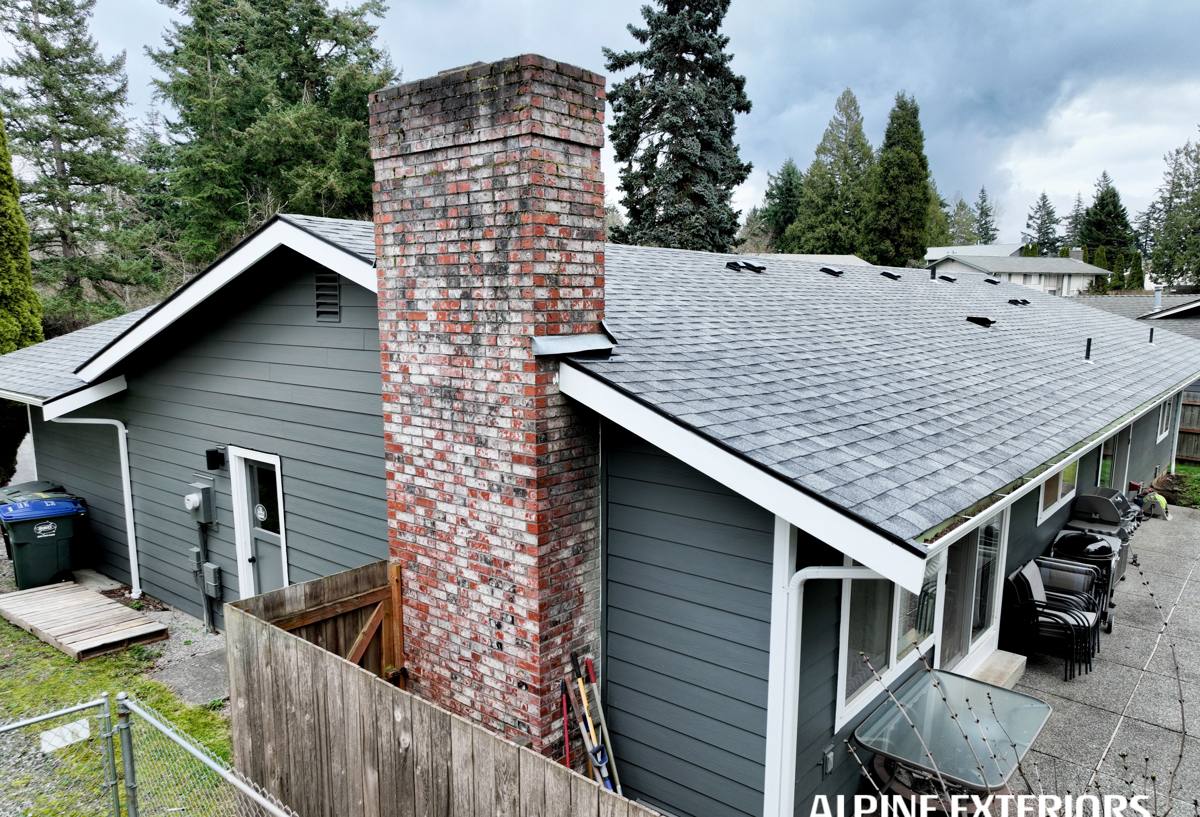
What This Climate Does to Vertical Siding Over Time
Three things drive almost every siding failure we see on vertical siding in this area:
- Driving rain that gets pushed sideways into vertical seams and batten joints, rather than just running down the face of the wall like it does on a flat surface.
- A long moss and algae season — shaded, damp exteriors in Whatcom County can stay wet for months at a stretch, which is exactly the environment moss and mildew need to take hold on porous or poorly finished siding.
- Salt-influenced marine air that speeds up corrosion of fasteners, trim, and any exposed metal, and accelerates the breakdown of finishes not engineered for coastal-adjacent exposure.
None of these are exotic problems — they're the normal operating conditions for a home in this part of Washington. The question isn't whether your siding will face them, it's whether it was chosen and installed with them in mind.
Why Vertical Profiles Are Less Forgiving Than Lap Siding
Lap siding is designed to shed water downward, with each course overlapping the one below it. Board and batten depends more heavily on the quality of the panel joints, the caulking at seams, and the water-resistive barrier behind the siding to keep moisture out — there's more vertical seam length exposed to wind-driven rain per square foot of wall. That's not a reason to avoid the look; it's a reason to be precise about material and installation.
Board & Batten Materials: What We Install and Why
We install James Hardie fiber cement exclusively — no vinyl, no LP SmartSide, no primed spruce, no cedar. That's a deliberate standard, not a limitation of what we're capable of installing. Fiber cement is dimensionally stable, doesn't feed moss and mildew the way wood-based products can, and comes factory-finished so the color layer isn't relying on a field-applied coat of paint to survive the wet season.
| Material | Moisture & Moss Behavior | Maintenance | Typical Lifespan |
|---|---|---|---|
| James Hardie fiber cement | Non-combustible core, engineered for wet climates; factory ColorPlus finish resists moss/mildew staining better than field paint | Occasional wash; repaint interval is long because color is baked in at the factory | 30+ years with correct install |
| Vinyl board & batten | Doesn't rot, but panels can warp/buckle with heat and gap at seams, giving moisture a path behind the wall | Low, but damaged panels are hard to color-match years later | 15-25 years, shorter in harsh exposure |
| LP SmartSide (engineered wood) | Wood-based core is more moisture-sensitive; cut edges and joints need diligent sealing or moisture can migrate into the panel | Requires attentive caulk/paint upkeep at seams | 20-30 years if maintenance is kept up |
| Cedar / primed spruce | Natural wood movement plus this area's moss season means real upkeep to prevent rot and staining | Regular refinishing and moss treatment | Highly variable; often 10-20 years before major refinishing |
Every product in that table has a legitimate market. Our position is narrower: for this climate, on a vertical profile that leans on tight seams and a good drainage plane, fiber cement with a factory finish gives us the most control over the two failure points — moisture at the joints and finish breakdown from moss and salt air.
What a Correct Board & Batten Installation Actually Involves
The material is only as good as the install behind it. A board and batten job that looks identical from the curb can perform very differently depending on what's happening under the surface.
Rainscreen Gap
We install with a drainage gap (furring strips or a purpose-built rainscreen product) behind the panels wherever the wall assembly calls for it. That gap lets any moisture that does get past the battens drain and dry out instead of sitting against the sheathing — which matters more here than in a drier climate, simply because the wall has more wet days to deal with each year.
Fastening and Layout
Fastener spacing, panel gaps, and batten placement follow James Hardie's published installation instructions, not a generic "close enough" pattern. Correct fastening keeps panels from working loose under wind-driven rain, and correct layout keeps seams landing where they can actually be flashed and sealed properly, rather than in awkward spots that invite shortcuts.
Flashing and Trim Details
Every horizontal transition — window heads, roof-to-wall intersections, the bottom starter course — gets flashed before the siding goes on, not caulked over after the fact as a substitute. Caulk is a finishing detail, not a waterproofing strategy. In a climate with this much sideways rain, the flashing is doing the real work.
Our Process for a Yew Street Board & Batten Project
- On-site assessment — we look at existing siding condition, moisture staining, moss buildup patterns, and how the home is oriented to prevailing wind and rain.
- Tear-off and sheathing check — old siding comes off and we inspect the sheathing and water-resistive barrier underneath for hidden rot before anything new goes up.
- Drainage plane and rainscreen install — house wrap or building paper, then furring or a rainscreen product where the wall design calls for it.
- Panel and batten install to Hardie spec — engineered layout, correct fastener schedule, proper gapping at joints.
- Flashing, trim, and sealant details — all penetrations, transitions, and terminations finished per manufacturer detail.
- Final walkthrough — we walk the job with you before calling it done, not just from the ground but up close at seams and trim.
What to Expect for Upkeep After Installation
Fiber cement board and batten with a factory finish is genuinely low-maintenance, but "low" isn't "none." Realistic expectations for this area:
- Rinse the exterior periodically, especially shaded or north-facing walls where moss is most likely to establish.
- Keep gutters and downspouts clear so water isn't sheeting down the wall face during heavy rain events.
- Trim back vegetation and tree cover that keeps a wall section shaded and damp longer than the rest of the house.
- Have caulking at trim and penetrations checked every few years — it's the one component that ages faster than the siding itself.
- Watch for any impact damage (branches, equipment) and get it addressed promptly rather than letting moisture find a way in through a chip or crack.
Why It Matters to Hire a Crew That Already Works This Area
Sudden Valley and the surrounding Yew Street area have their own installation realities: homes tucked into tree cover with slower-drying wall sections, wind patterns funneled by the lake and terrain, and — like many established communities in this area — architectural or HOA guidelines that can affect siding profile, color, and trim choices. A crew that already works this neighborhood has already dealt with those variables and isn't learning them on your project.
There's also a practical side: local crews know which James Hardie HZ product line and finish options perform best given this specific mix of rain exposure and moss pressure, and they can plan around Whatcom County permitting and inspection timelines without the project stalling. That familiarity translates directly into fewer surprises during the job and a better-performing wall assembly once it's finished.
Choosing the Right Board & Batten Look for Your Home
James Hardie's fiber cement system gives real flexibility in board width, reveal spacing, and factory color, so the vertical look can be dialed in to match the character of the home rather than forcing a one-size profile. We'll walk through those options on-site, factoring in your home's exposure and existing trim details, so the final result looks intentional rather than generic.
If you're weighing board and batten for a home on Yew Street or elsewhere in Sudden Valley, we're happy to take a look and give you a straightforward, no-pressure estimate — walk the exterior with you, point out anything worth knowing about your specific walls, and lay out what a correct install would involve before you decide anything.