 Sudden Valley Siding
 What Lake Whatcom's Climate Really Does to a Roof
Homes around Lake Whatcom don't wear out a roof the same way a house on an open, sunny lot does. Sudden Valley sits along the lake's south shore under heavy tree cover, and that combination of shade, still air, and constant moisture off the water creates conditions that are hard on roofing materials in ways that aren't always obvious from the ground. Add in Whatcom County's marine-influenced weather — long stretches of drizzle, driving rain off and on through fall and winter, and short winter days that don't give a roof much chance to dry out — and you get a climate that ages roofing faster than the manufacturer's brochure suggests.
The biggest culprit is moss. Shaded, moisture-retaining roof surfaces near mature conifers are close to ideal moss habitat, and once it establishes itself, moss holds water against the roofing material, works its way under shingle tabs and metal seams, and slowly lifts fasteners and edges. A roof that would last two to three decades in a drier, sunnier part of the state can show real wear a lot sooner here if it wasn't installed with this climate in mind, or if moss and debris were never kept in check.
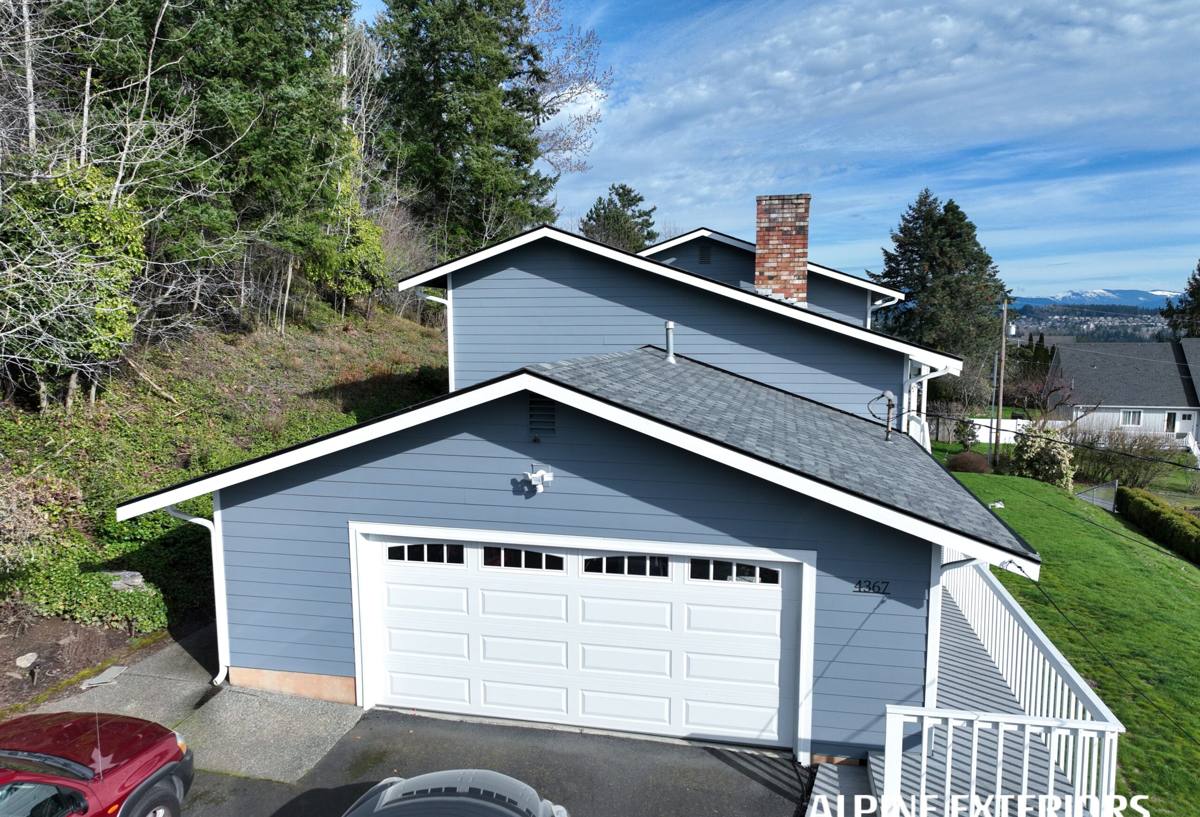
How to Tell When It's Time for a New Roof, Not Another Repair
Not every roof problem around Lake Whatcom means full replacement. A lot of leaks and stains are fixable with targeted repairs, especially on a roof that's still relatively young. But there's a point where patching individual spots stops making financial sense and a full new roof is the more honest recommendation — for the homeowner's budget as much as for the house.
Signs Worth a Second Look
- Shingles that are cupping, curling at the edges, or losing granules faster on the shaded, north-facing slopes
- Moss or algae streaking that comes back within a season or two of cleaning
- Soft spots, sagging, or visible daylight in the attic where there shouldn't be any
- Water stains on ceilings or in the attic that show up after heavy or wind-driven rain specifically
- A roof that's 18-25+ years old (for asphalt composition roofing) with multiple minor repairs already behind it
- Flashing around chimneys, skylights, and valleys that's rusted, lifted, or was never properly stepped in
If you're seeing two or more of these, it's worth having someone look at the whole roof system, not just the spot that's currently leaking. A leak is often the last symptom to show up, not the first.
Choosing the Right Roofing System for a Lake Whatcom Home
There's no single "best" roofing material for every house on the lake — it depends on the roof's pitch, how much shade it sits under, your budget, and how the home is built. What we can say plainly: whatever material goes on, it needs to handle sustained moisture well and shed water fast, because roofs here rarely get long dry stretches to recover in.
| Roofing Type | How It Handles This Climate | Maintenance Reality |
|---|---|---|
| Asphalt composition shingle (architectural) | Good water shedding when installed with proper underlayment and flashing; moss-resistant granule options available | Periodic moss/debris cleaning recommended, especially on shaded slopes |
| Standing seam metal | Sheds water and moss very effectively due to smooth, steep-shedding surface; performs well under trees | Low ongoing maintenance; higher upfront cost |
| Cedar shake | Traditional look, but wood is more sensitive to sustained shade and moisture in this specific setting | Requires more consistent upkeep to manage moss and moisture retention long-term |
For most Lake Whatcom homes we work on, a quality architectural asphalt shingle with algae-resistant granules is the practical middle ground — solid performance and lifespan for the cost. On heavily shaded roofs or homes where the owner wants to minimize maintenance long-term, metal earns a serious look despite the higher install cost. We'll walk you through the honest trade-offs for your specific roof rather than pushing one product across every house.
What a Correct Installation Actually Involves
Tear-Off and Deck Inspection
We remove the old roofing down to the deck rather than laying new material over old — that's the only way to actually see what's underneath. Around Lake Whatcom, this step matters more than usual, because trapped moisture under old roofing can rot sheathing without any obvious sign from above. Any soft or damaged decking gets replaced before anything new goes down; skipping this is one of the most common shortcuts that shows up as problems years later.
Underlayment and Flashing
This is where a roof either holds up to driving, wind-blown rain or doesn't. We install a synthetic or self-adhered underlayment appropriate to the roof's pitch and exposure, with extra protection — ice-and-water-type membrane — at eaves, valleys, and around penetrations where water backs up or driving rain gets pushed under the roofing surface. Flashing at chimneys, skylights, walls, and valleys gets properly stepped and sealed, not just caulked over. Caulk is a temporary fix; correctly formed flashing is not.
Field Installation
Shingles or panels go down to manufacturer spec — correct nailing pattern and placement, proper exposure, and matched ridge and hip details. This is also where we make sure valleys and low-slope transitions, which see the most standing water on shaded roofs, get extra attention rather than the minimum.
Ventilation and Moisture Control
A new roof is only as good as the airflow underneath it. Attics that don't ventilate properly trap warm, moist air against the underside of the roof deck, which accelerates rot and can actually encourage moss and mildew from the inside out — a problem that's easy to miss because it's invisible from the yard. As part of a new roof install, we check that intake (soffit) and exhaust (ridge or other) ventilation are balanced for the attic's size. On older Sudden Valley homes, this is frequently out of balance or blocked entirely, and fixing it during the reroof is far cheaper than addressing it later as a separate project.
Working Around Trees, Shade, and Site Access
Lake Whatcom's wooded lots are part of what makes the area beautiful, and part of what makes roofing here different from a project on an open suburban lot. Overhanging limbs get trimmed back before work starts, both for safety during the tear-off and to reduce future debris buildup and shade on the new roof. Steep driveways, limited staging space, and dumpster/material placement on tighter lots are all things we plan for up front rather than discovering on install day — it keeps the job moving and keeps your property protected.
Permits, Codes, and Warranty
Roof replacement in unincorporated Whatcom County typically requires a building permit, and we handle that process as part of the job rather than leaving it on the homeowner's plate. We also stand behind our installation workmanship separately from the manufacturer's material warranty, and we'll explain both in plain terms before any work starts — what's covered, for how long, and what voids it (usually things like unaddressed ventilation issues or work done by someone else afterward).
Our Process, Start to Finish
- On-site inspection — we get on the roof, check the deck where accessible, and look at attic ventilation, not just the surface
- Written estimate — clear scope, material options, and pricing, with the trade-offs explained rather than just a bottom-line number
- Scheduling — timed around weather windows, since a roof tear-off needs a reasonably dry stretch to do right
- Tear-off, deck repair, and install — most residential reroofs are completed in a small number of working days, weather permitting
- Final walkthrough — we review the finished roof and site cleanup with you before considering the job done
What a New Roof Costs — and What Changes the Number
Every roof is different, so we're not going to throw out a number that doesn't mean anything until we've actually seen your roof. What we can tell you is what tends to move the price up or down.
| Factor | Effect on Cost |
|---|---|
| Roof size and number of planes | More material and labor; complex roofs cost more per square than simple ones |
| Pitch and steepness | Steep roofs require more safety setup and labor time |
| Deck condition underneath old roofing | Rotted sheathing adds repair cost, usually only confirmed once tear-off begins |
| Material choice | Asphalt shingle is typically the most budget-friendly; metal costs more upfront but less upkeep long-term |
| Access and site conditions | Tight, tree-lined, or steep-driveway lots can add setup time |
| Ventilation or structural corrections | Fixing inadequate attic airflow adds modest cost but protects the new roof's lifespan |
Why Local Experience on Lake Whatcom Matters
A roofing crew that mostly works flatter, open, sunnier neighborhoods elsewhere in the county doesn't necessarily know how differently shaded, tree-covered lake lots behave — how fast moss actually returns, which valleys collect standing water on a given roof orientation, or how much ventilation correction older homes in this specific area tend to need. We work in and around Sudden Valley regularly, which means fewer surprises during the job and a roof that's actually built for the conditions it's going to sit under for the next couple of decades, not for a climate spec sheet written somewhere else.
If your roof is showing its age, or you'd just like an honest opinion on whether it's a repair situation or a replacement situation, we're happy to take a look. Fill out the form below for a free, no-pressure estimate on your Lake Whatcom home.