 Sudden Valley Siding
 Lake Whatcom's Climate Is Harder on Siding Than It Looks
Sudden Valley sits along the shore of Lake Whatcom, tucked into forest and hillside terrain that feels calm most of the year — but that same setting is tough on exterior siding. Whatcom County's broader climate is shaped by moisture-heavy marine air moving in off the Salish Sea, and around the lake that regional dampness gets compounded by heavy tree canopy, shaded lots, and humid air sitting over the water for long stretches of the fall, winter, and spring. The result is a microclimate where siding stays wet longer than it would in a more open, sun-exposed part of Whatcom County.
Homeowners who move to Sudden Valley from drier climates are often surprised at how much attention the exterior needs. It isn't dramatic weather that causes the wear — it's the slow, repeated cycle of rain, shade, and humidity that never fully dries out between storms. Over years, that cycle finds every weak point in a wall: a nail hole that wasn't sealed, a butt joint that was caulked instead of flashed, a low corner where water collects. Siding repair around the lake is rarely about one storm — it's about correcting damage that built up quietly over multiple wet seasons.
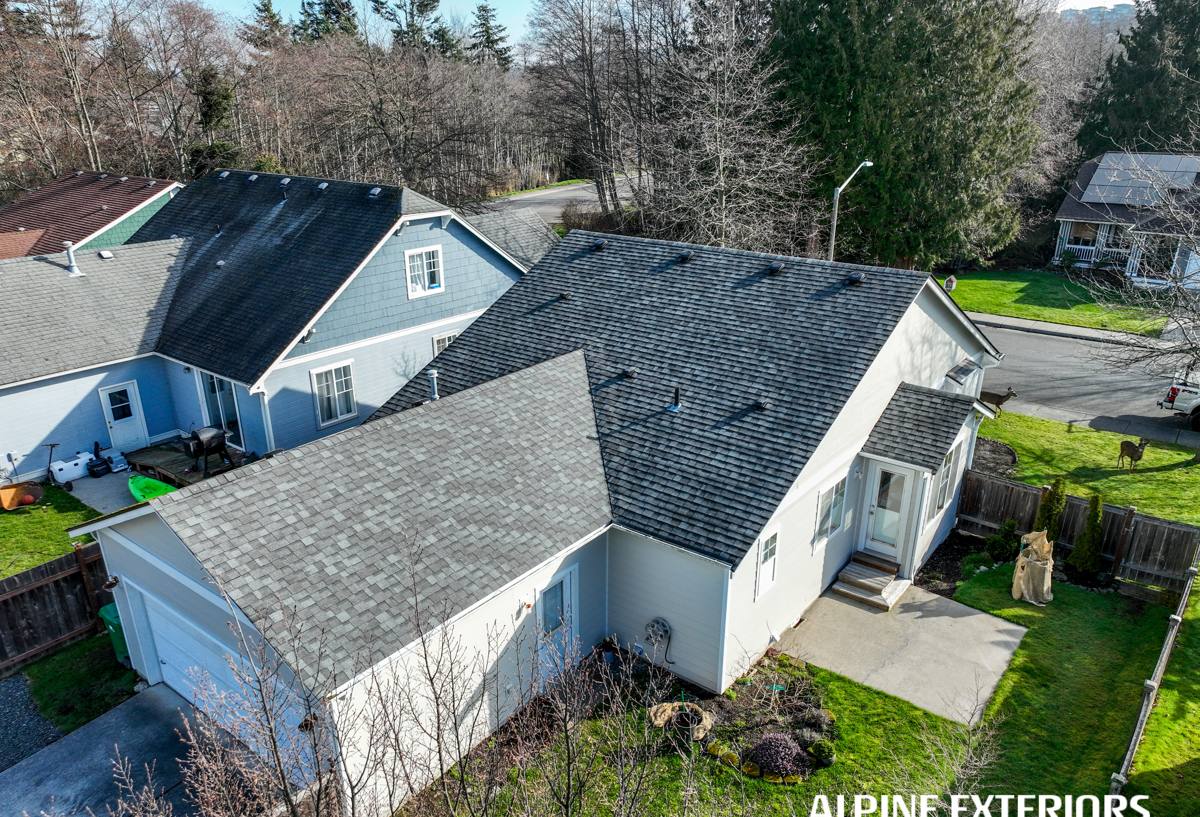
How Driving Rain, Shade, and Moss Actually Damage a Wall
Driving rain off the lake doesn't just fall straight down — wind pushes it sideways into walls, forcing water up under laps and into any gap where siding wasn't properly lapped, flashed, or caulked. On homes with heavy tree cover, that water has fewer chances to evaporate between rain events because sunlight and airflow are both limited. That combination — constant moisture plus limited drying — is exactly what moss and algae need to take hold, and once established, they hold even more moisture directly against the siding surface.
On wood-based or engineered wood products, that trapped moisture eventually reaches the substrate and starts breaking down fiber, causing swelling, soft spots, and eventually rot. On vinyl, trapped moisture behind the panels can promote mold growth on the sheathing and house wrap that homeowners never see until the siding is pulled off. Even well-installed siding can be affected if the flashing details, house wrap laps, or caulking weren't done correctly the first time — the material only ever performs as well as the installation behind it.
Where the damage shows up first
In our experience working around the lake, damage tends to appear first in predictable places: north- and west-facing walls that stay shaded most of the day, areas directly under large trees or near dense landscaping, siding close to grade where splash-back keeps the bottom courses wet, and anywhere a roofline, deck ledger, or window trim creates a horizontal surface for water to sit against the wall.
Signs Your Siding Needs Repair, Not Just a Cleaning
A lot of moss and algae staining can be addressed with a proper soft wash and doesn't necessarily mean the siding itself has failed. But some signs point to actual material damage that cleaning won't fix and that will get worse if it's ignored through another wet season.
- Soft, spongy, or crumbling spots when you press on the siding, especially near the bottom edge or seams
- Visible cupping, bowing, or warping of individual boards or panels
- Paint or coating that's bubbling, peeling, or flaking rather than just fading
- Persistent dark staining or streaking that returns quickly after cleaning
- Gaps opening up at trim, corners, or butt joints that weren't there before
- Visible daylight or drafts at seams from inside the home
- Musty odors near exterior walls, which can indicate moisture reaching the sheathing
If you're seeing any of these, it's worth having someone look at the wall assembly, not just the surface — the visible symptom is usually smaller than the underlying problem.
What a Correct Siding Repair Actually Involves
A repair that just covers the damaged spot without addressing the cause tends to fail again within a season or two, especially in a climate like this one. A repair worth doing starts with figuring out how water got in — a missing kick-out flashing, a caulked joint that should have been lapped, a failed sealant bead, or house wrap that was cut or torn during a prior project. Fixing the siding without fixing the water path just buys a little time.
Once the source is identified, the damaged material gets removed back to solid, dry substrate — not just the visibly stained section. Any compromised house wrap or flashing gets corrected before new siding goes back on. Fasteners get set to the manufacturer's spacing and depth, not just wherever the old nail holes happened to be, and any cut edges get properly sealed or primed so they don't become the next entry point for moisture.
Matching materials and finish
Matching is its own challenge on a repair. Board profile, exposure, and color all have to line up with the surrounding wall or the patch will stand out for the life of the siding. This is one reason a factory-applied finish system matters for repairs — a consistent, engineered color match is far more reliable long-term than field-applied paint trying to match years of weathering and fade on the existing wall.
Repair or Replace? How We Make That Call
Not every damaged wall needs full replacement, and not every repair is worth doing instead of replacement. The right call depends on how much of the wall is affected, what's underneath it, and how old the existing siding already is.
| Factor | Favors Repair | Favors Replacement |
|---|---|---|
| Extent of damage | Isolated to one or two small areas | Spread across multiple walls or elevations |
| Sheathing condition | Dry, solid substrate underneath | Soft, rotted, or water-stained sheathing found |
| Age of existing siding | Mid-life, otherwise sound material | Near or past its expected service life |
| Original material | Same product still available and code-compliant | Discontinued, incompatible, or a product we don't install |
| Root cause | Isolated flashing or sealant failure | Systemic house wrap or drainage plane failure |
An honest assessment sometimes means telling a homeowner that a small, inexpensive repair is all they need — and sometimes it means being direct that patching a failing wall is just deferring a bigger cost. We'd rather give you that answer up front than sell a repair we don't think will hold.
Why We Repair — and Replace — Only With James Hardie
We install and repair with James Hardie fiber cement exclusively. We don't install LP SmartSide, vinyl, Cemplank, Allura, primed spruce, or cedar, and we won't patch a failing wall with those products either. That's a deliberate standard, not a lack of options. In a climate like Lake Whatcom's, the products we've chosen not to install each carry trade-offs — engineered wood and untreated wood siding remain vulnerable to the exact moisture-driven rot cycle described above, vinyl can trap moisture behind it and shows heat and impact damage more readily, and cedar demands ongoing maintenance most homeowners don't want to keep up with for decades.
James Hardie fiber cement is non-combustible, engineered in climate-specific HZ product lines suited to wetter regions like the Pacific Northwest, and finished with a factory-applied ColorPlus coating designed to resist fading and hold up against moisture and mildew staining better than field-applied paint. It carries a strong transferable warranty when installed to Hardie's specifications. When a repair calls for new material, or when a wall has reached the point that replacement makes more sense than another patch, Hardie is what we put on the house — and it's also why we can stand behind the color match and long-term performance of that repair.
Why Hiring a Crew That Already Works Sudden Valley Matters
Every neighborhood around Lake Whatcom has its own quirks — heavier tree cover on some lots than others, slopes down toward the water that affect drainage and access, and homes built across different decades with different original construction details. A crew that's already worked in Sudden Valley has seen those patterns repeat house to house and knows what to check first, rather than treating every repair as a fresh guess.
That local familiarity also shows up in smaller, practical ways: knowing how tree cover and shade patterns affect drying time and scheduling, understanding typical access considerations on sloped and forested lots, and recognizing which failure patterns are common to the area versus which point to something unusual worth a closer look. None of that replaces a proper inspection, but it means less time spent relearning the basics on your job.
Our Process for a Lake Whatcom Siding Repair
- Inspect the affected siding and the surrounding wall, including a check of flashing, caulking, and house wrap where accessible
- Identify the actual moisture source rather than just the visible damage
- Recommend repair or replacement honestly, based on the extent of damage and condition of the substrate
- Provide a clear, written estimate before any work begins
- Remove damaged material back to solid, dry substrate and correct any underlying flashing or wrap issues
- Install matching James Hardie material with correct fastening, clearances, and sealant details
- Clean up the site and walk the finished repair with you
If you're seeing moss buildup, staining, soft spots, or gaps in your siding around Lake Whatcom or elsewhere in Sudden Valley, we're happy to take a look and give you a straight answer about what it needs. Reach out for a free, no-pressure estimate using the form below.