 Sudden Valley Siding
 Why Ferndale Roofs Wear Differently Than Roofs Inland
Ferndale sits close enough to Bellingham Bay and the Salish Sea that homes here deal with a combination most inland Washington towns never see: salt-laden air, driving rain that comes in sideways off the water, and a moss season that can run nearly year-round under the right shade and moisture conditions. None of these factors are dramatic on their own, but stacked together over years, they shorten the useful life of a roofing system that wasn't installed with them in mind.
Salt air is corrosive to exposed metal — fasteners, flashing, vent boots, and drip edge all take a slower but steady beating compared to the same materials fifty miles inland. Driving rain doesn't just fall straight down; wind-driven moisture gets pushed up under shingle tabs and into flashing laps that would stay dry in a calmer climate. And moss doesn't just look bad — it holds water against the roofing surface far longer than the material was designed to tolerate, which accelerates granule loss on asphalt and can encourage rot in wood components underneath.
A roof built for Ferndale has to account for all three at once. That's a different job than a standard reroof, and it shows up in the details — not in the shingle brand on the wrapper, but in the flashing, ventilation, and fastener choices underneath it.
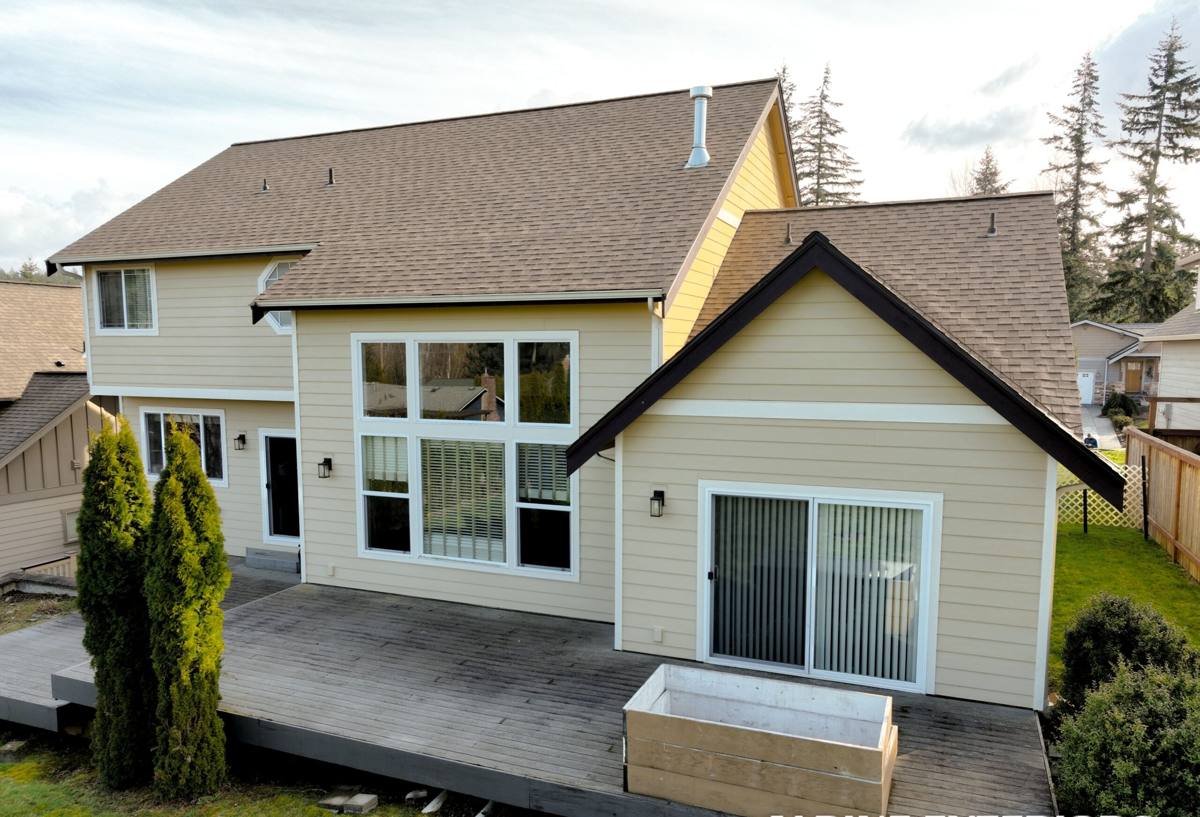
What a Correct New Roof Installation Actually Involves
Tear-Off and Deck Inspection
Every legitimate reroof starts with a full tear-off down to the decking, not an overlay. This is the only point in the project where the crew can actually see the plywood or plank sheathing underneath. In Whatcom County, we routinely find soft or delaminated decking near valleys, chimneys, and old vent penetrations — the spots where small leaks go unnoticed the longest. Any compromised decking gets replaced before anything new goes down. Skipping this step is the single most common shortcut that leads to early roof failure.
Underlayment and Water Barriers
Given how much wind-driven rain this area sees, underlayment choice matters more here than in drier climates. Self-adhered ice-and-water membrane belongs at eaves, valleys, and around every penetration, with a synthetic underlayment covering the rest of the field. This layer is the backup system — the thing that keeps the house dry if wind ever drives water past the shingles themselves, which does happen during a hard coastal storm.
Flashing Details
Flashing failures cause more roof leaks than worn-out shingles do. Step flashing at walls, counter-flashing at chimneys, and properly lapped valley metal all need to be installed — and re-installed new, not reused — during a full replacement. Because salt air accelerates corrosion on exposed metal, we favor flashing materials and fasteners rated for coastal exposure rather than the cheapest stock option.
Field Roofing Material
Whatever material is chosen — asphalt, metal, or otherwise — it has to be installed to the manufacturer's nailing pattern and exposure spec exactly, not "close enough." Under-driven or over-driven fasteners are a quiet cause of shingle blow-off in this area's wind events, and they're invisible once the job is finished, which is exactly why they matter at install time.
Choosing a Roofing Material for Ferndale's Climate
There isn't one "correct" material for every home — the right choice depends on budget, roof pitch, architectural style, and how much long-term maintenance a homeowner wants to take on. Here's how the common options actually compare under local conditions.
| Material | Moss & Moisture Behavior | Coastal / Salt-Air Durability | Typical Lifespan Here | Maintenance Load |
|---|---|---|---|---|
| Architectural Asphalt Shingle | Good with proper ventilation and periodic cleaning; algae-resistant granules help | Solid when paired with corrosion-rated flashing and fasteners | 20-30 years | Low to moderate |
| Standing Seam Metal | Excellent — sheds moisture and resists moss growth on the panel surface | Very good with coastal-rated coatings and stainless fasteners | 40-50+ years | Low |
| Cedar Shake | Requires consistent airflow underneath and regular treatment to manage moisture retention | More sensitive to salt exposure and needs diligent upkeep | 20-30 years with maintenance | High |
We'll walk through these trade-offs honestly during your estimate. A higher upfront cost on metal, for example, often makes sense on a home with heavy tree cover or a north-facing slope that never fully dries out — where a lower-maintenance material saves real money over the life of the roof.
Ventilation: The Difference Between a Roof That Lasts and One That Doesn't
Balanced intake and exhaust ventilation is easy to overlook because you can't see it from the ground, but it's one of the biggest factors in how long a Ferndale roof actually lasts. Without enough airflow, moisture from the living space and damp Whatcom County air gets trapped in the attic. That trapped moisture condenses on the underside of the decking, encourages rot from the inside out, and can even promote moss and mildew growth that has nothing to do with what's happening on the outside of the roof.
A correct installation sizes intake vents (typically at the soffit) and exhaust vents (ridge or box vents) to work together, not just adds vents wherever there's room. On a reroof, this is the right time to fix ventilation problems, since the roofing surface is already open.
Managing Moss Over the Long Term
Moss isn't a sign of a bad roof — it's a sign of a roof living in a shaded, moist climate, which describes most of Whatcom County for a good part of the year. The goal isn't to eliminate the conditions that cause moss; it's to install a roof system that manages it instead of letting it take hold unchecked. A few things make a real difference:
- Zinc or copper strips installed near the ridge, which release trace metal ions in the rain that discourage moss regrowth across the roof plane
- Keeping valleys, gutters, and downspouts clear so water isn't sitting against the roof edge or backing up under shingles
- Trimming back tree canopy where practical, since shade and falling debris are the biggest drivers of moss growth
- Choosing a roofing material and ventilation setup that dries out faster after the region's long stretches of wet weather
Gentle, periodic moss removal by someone who knows not to pressure-wash granules off the shingle surface is part of normal roof maintenance here — not a sign that anything went wrong with the installation.
Signs Your Ferndale Home May Be Due for a New Roof
Roofs rarely fail all at once. Usually there's a stretch of warning signs first. Worth checking for:
- Moss that returns thick and fast within months of cleaning, even after treatment
- Granules collecting in gutters or at downspout outlets in noticeable amounts
- Shingles that are cupping, curling at the edges, or cracked
- Soft or spongy spots when walking the roof, especially near valleys or chimneys
- Daylight visible through the roof deck from inside the attic
- Water stains on interior ceilings or in the attic after heavy rain
- A roof that's 20+ years old (asphalt) and hasn't had a full tear-off in that time
Any one of these on its own isn't necessarily an emergency, but two or three together usually mean it's time for a proper inspection rather than another round of patching.
Our Installation Process
We keep the process straightforward and communicate at each stage, since a full reroof is disruptive enough without added surprises:
- On-site inspection of the current roof, attic, and ventilation, with photos to show you what we're seeing
- A written estimate covering material options, scope of work, and a realistic timeline
- Protecting landscaping, siding, and gutters before tear-off begins
- Full tear-off to the decking, with any compromised sheathing replaced and documented
- Installation of underlayment, ice-and-water membrane, new flashing, and ventilation components
- Installation of the new roofing material to manufacturer spec
- Full site cleanup, including a magnetic sweep for stray fasteners
- A final walkthrough so you can see the finished work and ask questions before we consider the job done
Permits and Local Considerations in Whatcom County
Most full roof replacements in and around Ferndale require a building permit, and the requirements can differ slightly depending on whether the property falls under city or Whatcom County jurisdiction. We handle the permit process as part of the job so you're not the one tracking down paperwork. Beyond permitting, local wind and rain exposure are factored into fastening schedules and underlayment choices — a roof detailed for a drier, calmer climate simply isn't built for what this area sees in a winter storm.
Why Hiring a Crew That Already Works in Ferndale Matters
A roofing crew that works this area regularly already knows which details matter here — how far up a valley the ice-and-water membrane needs to run, which flashing metals hold up against the salt air, and how much ventilation a shaded, moss-prone roof actually needs versus a sun-exposed one across town. That's knowledge you don't get from a general contractor passing through once. It also means faster response if a storm causes damage and you need someone who already knows your roof and your neighborhood, not a crew starting from zero.
If your roof is showing its age or you're planning ahead rather than waiting for a leak, we're happy to take a look and talk through honest options for your home — no pressure, no obligation. Fill out the form below and we'll set up a free estimate.