 Sudden Valley Siding
 Why Siding Repair Looks Different in Cordata
Cordata sits inland from Bellingham Bay, but that doesn't mean it's spared from the weather that defines Whatcom County. The same marine air that moves in off the Salish Sea still reaches every neighborhood in the area, carrying salt-laden moisture that settles on exterior surfaces year-round. Add in the long stretches of driving rain that show up every fall and winter, plus a moss season that can run six months or more under the tree cover common to this part of Washington, and you have a climate that is genuinely hard on siding — regardless of whether a house is a mile from the water or several miles back from it.
That combination doesn't announce itself. It doesn't show up as a single dramatic failure. It shows up as a soft spot near a downspout, a paint line that's started to bubble, a corner board that's gone spongy, or a patch of siding that stays damp two days after everyone else's has dried. Repair work in Cordata is rarely about one big problem — it's about catching a handful of small ones before the wet season turns them into big ones.
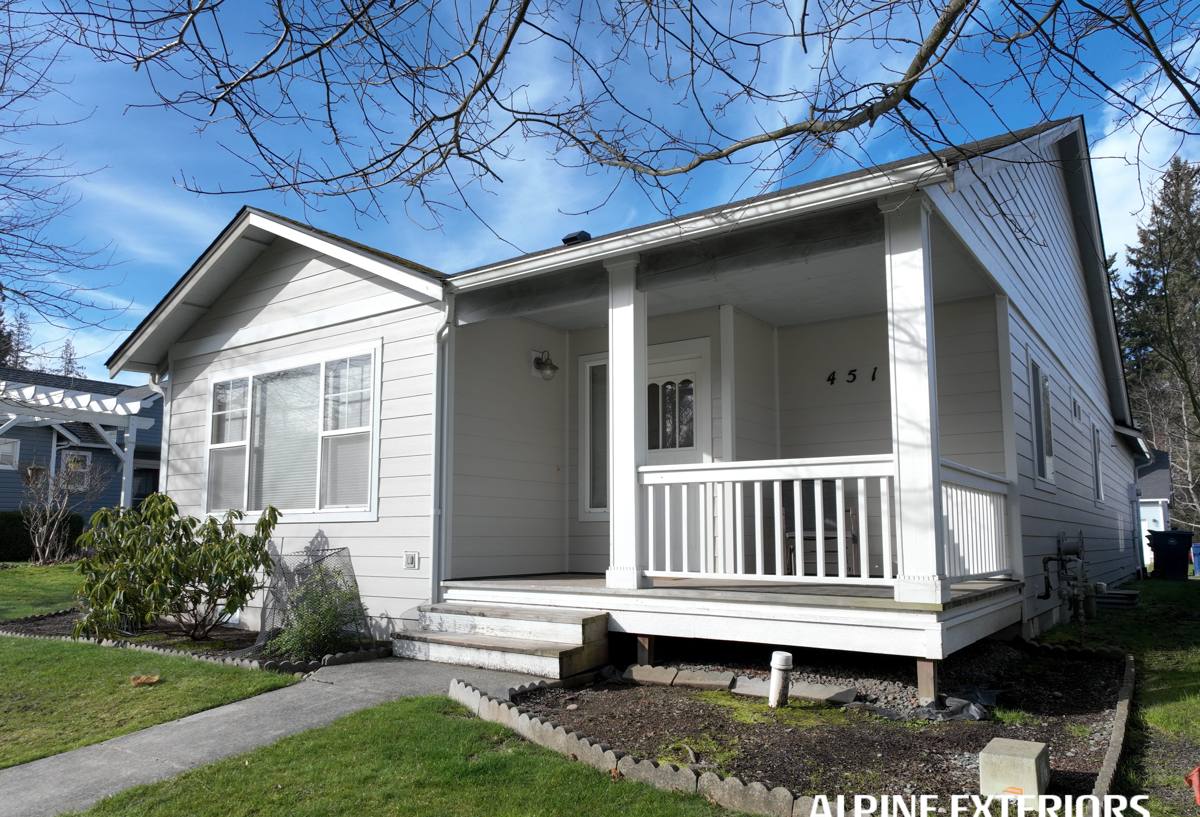
Common Siding Damage We See in Cordata
Every region has its own damage pattern, driven by its own climate. In Cordata and the surrounding Whatcom County area, the repair calls we get tend to fall into a few recurring categories:
- Moisture intrusion at penetrations — around hose bibs, dryer vents, light fixtures, and anywhere siding was cut for a fixture and not properly flashed or sealed.
- Moss and algae buildup in shaded, north-facing, or tree-covered sections that stay damp longest between rain events.
- Caulk and sealant failure at trim joints and butt seams, which opens a path for water once the original sealant dries out and cracks.
- Soft or delaminating panels, especially on older wood-based or engineered wood siding that was never rated for this level of sustained moisture exposure.
- Impact damage from storm debris, ladders, or landscaping equipment — usually a cracked or dented panel that's now an entry point for water even if it looks minor.
- Warping or buckling from siding installed too tight against itself or the framing, leaving no room for normal expansion and contraction.
Some of these are cosmetic annoyances. Others are early warnings of moisture getting behind the siding, where it can sit against sheathing and framing far longer than anyone realizes — because unlike the front of the wall, the back of it doesn't get a chance to dry between rains.
What a Correct Siding Repair Actually Involves
Diagnosis Before Demo
A repair that starts with pulling a panel off before anyone's checked what's underneath is a repair that's guessing. The first step on any legitimate repair job is figuring out how far the damage actually extends — is it surface-level, or has moisture already reached the water-resistive barrier, the sheathing, or the framing behind it? That determines whether this is a simple panel swap or a more involved repair that includes drying out and possibly replacing sheathing.
Matching the Existing Material
Siding repair only looks right if the patch disappears into the wall. That means matching profile, reveal, and — where possible — finish. This is one of the practical advantages of factory-finished fiber cement systems like James Hardie's ColorPlus: the color is baked on at the factory to a documented match, which makes a repair years down the road far more likely to blend rather than stand out as an obvious patch.
Getting the Water Management Right
Any repair that doesn't address flashing, house wrap, and drainage at the repair site is a repair that will fail again. Water has to have a path down and out, not a place to collect. This is the step that gets skipped most often on rushed repair jobs, and it's the one that determines whether the fix lasts five years or fifteen.
Sealing and Finishing
The last step is finishing the repair so it holds up to the next wet season — proper caulking at joints (not as a substitute for flashing, but as a supplement to it), touch-up or panel-matched paint, and a final check that the repaired section sheds water the same way the surrounding wall does.
Repair or Replace? How We Help You Decide
Not every damaged section needs to come down. But not every repair is worth doing either, if the surrounding siding is close behind it in age and condition. Here's how we walk homeowners through that decision:
| Factor | Leans Toward Repair | Leans Toward Replacement |
|---|---|---|
| Extent of damage | Isolated to one or a few panels | Spread across multiple walls or elevations |
| Moisture behind siding | None found, or limited to the surface | Sheathing or framing already affected |
| Age of existing siding | Under 10-15 years, still sound overall | Near or past expected service life |
| Material type | Fiber cement, sound wood | Failing engineered wood or degraded vinyl |
| Match availability | Profile and color can be matched closely | Discontinued profile or faded, unmatched color |
When a repair makes sense, we do the repair — there's no reason to sell a homeowner a full re-side when a section can be properly fixed. When the underlying siding is failing broadly, we say so plainly and explain why a patch would just be a short-term answer to a longer-term problem.
Why We Repair With James Hardie Fiber Cement
Our company installs and repairs with James Hardie fiber cement exclusively — we don't install vinyl, LP SmartSide, Cemplank, Allura, or unfinished wood siding. That standard applies to repair work too, and there's a practical reason for it. Fiber cement doesn't absorb water the way wood-based or engineered wood products can, which matters enormously in a climate where sections of a wall can stay damp for days at a time during moss season and the winter rain stretch. It's also non-combustible, holds paint and factory finish differently than wood-based products, and — when it's Hardie's ColorPlus finish — comes backed by a warranty structure built around that finish holding up over time.
When we repair an existing James Hardie wall, matching is straightforward because the product line, profiles, and ColorPlus color system are documented and consistent. When we're asked to patch a different product, we'll tell a homeowner honestly what we can and can't guarantee about that repair — and where it makes sense, we'll talk through what replacing the affected section with Hardie would look like instead, without pushing anyone toward a bigger job than the situation calls for.
Our Repair Process
- Inspection. We look at the damaged area and the surrounding siding, checking for moisture intrusion, not just visible surface damage.
- Assessment and explanation. We tell you what we found, what caused it, and what the repair will involve — including if we think replacement is the better call.
- Estimate. A clear, written scope of work and cost before anything is touched.
- Repair. Removal of the affected material, correction of any underlying water management issue, installation of matched siding, and proper sealing and finishing.
- Final check. A walk-through to confirm the repair sheds water correctly and blends with the rest of the wall.
Signs a Cordata Homeowner Shouldn't Ignore
Because the damage that matters most is often the damage you can't see from the ground, it helps to know the visible warning signs that usually mean something is happening behind the siding:
- Paint that's bubbling, peeling, or flaking in one specific area rather than uniformly across the house
- Siding that feels soft, spongy, or gives slightly when pressed
- Persistent moss or dark staining that keeps coming back after cleaning
- Visible gaps, cracks, or missing caulk at trim joints and corners
- A musty smell near an exterior wall from the inside of the house
- Warped, bowed, or separated panels
Any one of these is worth a look. Several at once, especially on the same elevation, usually means it's time to have someone check what's happening behind the wall, not just on top of it.
Why Local Experience Matters for This Kind of Work
Siding repair is diagnostic work as much as it's carpentry. Knowing that a north-facing wall in a shaded Cordata yard is going to hold moss longer than a south-facing one, or that a particular style of older home in this part of Whatcom County tends to have thin or missing kick-out flashing at roof-wall intersections, comes from having done this work here — not from a general checklist. A crew that already works in this area has seen how the local combination of salt-tinged marine air, sustained rain, and long moss season plays out on real houses, and that shows up in faster, more accurate diagnosis and a repair that's built for the conditions it actually has to survive, not generic conditions from somewhere drier.
It also matters for the parts of the job that aren't glamorous — showing up when we say we will, giving a straight answer about whether something needs a patch or a full section replacement, and standing behind the work if a repair doesn't hold. That's the standard we hold ourselves to on every repair call in Cordata and the surrounding area.
If you've noticed a soft spot, a stubborn stain, or a section of siding that just doesn't look right, we're happy to take a look. Request a free, no-pressure estimate using the form below and we'll walk the property with you and give you a straight answer about what it needs.