 Sudden Valley Siding
 South Hill Roofs Take a Different Kind of Beating
If you own a home on South Hill, you already know your roof works harder than a roof on flat, sheltered ground. Elevation means more wind exposure. Tree cover means more debris, more shade, and more moisture that never quite dries out between storms. And because South Hill sits within the broader Whatcom County weather pattern — salt-laden air moving in off the water, long stretches of driving rain through fall and winter, and a moss season that can run eight months or more — the wear on a roof up here compounds in ways that a generic "storm damage repair" checklist doesn't capture.
We're not describing a single dramatic event when we talk about storm damage. Most of what we repair on South Hill roofs is the slow accumulation of dozens of ordinary storms: a wind gust that lifts three shingle tabs, a week of sideways rain that finds a gap in the flashing, a winter's worth of moss holding moisture against the deck. By the time a homeowner notices a stain on the ceiling, the damage underneath has usually been building for months.
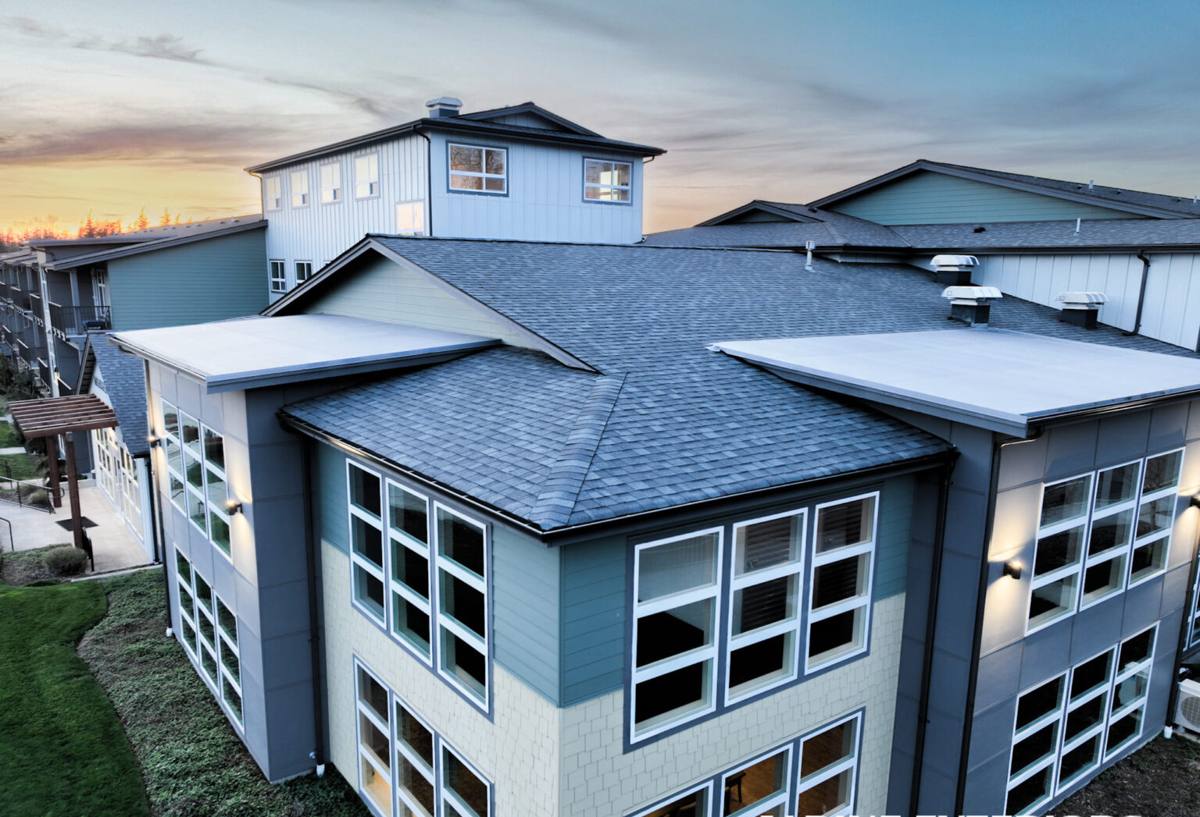
What "Storm Damage" Actually Covers
Storm damage isn't just missing shingles after a windstorm. On a South Hill roof, we typically see it show up in four distinct ways, often at the same time:
Wind Damage
Elevated, tree-adjacent lots catch gusts that lower, more sheltered properties don't. Wind doesn't need to be dramatic to do damage — it just needs to work a shingle edge loose, and once one tab lifts, the ones around it become vulnerable the next time the wind picks up.
Wind-Driven Rain
This is the one homeowners underestimate most. Rain that's being pushed sideways by wind doesn't behave like rain falling straight down. It gets under shingle laps, behind flashing, and into vents and penetrations that are perfectly fine in calm weather. A roof can look intact from the ground and still be taking on water during a driving rain event.
Impact Damage
Tree limbs, wind-thrown debris, and even hail in a harder storm can bruise or crack shingles, dent metal flashing, or puncture underlayment. Impact damage is sometimes obvious and sometimes not — a cracked shingle mat can look fine on the surface while losing its ability to shed water.
Moss and Moisture Damage
This is less a single storm and more the cumulative effect of our climate. Moss holds moisture against the roofing material, works its way under shingle edges, and — left unaddressed through a full moss season — can lift shingles and rot decking. We treat this as storm-related because it's driven by the same wet weather pattern, and it's often the underlying reason a roof fails during an otherwise ordinary storm instead of holding up the way it should.
The Damage Homeowners Usually Miss
The visible stuff — missing shingles, a dented gutter, a branch on the lawn — gets attention. What doesn't get attention is everything underneath, and that's usually where the real cost lives.
- Underlayment tears beneath shingles that still look fine from above
- Flashing that's been bent or separated around chimneys, skylights, and roof-to-wall transitions
- Fascia and soffit rot starting where wind-driven rain has been finding a gap for months
- Nail pops from wind flex, which create small entry points for water long before a leak appears indoors
- Granule loss on shingles from repeated impact and abrasion, which shortens the life of the whole roof even without a visible hole
None of these show up in a quick look from the ground. That's the reason we recommend an actual on-roof inspection after any significant weather event, rather than waiting for a ceiling stain to tell you something's wrong.
How We Approach a Storm Damage Repair
Our process is the same whether the damage is from last week's storm or from a slow leak that's been developing over a wet winter. We don't skip steps because a job looks small.
- On-roof assessment. We walk the roof, not just the yard. Ground-level inspections miss most of what actually matters.
- Document everything. Photos of every affected area, before any repair begins — this matters both for our own records and for insurance purposes if you're filing a claim.
- Check the layers, not just the surface. We look at decking condition, underlayment integrity, and flashing along with the visible shingles.
- Scope the repair honestly. We tell you what needs to be fixed now, what's worth watching, and what can wait — we don't pad a scope to make a job bigger than it is.
- Repair to match, not patch and hope. Replacement shingles are matched as closely as possible in type and, where feasible, in age-appropriate color. Flashing is replaced, not just re-sealed, when it's compromised.
- Final water test and walkthrough. Before we call a repair done, we confirm the fix holds and walk you through what was found and what was done.
Repair or Replace? What Actually Drives That Decision
Not every storm-damaged roof needs to be replaced, and not every roof that "just needs a patch" should be repaired instead of replaced. The honest answer depends on a handful of factors we weigh together, not any single one.
| Factor | Favors Repair | Favors Replacement |
|---|---|---|
| Age of roof | Under roughly 10-12 years | Nearing or past expected lifespan |
| Extent of damage | Isolated to one section or slope | Spread across multiple slopes |
| Decking condition | Solid, no rot found | Soft spots or rot present |
| Moss/moisture history | Recent, caught early | Long-term, recurring lifting |
| Shingle match availability | Close match still available | Discontinued or badly weathered mismatch |
We'll always give you the repair option when it's genuinely sound. A roof that's well past its service life and gets patched instead of replaced usually costs a homeowner more in the long run — not because the patch fails, but because the next storm finds the next weak spot, and the one after that finds another. There's a point where repeated repair stops being the economical choice.
Materials We Use — and Why
We install and repair with roofing systems chosen for how they hold up under Pacific Northwest conditions specifically, not just for cost or appearance. In a climate with this much sustained moisture, a few things matter more than they would in a drier region: how a shingle sheds wind-driven rain at the lap, how resistant it is to moss colonization, and how forgiving the installation is of small imperfections that show up over years of freeze-thaw and wet-dry cycling.
Some lower-cost or more installation-sensitive products look fine on day one but demand near-perfect conditions and technique to perform over time — a tough standard to hold in a climate where crews are often working around weather windows. Our standard is to use materials and methods that give a wider margin for error over a 20-30 year service life, because that's the honest trade-off homeowners are making when they choose a roofing system, whether anyone tells them that up front or not.
Common Signs You Need a Roofer, Not Just a Look
| What You Notice | Likely Cause |
|---|---|
| Granules collecting in gutters | Impact or wind abrasion accelerating shingle wear |
| Dark streaks or green patches | Moss or algae colonization, moisture retention |
| Ceiling stain after a windy rain | Wind-driven rain finding a flashing or lap gap |
| Curling or lifted shingle edges | Wind stress, age, or underlying moisture |
| Sagging in a small section | Possible decking rot beneath the surface |
Insurance Claims: What Homeowners Should Know
Storm damage is often covered under a standard homeowner's policy, but the process rewards documentation and moves faster when someone who knows what an adjuster is looking for is involved. We're not your insurance company and we won't promise a claim outcome, but we can provide the photo documentation, damage description, and repair scope that make a claim easier to support. If damage is limited enough that a claim isn't worth the deductible, we'll tell you that directly rather than encouraging a claim that doesn't make financial sense for you.
Why Local Experience on South Hill Actually Matters
A roofing crew that's worked South Hill roofs before isn't guessing at what they'll find. They know the tree cover and elevation mean different wind exposure than a roof a mile away on flatter ground. They know moss shows up earlier and more aggressively on north-facing slopes shaded by mature trees. They know that a roof here spends more of the year wet than dry, which changes how flashing, ventilation, and underlayment choices should be made — not just how a repair should be patched.
That local familiarity also means faster, more accurate estimates. We're not learning the neighborhood's roofing conditions on your dime — we bring that knowledge to the first visit, which shortens the time between "something's wrong" and "it's fixed correctly."
After a Storm: What to Do First
- Do a ground-level visual check for obvious debris, displaced shingles, or damaged gutters — don't get on the roof yourself
- Check attic spaces or upper ceilings for new staining, dampness, or odor
- Photograph anything visible from the ground or from inside, dated if possible, for your own records
- Avoid DIY tarping on steep or wet roofs — it's a common cause of fall injuries and can trap moisture if done incorrectly
- Call for an on-roof inspection promptly, even if damage seems minor — small gaps get worse with the next storm, not better
What a Correct Repair Looks Like When It's Done
A properly completed storm damage repair on a South Hill roof should leave you with matched materials that blend with the existing roof, flashing that's been replaced rather than caulked over, no soft or spongy decking left unaddressed, and a clear explanation of what was found and fixed. If a repair crew can't tell you specifically what caused the damage and what they did to prevent it recurring, that's worth asking more questions about before the work is called finished.
Storm damage on a roof rarely improves by waiting. If you're seeing signs of wind, rain, or moss damage on your South Hill home, we're glad to come take an honest, on-roof look and give you a free, no-pressure estimate — no obligation, just a clear picture of what your roof actually needs. You can request one using the form below.