 Sudden Valley Siding
 Storm Damage Roof Repair for Yew Street Homes
Yew Street sits inside Sudden Valley's wooded community on the south shore of Lake Whatcom, under the same heavy second-growth canopy that shapes exterior work across the neighborhood. When a windstorm comes through Whatcom County, homes along Yew Street don't just get rained on — they take wind funneled through tree cover, branches and debris knocked loose from surrounding trees, and driving rain that gets pushed sideways into any gap a storm manages to open up. Some of that damage is obvious the next morning. A lot of it isn't, and shows up weeks later as a stain on a ceiling or a soft spot underfoot that started with a single lifted shingle nobody noticed.
This page is about storm damage roof repair specifically — not a full re-roof, not general roofing services — for homes on and around Yew Street. It covers what local storms actually do to a roof in this setting, how to tell cosmetic damage from something that needs real repair, what a correct repair involves, and why it's worth having someone who already works this street handle it.
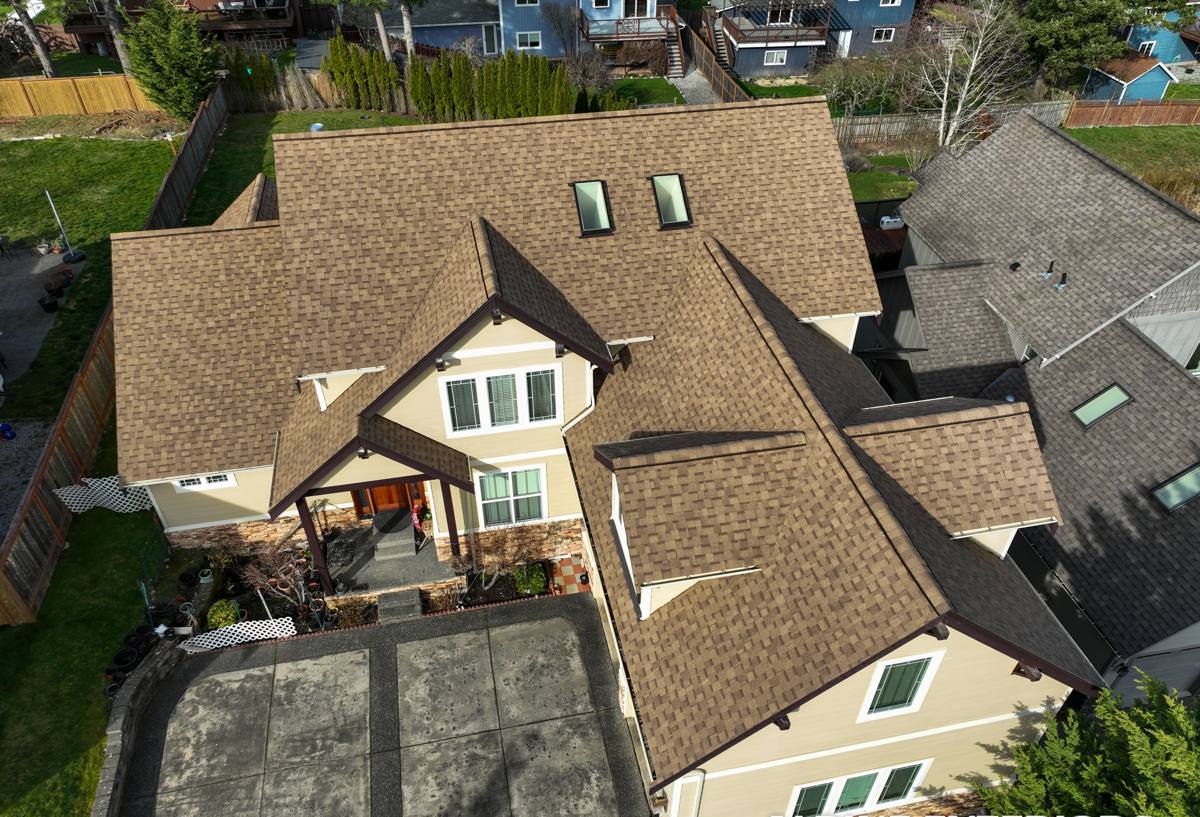
What Whatcom County Storms Actually Do to a Roof
Wind and Wind-Driven Rain
Wind moving through Sudden Valley's tree-lined terrain doesn't hit a roof evenly. It gets funneled and gusts unpredictably, catching shingle edges and ridge lines hard enough to break the factory seal that normally holds tabs flat. Once that seal is broken, rain that's being driven sideways rather than falling straight down finds its way underneath, and a shingle that looks intact from the ground can already be letting water past it.
Salt Air and Slow Corrosion
Salt-laden air reaching inland off the Sound works on exposed metal for years before a storm ever becomes the trigger for a visible leak. Flashing and fasteners that have been quietly corroding become the weak point a storm finds first — the storm doesn't create that vulnerability, it just exposes one that was already there.
Falling Debris From Surrounding Trees
Heavy canopy is part of what makes Sudden Valley what it is, and it's also a real source of roof damage during wind events. Branches and limbs coming down can puncture shingles, crack decking, or dent and displace flashing around vents and chimneys — damage that's often localized to one section of roof rather than spread evenly across the whole structure.
Moss That Was Already Working Against the Roof
Whatcom County's long moss season means many roofs here go into a storm with shingle edges already lifted slightly by moss growth, especially on shaded, north-facing slopes. A roof section weakened by months of moss holding moisture against it is far more likely to lose shingles outright in a wind event than a clean, well-maintained slope.
Reading Storm Damage Correctly: Cosmetic vs. Structural
Not every mark on a roof after a storm needs the same response. Some damage is worth documenting and watching; other damage needs to be addressed before the next rain. Knowing the difference is the first real step in figuring out what a repair actually requires.
| Damage Type | What It Looks Like | Typical Repair Scope |
|---|---|---|
| Wind-lifted shingles | Tabs raised or torn loose along an edge, ridge, or slope | Re-secure or replace the affected shingles and courses around them |
| Torn-off sections | Shingles missing entirely, down to underlayment or bare decking | Tear out and rebuild the section, matching underlayment and flashing |
| Flashing separation | Gaps or lifted metal at valleys, chimneys, vents, or wall transitions | Re-lap and reseal flashing as part of the repair, not caulk alone |
| Deck-level soft spots | Spongy feel or visible sag when walked or viewed from the attic | Cut back to sound decking and replace before new roofing goes on |
| Granule loss or bruising | Shingles still in place but visibly worn, dented, or thinning | Document and monitor; often doesn't need immediate repair |
What a Correct Storm Repair Involves
A storm repair that actually holds up is a smaller version of a full roofing job, not a shortcut version of one. That means tearing back to sound material rather than layering new shingles over a damaged spot, checking the deck underneath for hidden moisture, and integrating new flashing and underlayment with what's already there instead of relying on caulk to bridge the gap. It also means inspecting the roof section around the visible damage, not just the spot a homeowner points to, since wind and falling debris rarely damage just one shingle in isolation.
- A full inspection of the damaged area and the roof section around it, not just the spot that's visibly broken
- Tear-back to sound decking and roofing material before anything new goes on
- A deck inspection for soft spots or hidden moisture that predates the storm
- Underlayment and flashing integrated with the surrounding roof system, not caulked over the top
- Shingle color and profile matched as closely as possible where the repair will be visible
- A written scope that specifies exactly what's being torn out and replaced, not a vague line item
Repair vs. Full Replacement After a Storm
Most storm damage on Yew Street roofs is repairable, but not all of it is, and an honest contractor should be willing to say so either way. The decision usually comes down to a handful of practical factors rather than a single rule.
| Factor | Favors a Targeted Repair | Favors Full Replacement |
|---|---|---|
| Roof age | Well under its expected service life | Already nearing or past its expected lifespan |
| Extent of damage | Isolated to one or two sections | Spread across multiple slopes or elevations |
| Condition before the storm | Roof was in solid shape going in | Moss buildup, granule loss, or wear were already advanced |
| Shingle availability | Matching product is still available | Product is discontinued and a visible mismatch is likely |
A roof that was already near the end of its useful life before the storm is a different conversation than a five-year-old roof that took isolated wind damage. We'll tell you honestly which situation you're in rather than defaulting to whichever option costs more.
Working With Your Insurance Claim
Many storm repairs on Yew Street go through homeowners insurance, and there are a few things worth knowing before that process starts. Document the damage with dated photos as soon as it's safe to do so, before any repair work begins — that record matters if there's ever a question about when damage occurred. An adjuster's initial scope is a starting point, not necessarily the final word, and it's reasonable to have your own contractor walk the roof and compare notes, especially if the adjuster didn't get on the roof itself.
It's also worth being cautious about contractors who show up unprompted right after a storm asking you to sign a contract on the spot before any real inspection has happened. That's a common pattern after major weather events in this region, and it's fine to slow down, get a second opinion, and make sure whoever you hire is someone you can still reach a year from now if a question comes up.
Our Process for Yew Street Storm Repairs
- On-site assessment: We walk the roof and attic ourselves and document what we actually find, rather than estimating from photos or a drive-by.
- Honest scope recommendation: We tell you plainly whether this is a targeted repair or something that's crossed into full replacement territory, and why.
- Written estimate: A clear, itemized scope covering tear-back, decking, underlayment, flashing, and shingle matching — not a single vague number.
- Temporary protection if needed: If more weather is coming before the repair can be completed, we address that first so the damage doesn't spread.
- Repair execution: The affected section is torn back to sound material and rebuilt to match the surrounding roof system.
- Final walkthrough: We review the completed repair with you and do a full site and magnetic nail sweep before we call the job done.
Why a Crew That Already Works Yew Street Matters
A crew that regularly works in Sudden Valley already understands the practical side of a job here — how access and scheduling work within a private, HOA-governed community, and how tree cover and shade change from one lot to the next even along the same street. That familiarity shows up in smaller decisions too: which roof products and ages are common in the neighborhood, which slopes tend to hold moss longest, and how salt air and driving rain off the lake have historically affected flashing details on homes nearby.
It also matters after the repair is finished. Storm damage work sometimes attracts crews that move from region to region chasing weather events and are difficult to reach again once the job is done. A contractor with an ongoing, established presence in Whatcom County is one you can actually call if a question comes up during the next wet season.
Signs Your Yew Street Roof Needs a Storm Inspection
- Missing, torn, or visibly lifted shingles after a windstorm
- Granules collecting in gutters or at downspout outlets shortly after a storm
- New or worsening water stains on ceilings or in the attic
- Dented, bent, or displaced flashing around chimneys, vents, or valleys
- Fresh debris strikes or visible impact marks on the roof surface
- Daylight visible through the roof deck from inside the attic
If a recent storm has left any of this behind, it's worth having the roof looked at before the next stretch of wet weather rather than waiting for a leak to force the decision. We're glad to walk the roof, give you a straight read on what we find, and put together a written, no-pressure estimate — use the form below to reach out.