 Sudden Valley Siding
 What Alger's Climate Does to Exterior Siding
Homes around Alger sit in a stretch of Whatcom and Skagit County where three things work against exterior siding at the same time: salt-laden air moving in off the nearby saltwater, driving rain that comes in sideways during fall and winter storms, and a moss season that can run eight months out of the year under all that tree cover. Any one of those is manageable. Together, they shorten the life of the wrong siding product fast.
Salt air accelerates corrosion on fasteners, trim flashing, and any exposed metal components. Driving rain doesn't just wet the surface of a wall — it tests every seam, joint, and butt edge, looking for a way behind the cladding. And moss doesn't just look bad; it holds moisture against the siding surface for weeks at a time, which is exactly the condition that rots wood-based products and de-laminates the wrong composite panels. A siding system that isn't built with all three of these in mind will show it within a few years, not a few decades.
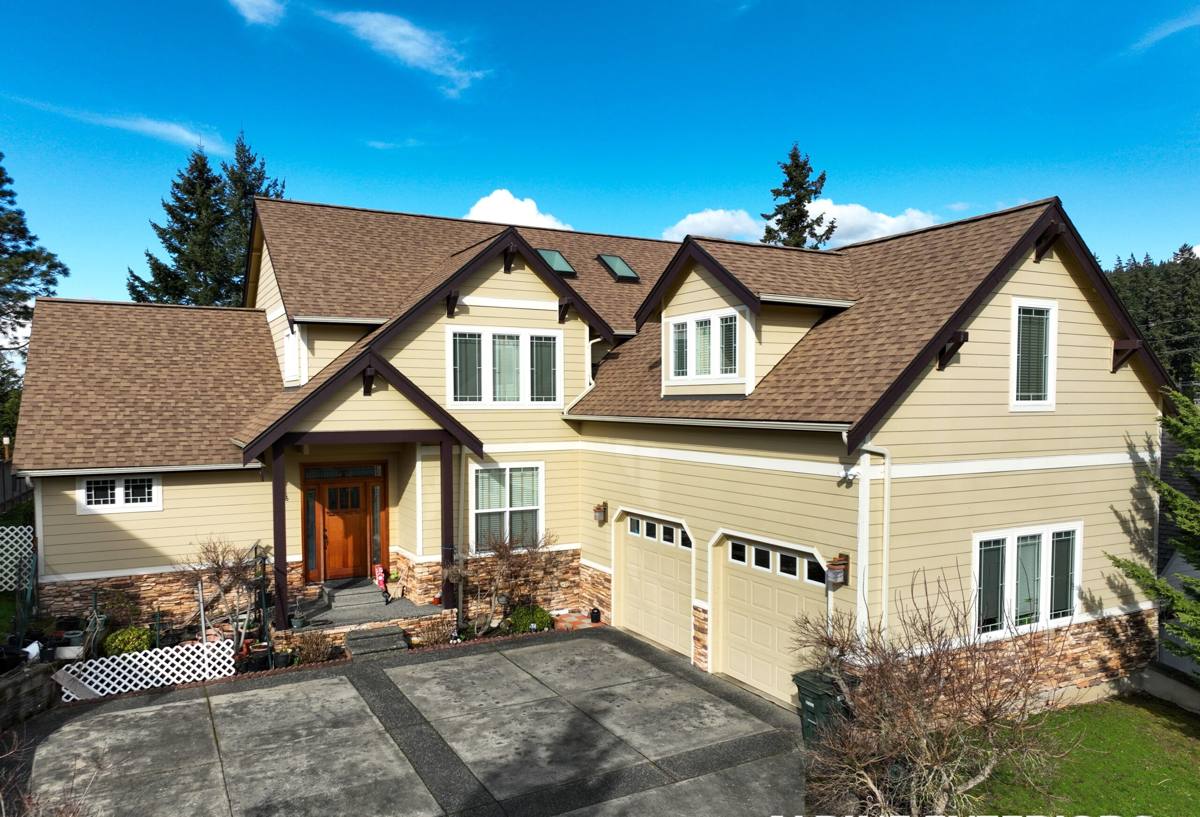
Why We Install Only James Hardie Fiber Cement Siding
We made a decision a while back to stop installing anything except James Hardie fiber cement siding, and Alger's climate is a good example of why. We used to install other products — vinyl, LP SmartSide, cedar — and we still respect what each of them does well. But when we weighed how those materials actually perform over 15-20 years in a wet, mossy, salt-air environment against the maintenance calls and premature failures we kept seeing, Hardie was the clear standout for the homes we work on.
Fiber cement is non-combustible, which matters increasingly in Washington as wildfire smoke and ember exposure become a more regular part of summer. It doesn't feed insects the way wood-based products can. And critically for this region, it doesn't absorb and swell with moisture the way engineered wood products do when a caulk joint fails or a nail hole isn't sealed properly. Hardie's core material is essentially inert to the kind of sustained dampness that moss and driving rain create here.
How Hardie's HZ5 Line Is Engineered for This Region
James Hardie manufactures its siding in different formulations for different climate zones, and Washington falls into the HZ5 zone — the line engineered specifically for cold, wet, high-moisture climates. HZ5 products are formulated to resist moisture-related damage and hold up to freeze-thaw cycling better than the general-purpose product sold in drier parts of the country. When we quote a job in Alger, we're speccing HZ5 boards and panels, not a one-size-fits-all product pulled off a national price sheet.
On top of the substrate itself, Hardie's ColorPlus factory-applied finish is baked on in a controlled environment rather than sprayed or rolled on site. That finish resists fading and holds its color far more consistently through UV exposure and salt air than field-applied paint, and it comes with its own finish warranty separate from the product warranty on the boards.
What a Correct Siding Installation Actually Involves
Fiber cement siding is only as good as the installation behind it. Hardie's own installation instructions are detailed for a reason — get the details wrong and you can void the warranty and create the exact moisture problems the product is designed to prevent. A correct job on an Alger home involves several layers most homeowners never see once the siding is up.
Water Management Starts Behind the Siding
Before a single board goes up, the wall needs a water-resistive barrier installed correctly, lapped shingle-style so water sheds downward and out, never inward. In a climate with this much driving rain, we also install rainscreen furring in most applications — a thin gap between the barrier and the siding that lets any water that does get behind the cladding drain and dry out instead of sitting against the wall sheathing. This is one of the most common corners cut on budget installs, and it's one of the most consequential in a wet region like this.
Flashing at windows, doors, and every horizontal trim intersection has to be integrated with the water-resistive barrier in the correct shingle-lap order — not just caulked over the top. Caulk is a backup, not a strategy. On a home exposed to salt air and prevailing storm winds, poorly integrated flashing is usually where the first leak shows up, often years after the caulk has already failed.
Fasteners, Clearances, and Finish Details
Hardie specifies corrosion-resistant fasteners, and in a salt-air environment we don't cut that corner — cheap fasteners will bleed rust through the ColorPlus finish within a couple of seasons. Board ends need to be field-primed if cut on site, gaps at butt joints need consistent caulking with a product rated for the application, and the bottom edge of the siding needs proper clearance from grade, decks, and roof lines so it isn't sitting in standing water or splashback during heavy rain events.
All of this adds labor time compared to a quick nail-and-go install. It's also the difference between siding that looks good for two years and siding that looks good for thirty.
Our Installation Process for Alger Homeowners
Every home is different, but the sequence we follow stays consistent because it's built around getting the water management right before the finish work ever starts.
- On-site assessment — we look at existing siding condition, wall sheathing, moss and moisture patterns, and any trouble spots around windows, decks, or roof-to-wall intersections.
- Tear-off and sheathing check — old siding comes off and we inspect the sheathing underneath for rot or damage before anything new goes on. Problems found here get addressed before we move forward, not covered up.
- Water-resistive barrier and rainscreen — the barrier is installed and lapped correctly, with furring added where a rainscreen gap is called for.
- Flashing integration — window, door, and trim flashing is tied into the barrier system before siding installation begins.
- Hardie board and panel installation — HZ5-rated boards installed to manufacturer spec, with correct fastener spacing, clearances, and butt joint treatment.
- Trim, caulking, and touch-up — factory finish touch-up paint is used at cut ends and fastener heads to maintain the ColorPlus warranty coverage.
- Final walkthrough — we go over the finished job with the homeowner and explain any maintenance items specific to the home's site conditions.
Comparing Siding Options for an Alger Home
We get asked to compare products often enough that it's worth laying out plainly. This isn't about which product is "bad" — it's about which trade-offs make sense for a home dealing with salt air, driving rain, and heavy moss.
| Factor | James Hardie Fiber Cement | Vinyl Siding | LP SmartSide / Cedar |
|---|---|---|---|
| Moisture behavior | Inert core, resists swelling and rot | Doesn't absorb water, but seams can trap moisture behind panels | Wood-based; prolonged moisture exposure is the main failure point |
| Salt air / corrosion | Non-metallic core; use corrosion-resistant fasteners | Fasteners and trim hardware still exposed to corrosion | Fasteners and any metal trim still exposed to corrosion |
| Fire resistance | Non-combustible | Melts and can deform under heat exposure | Combustible |
| Finish longevity | Factory ColorPlus finish, separate warranty | Color molded through material, can fade and chalk over time | Field-applied paint/stain, needs re-coating on a cycle |
| Maintenance | Periodic wash, repaint on a long cycle if not ColorPlus | Low maintenance but can crack or warp with temperature swings | Higher maintenance — recoating, sealing, moss and rot monitoring |
We don't install vinyl, LP SmartSide, or cedar on the homes we work on — not because they don't have a place in the market, but because after years of installing and later repairing all of them, Hardie is the product we're willing to stand behind in this specific climate.
Signs Your Current Siding Is Struggling With This Climate
Homeowners in the Alger area often call us after noticing one or more of these warning signs. If you're seeing any of the following, it's worth having someone take a look before it turns into a sheathing repair instead of a siding job:
- Persistent moss or algae staining that comes back within weeks of cleaning
- Soft or spongy spots when you press on the siding, especially near the bottom courses
- Visible warping, buckling, or gaps opening up at seams and butt joints
- Paint that's peeling, bubbling, or failing faster than a normal repaint cycle
- Rust streaking below fasteners or trim hardware
- Rising energy bills that suggest the wall assembly isn't performing the way it should
What to Expect for Cost and Timeline
Every home is priced individually based on square footage, the amount of trim and detail work, tear-off scope, and any sheathing repair uncovered along the way. Broadly, fiber cement installation costs more up front than vinyl and is competitive with or less than a properly installed cedar or engineered wood system once you account for finish work. Where Hardie earns that cost back is in the years between major maintenance cycles — homeowners aren't repainting on the same schedule wood siding demands, and they're not replacing panels that have delaminated from years of trapped moisture.
Timeline depends on home size and how much tear-off and repair work is involved, but most single-family homes in this area are a matter of days to a couple of weeks from tear-off to final touch-up, weather permitting. Given how much rain this region gets, we build weather buffer into every schedule rather than rushing water-sensitive steps to hit an arbitrary date.
Why Hiring a Crew That Already Works in Alger Matters
Siding installation isn't a generic skill you either have or don't — it's specific to the conditions a home actually faces. A crew that mostly works drier inland climates may not default to rainscreen furring, may not think twice about fastener corrosion resistance, and may not recognize early moss and moisture patterns the way a crew that works this stretch of Whatcom and Skagit County does every week.
We've seen what happens to siding installed without the region's rain and salt exposure in mind, because we're the ones who get called out to repair or replace it a few years later. Working in Alger regularly means we already know which details can't be skipped here — the flashing integration, the fastener spec, the clearance at grade — because we've seen what happens when they are.
Caring for Hardie Siding After Installation
One of the honest selling points of fiber cement is how little it asks of you afterward. A periodic rinse to keep moss and algae from taking hold, prompt attention to any caulk joints that show wear, and keeping gutters and downspouts clear so water isn't sheeting down the wall are really the extent of routine maintenance. There's no recoating cycle to track and no annual inspection for rot the way there is with wood-based siding. That said, we still recommend a walk-around once a year, especially heading into the wet season, just to catch anything small before it becomes a repair.
If you're dealing with aging, failing, or moisture-damaged siding on an Alger home, or you're just planning ahead for a replacement, we're happy to take a look and walk you through what your home specifically needs. Fill out the form below for a free, no-pressure estimate.