 Sudden Valley Siding
 Roofing in Deming: A Different Set of Demands Than the Lake
Deming sits up the Nooksack River valley, in the shadow of the foothills that lead toward Mount Baker, and it gets a different kind of weather punishment than a roof sitting closer to Bellingham Bay. The same wet Pacific weather system that pushes salt-laden air off the water still reaches this far inland on a strong westerly, but what really defines a Deming roof's life is standing tree cover, river-valley humidity, and long stretches where a shingle field never fully dries out. Add driving rain that comes in sideways during fall and winter storms, and you have a roofing environment that punishes shortcuts fast.
We work throughout Whatcom County, from Sudden Valley and the Lake Whatcom shoreline out to the smaller communities along the Mount Baker Highway corridor, and Deming is one of the areas where we see the clearest difference between a roof installed for a coastal subdivision and one actually built for a shaded, damp valley lot. Asphalt shingles remain the right choice for the vast majority of homes here — they are cost-effective, well understood by every insurer and inspector, and available in a wide range of grades — but only when the installation accounts for how much longer this area stays wet after a storm passes.
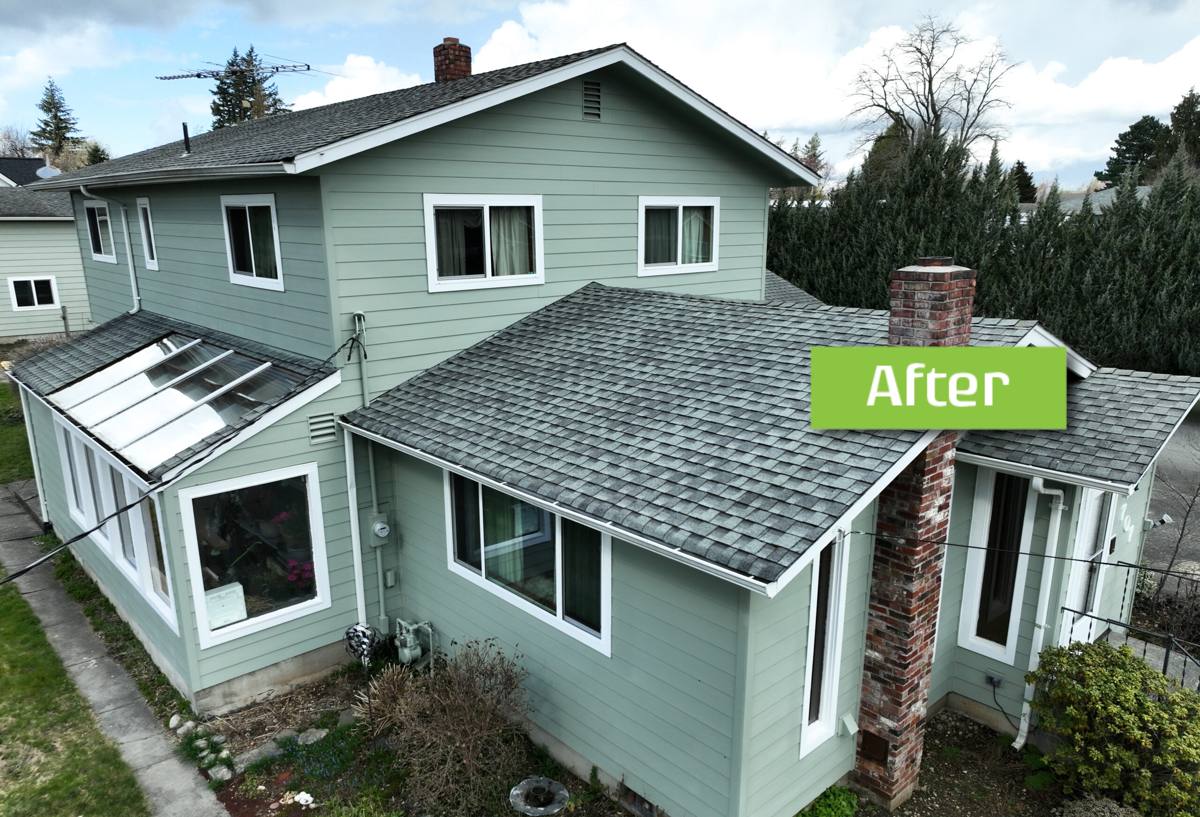
What Deming's Climate Actually Does to a Shingle Roof
Moss and Organic Growth
Tree canopy and river-valley humidity are the two biggest factors working against a Deming roof, and they work together. Shaded north- and east-facing slopes, and any roof plane sitting under or near mature conifers, can stay damp for days after a rain event. That moisture, combined with organic debris — needles, cones, leaf litter — is exactly what moss and algae need to take hold. Once moss establishes itself on a shingle, it lifts the tabs at the edges, holds water directly against the granule surface, and accelerates the shingle's aging far faster than sun exposure ever would on its own.
Driving Rain and Wind-Driven Moisture
Whatcom County storms don't always fall straight down. When wind pushes rain sideways across a roof plane, water gets forced up under shingle tabs, into exposed nail heads, and along ridge and hip lines that weren't sealed with enough overlap. A roof that would perform fine under calm rainfall can still leak under a sideways-driving storm if the underlayment, flashing, and shingle-lap details weren't built with that wind pattern in mind.
Freeze-Thaw and Temperature Swings
Deming sits at a slightly higher elevation and further from the moderating effect of open water than lakefront properties, which means it can see harder frosts and a wider daily temperature swing in winter. Repeated freeze-thaw cycling is hard on any roofing material, but it's especially hard on a shingle roof where trapped moisture has nowhere to go — water that gets under a lifted shingle tab and then freezes expands, widening the gap it started in.
What a Correctly Built Shingle Roof Looks Like Here
A shingle roof that's actually built for Deming's climate — not just for a spec sheet — starts below the shingles themselves. The materials and sequencing matter more here than in a drier, more open part of the county.
- Synthetic or high-quality felt underlayment installed with full, correctly-lapped coverage — this is the backup layer that has to work when wind-driven rain gets past the shingles
- Self-adhered ice-and-water membrane at eaves, valleys, and any roof-to-wall transition, since these are the spots where standing moisture and wind-driven rain concentrate
- Proper nailing pattern and nail placement — high nailing or underdriven nails are a leading cause of premature shingle blow-off and leaks, and they're not always visible from the ground
- Metal step flashing and counterflashing at every wall intersection, chimney, and skylight, rather than relying on roofing cement alone
- Balanced intake and exhaust ventilation, so the attic space isn't trapping moisture that condenses back onto the roof deck from underneath
- Shingle selection matched to the site — algae-resistant (AR) granules matter more on a shaded Deming lot than almost anywhere else in the county
Skipping any one of these doesn't necessarily cause an immediate failure. What it does is remove the margin a roof needs to handle a wet valley climate over 20-30 years instead of 10-15.
Our Process for a Deming Shingle Roof Project
1. On-Site Inspection and Honest Assessment
We start by getting on the roof, not just looking at it from the driveway. We check the shingle field for granule loss, lifted or curling tabs, and moss or algae coverage, and we check the roof deck itself where we can access it — soft spots, staining, or rot around valleys and penetrations tell us more about a roof's real condition than its age alone.
2. A Straight Answer on Repair vs. Replacement
Not every problem roof needs a full tear-off. If the underlying deck is sound and the damage is isolated — a section of storm-damaged shingles, a failed flashing detail, a localized moss problem — a targeted repair is the honest recommendation and the one we'll make. Full replacement gets recommended when the shingles are broadly past their service life, when there's widespread granule loss, or when repeated moisture exposure has compromised the deck itself.
3. Tear-Off and Deck Assessment
On a replacement, we remove the old roofing down to the deck rather than layering over it. That's the only way to actually see and address any rot or soft sheathing before it's sealed back up under a new roof for another two to three decades.
4. Underlayment, Flashing, and Ventilation Detail Work
This is where a roof built for Deming's climate is decided — the ice-and-water membrane at vulnerable spots, the step flashing at walls and penetrations, and a ventilation setup that actually balances intake and exhaust for the attic space involved.
5. Shingle Installation to Manufacturer Spec
Correct nail count, correct nail placement, correct exposure and offset pattern. This is also where wind-rated installation matters — following the manufacturer's high-wind nailing pattern is what keeps a warranty valid and keeps shingles on the roof during a driving storm.
6. Final Walkthrough
We walk the finished roof and go over what was done, what to expect from it, and what basic maintenance — if any — makes sense going forward.
Asphalt Shingles vs. Other Common Roofing Options
Homeowners in Deming sometimes ask us to compare shingles against other roofing types they've seen elsewhere in the county. Here's an honest breakdown of the trade-offs, without overselling any one product.
| Roofing Type | Upfront Cost | Performance in Moss/Moisture Climate | Maintenance Burden |
|---|---|---|---|
| Asphalt Shingles (standard) | Lowest | Good with proper underlayment and AR granules; needs periodic moss removal | Low to moderate |
| Asphalt Shingles (impact/algae-resistant) | Moderate | Better resistance to algae and moss staining; same underlayment needs apply | Low |
| Metal Roofing | Highest | Sheds moisture and moss very well due to slick surface; fewer places for debris to sit | Very low |
| Wood Shake/Shingle | High | Poor in a shaded, damp valley climate — retains moisture and feeds organic growth | High |
Our standard is to steer homeowners away from wood shake and shingle products on shaded, damp Deming lots. It's not that the material is defective — it's that wood roofing needs airflow and sun exposure to shed moisture properly, and a lot of Deming's tree-covered lots simply don't offer that. On those same lots, a well-installed asphalt shingle roof with the right underlayment and AR granules gives a homeowner the best balance of upfront cost and realistic long-term performance, with metal as the higher-cost option for anyone who wants to minimize moss maintenance entirely.
Maintenance That Actually Extends a Deming Roof's Life
A shingle roof isn't maintenance-free, and in a climate like this one, ignoring it costs years off its service life. None of this requires major work, but it does require doing it.
- Keep gutters and valleys clear of needles and debris — clogged water has to go somewhere, and that somewhere is often up under a shingle edge
- Trim back overhanging branches where practical, to reduce shade, debris load, and physical abrasion on the shingle surface
- Have moss and algae growth treated and removed before it spreads across a full roof plane, not after
- Check attic ventilation isn't blocked by insulation or debris, since trapped attic moisture works against the roof from underneath
- Get an inspection after any major windstorm, even if nothing looks obviously wrong from the ground
Why It Matters to Hire a Crew That Already Works in Deming
Roofing crews that mostly work drier, more open sites don't always build in the underlayment coverage, flashing details, and ventilation balance that a shaded, damp valley property actually needs — because they haven't had to. We work this climate regularly, from the Lake Whatcom side of Whatcom County out through the Mount Baker Highway corridor, and that means we're not guessing at how much moss pressure, wind-driven rain, or freeze-thaw cycling a Deming roof will see over its lifetime. We build to that reality from the first course of underlayment, not just to a generic spec sheet.
It also means we can give a straight answer, on-site, about what a specific roof actually needs — repair or replacement, standard shingles or algae-resistant, and where the real risk points on that particular house are — instead of a one-size-fits-all recommendation.
Signs a Deming Homeowner Shouldn't Ignore
Some warning signs are easy to miss from ground level, especially on a roof partly hidden by tree cover. Watch for these:
- Visible moss or dark algae streaking across shingle tabs, especially on shaded slopes
- Granules collecting in gutters or at the base of downspouts
- Shingle tabs that look lifted, curled, or cupped rather than lying flat
- Daylight visible through the roof deck from inside the attic
- Water stains on interior ceilings, especially near valleys, chimneys, or skylights
- Sagging in any section of the roofline
Any one of these is worth a look before it turns into an interior repair on top of a roofing one.
If you're in Deming and want a straight, no-pressure look at your roof's actual condition — repair or replace, what it would take, and roughly what it costs — fill out the form below and we'll get you a free estimate.