 Sudden Valley Siding
 Siding Repair in Barkley: Reading What the Climate Left Behind
By the time most Barkley homeowners call about a siding problem, the damage has usually been building for a while. Salt air, driving rain, and a moss season that runs far longer here than in drier parts of the state don't cause dramatic, sudden failures — they cause slow, cumulative wear that shows up as a soft spot near the ground, a stained panel under an eave, or a section of trim that's started to pull away. Diagnosing that kind of damage correctly, and repairing it in a way that actually holds up through another Whatcom County winter, takes a different set of judgment calls than a straightforward new installation does.
A repair on a Barkley home isn't just about matching a board. It's about figuring out why that specific spot failed first, whether the moisture that caused it is still active behind the wall, and what needs to change about the detailing so the same failure doesn't reappear a few feet away in another two or three years. That's the standard we hold every repair to.
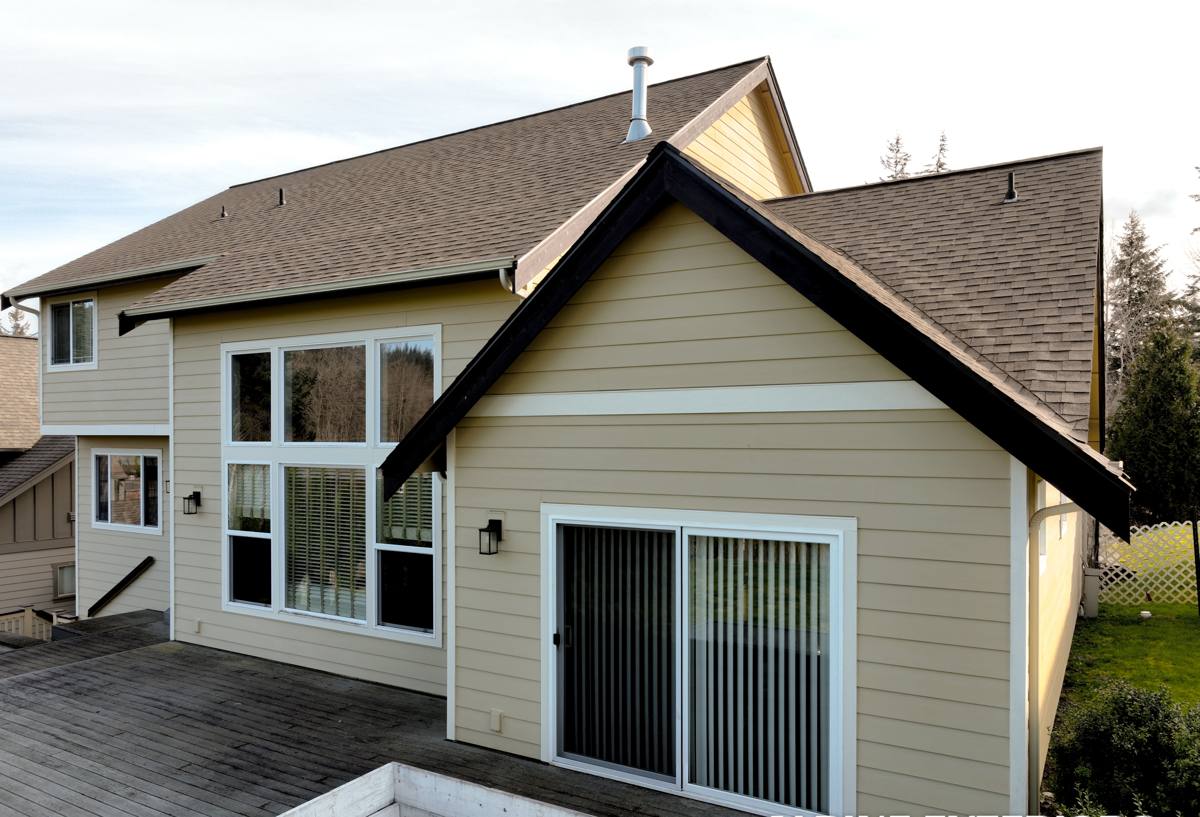
Signs a Barkley Home Needs Siding Repair
Most siding damage is easiest to fix — and cheapest to fix — before it spreads. In this climate, a few specific warning signs show up more often than others, usually clustered on north-facing walls, shaded sections, and anywhere water tends to collect or run off a roofline onto the wall below.
- Soft, spongy, or crumbling siding when you press on it, especially near the bottom courses or below windows
- Visible green or black staining, particularly on shaded or tree-covered walls that stay damp longer between rain events
- Cracked, buckled, or bowed panels, which often point to trapped moisture pushing the material out of shape
- Gaps opening up at seams, corners, or where siding meets window and door trim
- Paint or finish that's peeling, chalking, or failing unevenly in patches rather than across the whole wall
- Soft trim boards or visible rot at the bottom edge of siding near grade or a deck ledger
- Interior clues — a musty smell, a damp patch on drywall, or peeling interior paint on an exterior wall — that suggest water is already getting past the siding
What a Correct Repair Actually Involves
Finding the Real Cause, Not Just the Symptom
Replacing a damaged panel without figuring out why it failed is the most common shortcut in siding repair, and it's the reason so many repairs need to be redone within a few years. If water got behind the cladding because of a flashing gap at a window, a missing kick-out flashing where a roofline meets a wall, or house wrap that wasn't lapped correctly, swapping the visible board does nothing to stop the next one from failing the same way. Every repair we do starts with figuring out where the water actually got in, not just where it became visible.
Matching Material and Finish
Because we work exclusively in James Hardie fiber cement, repairs on a Hardie-sided home can be matched to the existing product line, profile, and ColorPlus finish far more precisely than a generic patch job. On homes with older or non-Hardie siding, we're upfront about what a genuine like-for-like match looks like versus what will read as a visible patch, and we'll walk through the honest options rather than promise a seamless blend that isn't realistic.
Checking What's Behind the Siding
Any repair involving suspected moisture intrusion includes a look at what's underneath — the weather-resistive barrier, the sheathing, and the framing at that section of wall. If there's rot in the sheathing or framing, replacing the siding over it just hides a structural problem for a while longer. We address what's underneath before anything new goes back on.
Repair or Replace? Factors We Weigh
Not every siding problem calls for full replacement, and not every problem is a candidate for a simple patch. The right call depends on how much of the wall is affected, how old the existing siding is, and whether the moisture source has been contained.
| Factor | Leans Toward Repair | Leans Toward Replacement |
|---|---|---|
| Extent of damage | Isolated to one or two sections | Spread across multiple walls or elevations |
| Age of existing siding | Still well within its expected service life | Nearing or past the age where widespread failure is likely |
| Moisture source | Identified and correctable at the repair point | Systemic — poor drainage, grading, or barrier failure across the wall |
| Underlying structure | Sheathing and framing intact | Rot or damage found behind multiple sections |
| Material match | Existing product still available or close enough to match | Discontinued profile or finish, or non-Hardie material we won't extend |
Where a wall shows scattered failure rather than one contained problem, we'll say so plainly rather than patch it piecemeal and have the same conversation again next year.
Why We Repair Only with James Hardie Fiber Cement
We don't install vinyl, LP SmartSide, primed spruce, cedar, or other fiber cement brands, and that standard applies to repair work as much as it does to new installs. Extending a repair with a different material than what's on the rest of the wall creates a mismatch in how the wall handles moisture and movement over time — different products expand, contract, and absorb water at different rates, and mixing them at a seam is a common place for the next failure to start.
James Hardie's climate-engineered HZ product lines and factory-applied ColorPlus finish are built to perform consistently over the long run, which makes repairs more predictable: a matched panel behaves the same way the surrounding siding does, rather than becoming a new weak point. Where a repair calls for finish touch-up, Hardie's ColorPlus system also gives us a defined color reference to work from instead of guessing at a field match.
Our Siding Repair Process
- Inspection and diagnosis — we examine the damaged area and the surrounding wall, check flashing and drainage paths, and probe for hidden moisture or soft sheathing before proposing a fix
- Straightforward estimate — you get a clear explanation of what's actually wrong, what the repair involves, and a no-pressure cost range before any work starts
- The repair itself — damaged material is removed, any underlying moisture or structural issue is addressed, and new Hardie material is installed with correct fastening, clearance, and flashing detail
- Finish and cleanup — panels are matched and finished as closely as the product line allows, and the work area is left clean, with a final check to confirm the fix is solid
Why Hiring a Crew That Already Works Barkley Matters
Siding repair is one of the easiest trades to do poorly and have it look fine for a season. A patch that isn't flashed correctly, or a board that's fastened without the right clearance above grade, can look perfectly acceptable on the day it's finished and still fail again within a year or two once the next stretch of driving rain and shaded, damp weather sets in. A crew that regularly works in Barkley and the surrounding Whatcom County area has already seen how these specific conditions play out on homes like this one — which walls tend to hold moisture longest, where moss reliably re-establishes itself, and which repair shortcuts don't survive a full wet season here.
That familiarity matters more in repair work than almost anywhere else in exterior construction, because a repair is only as good as its weakest detail, and the details that matter most are exactly the ones shaped by this particular climate.
Keeping a Repair From Becoming a Recurring Job
A well-executed repair should be the last time you deal with that section of wall for years. That outcome depends less on the visible patch and more on whether the underlying cause was actually fixed — corrected flashing, proper drainage, adequate clearance, and a moisture barrier that's sealed and lapped the way it should be. We treat every repair as a chance to fix the actual problem, not just cover it, because a repeat call a year later isn't a good outcome for either of us.
If you're seeing early signs of siding trouble on a Barkley home, or you've already got a section you know needs attention, we're glad to take a look and give you a straightforward, no-pressure estimate for what it would take to fix it right. There's no cost or obligation to have someone come out and tell you honestly what you're dealing with.