 Sudden Valley Siding
 Why Cordata Roofs Wear Differently Than You'd Expect
Cordata sits in one of the wetter, windier corners of Whatcom County, and the roof over your head takes the brunt of it. Asphalt shingles are the most common roofing material in this area for good reason — they're affordable, proven, and available in styles that hold up well when installed correctly. But "installed correctly" is doing a lot of work in that sentence. A shingle roof that would last three decades in a dry inland climate can show serious wear in half that time here if it wasn't built for the conditions Cordata actually sees year-round.
A Long, Wet Moss Season
Whatcom County's moss season isn't really a season — it's most of the year. Shade from mature trees, north-facing slopes, and the near-constant low-level moisture in the air give moss and algae exactly what they need to take hold on a roof. Left alone, moss doesn't just sit on top of shingles; it works its way under tabs and lifts them, creating gaps where wind-driven rain can get underneath.
Salt Air and Wind Off the Water
Cordata's proximity to Bellingham Bay means salt-laden air is a real factor, not a footnote. Salt air accelerates the breakdown of metal flashing, fasteners, and vent components faster than it does further inland. Combine that with the wind gusts that regularly move through this part of the Puget Sound region during fall and winter storms, and you've got a roof that's fighting moisture intrusion and wind uplift at the same time.
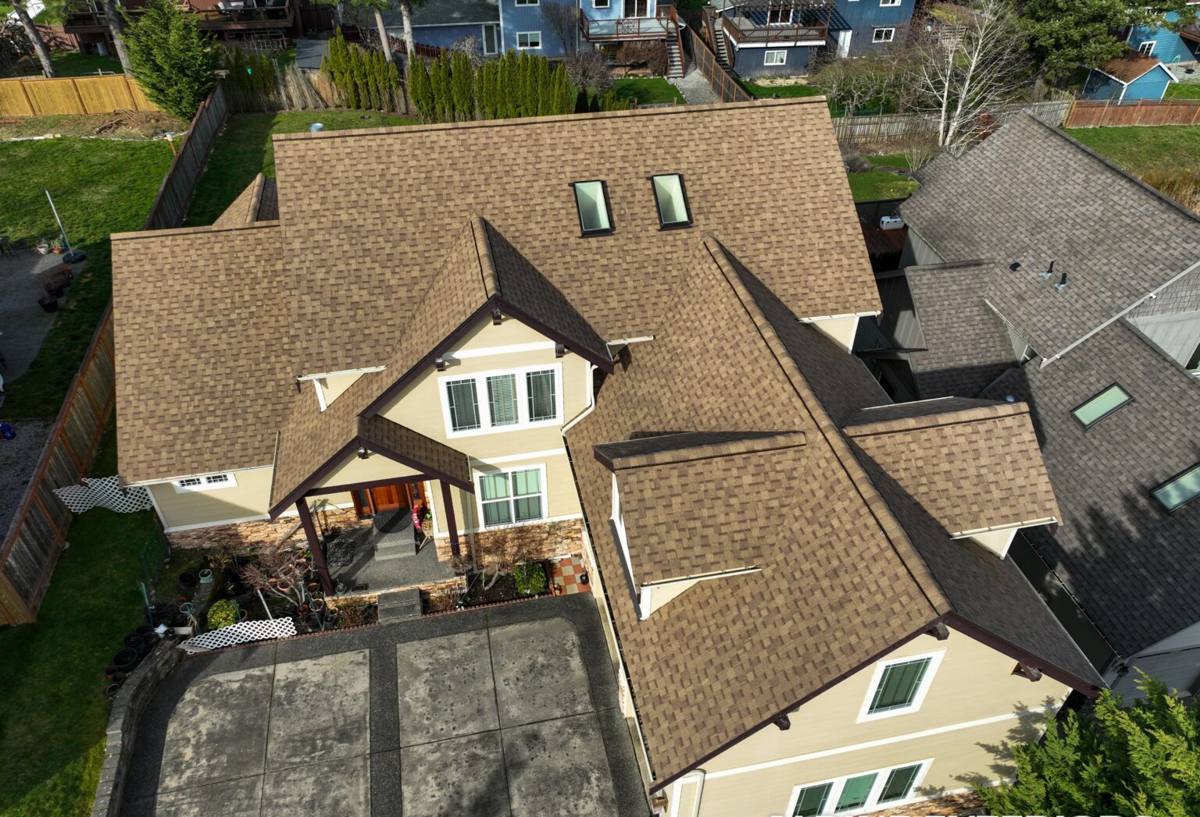
What That Climate Actually Does to a Shingle Roof
It helps to understand the mechanics, not just the symptoms. Moss growing on a shingle roof holds water against the surface far longer than open air ever would. That constant dampness speeds up granule loss — the granules are what protect the asphalt layer underneath from UV and weather damage, so once they're gone, the shingle ages fast. Algae staining (the dark streaks you'll see on older roofs) is a separate but related issue caused by algae feeding on limestone filler in the shingles, and it's cosmetic rather than structural, but it's often an early warning sign that a roof's surface is holding moisture longer than it should.
Wind is the other half of the equation. Sealant strips on asphalt shingles need heat and time to bond fully, and a roof installed late in the season, or with the wrong nailing pattern, may never seal as tightly as it should. In a driving-rain wind event, that's exactly where you'll see tabs lift or blow off first — usually at the eaves, ridges, and rake edges where wind pressure concentrates.
Choosing the Right Shingle for a Cordata Home
Not every asphalt shingle is built the same, and in a climate like this, the differences matter more than they would somewhere drier. Here's how the main categories stack up for a Cordata roof:
| Shingle Type | Typical Lifespan | Moss/Algae Resistance | Wind Rating | Best For |
|---|---|---|---|---|
| 3-Tab (economy) | 15-20 years | Low, unless AR-rated | Lower (60-70 mph typical) | Budget-focused projects, secondary structures |
| Architectural/Laminate | 25-30 years | Moderate, better with AR granules | Higher (110-130 mph rated lines available) | Most Cordata homes; balance of cost and durability |
| Premium AR (algae-resistant) | 30+ years | High — copper/zinc granules actively resist growth | Highest tier ratings available | Shaded lots, north-facing roofs, homes with a history of moss |
For most homes in this area, we lean toward architectural shingles with algae-resistant (AR) granules as the baseline, not an upgrade. The copper and zinc compounds embedded in AR granules slowly release trace amounts that inhibit algae and moss growth on the shingle surface. It's not a permanent shield, and it doesn't eliminate the need for gutter and roof maintenance, but on a shaded or north-facing roof in Whatcom County, it buys real years of service life.
What a Correctly Installed Roof Includes
The shingle brand gets most of the attention, but the components underneath it are what actually determine whether a roof survives a Whatcom County winter. A correct installation here includes:
Ventilation Matters as Much as the Shingle
Balanced intake and exhaust ventilation keeps the attic space close to outdoor temperature and humidity. Without it, warm moist air from inside the home collects against the roof deck, which promotes rot and can shorten shingle life from underneath — a failure mode that has nothing to do with the shingle brand and everything to do with airflow. We check existing ventilation on every reroof and correct it if it's undersized or blocked.
Flashing and Valleys Are Where Roofs Actually Fail
Most leaks don't start in the open field of shingles — they start at transitions: chimneys, skylights, sidewalls, and roof valleys. Ice-and-water shield membrane at eaves and valleys, combined with properly stepped and counter-flashed walls and penetrations, is what keeps driving rain out of those transition points. This is also where salt-air corrosion shows up first on older flashing, so metal choice and detailing matter here more than in a drier inland climate.
- Ice-and-water shield membrane at eaves, valleys, and around all penetrations
- Synthetic underlayment across the full deck, not just felt paper
- Corrosion-resistant drip edge along all rakes and eaves
- Properly balanced intake and exhaust ventilation
- Correct nailing pattern and count per manufacturer specification (not just "enough nails")
- Step and counter-flashing at every wall, chimney, and skylight intersection
Our Process for Cordata Roofing Projects
- On-site inspection of the existing roof, attic ventilation, and decking condition
- Written estimate with shingle options and a clear explanation of what's included
- Material ordering and scheduling around a realistic weather window
- Full tear-off and deck inspection, replacing any soft or damaged sheathing before anything new goes down
- Installation of underlayment, flashing, ventilation components, and shingles per manufacturer specification
- Full site cleanup, including a magnetic sweep for stray nails
- Final walkthrough and warranty paperwork before we consider the job done
We don't skip the deck inspection step, even when it adds a day. A shingle roof is only as good as the surface it's nailed to, and soft or water-damaged sheathing is common on older Cordata roofs that have carried moss and moisture longer than they should have.
Maintenance That Actually Extends Roof Life Here
A well-installed roof still needs upkeep in this climate. The good news is that most of it is simple and doesn't require getting on the roof yourself:
- Clear gutters and downspouts at least twice a year — clogged gutters back water up under the roof edge
- Have moss treated (not pressure-washed) as soon as it appears rather than waiting for a heavy buildup
- Trim back overhanging branches to cut down on shade and debris that feed moss growth
- Check attic ventilation isn't blocked by insulation or storage
- Inspect the roof after major wind storms for lifted or missing shingles
- Avoid pressure washing shingles directly — it strips protective granules and shortens shingle life
Cost Factors for a Cordata Asphalt Shingle Roof
Every roof is priced around its own specifics, but the factors that move the number are consistent:
| Factor | Why It Affects Cost |
|---|---|
| Roof size and number of stories | More square footage and steeper access both add labor time |
| Roof pitch and complexity | Multiple valleys, dormers, and steep pitches take longer and require more flashing detail |
| Deck condition underneath | Rotted or soft sheathing found during tear-off needs replacing before installation continues |
| Shingle tier chosen | Premium AR and higher wind-rated lines cost more per square than economy shingles |
| Ventilation upgrades needed | Adding or correcting intake/exhaust vents is easiest to do during a full tear-off |
| Number of layers to remove | Tearing off two layers of old shingles takes more labor than one |
Most full asphalt shingle roof replacements in this area land in a broad range depending on those factors — a small, simple roof will run well below a large home with a steep, complex roofline. We'll always walk you through exactly what's driving your number rather than handing you a flat quote with no explanation.
Why Local Experience in Cordata Matters
A roofing crew that only sees a neighborhood occasionally doesn't build the same instinct as one that works it regularly. Knowing which streets tend to hold shade and moss longer, which roof orientations catch the worst of the wind off the bay, and how the local building department expects flashing and ventilation details to be handled all comes from repetition, not a general contractor license. We schedule around Whatcom County's weather patterns, we know what moss pressure actually does to a shingle roof over a few winters here versus a dry-climate roof, and we stand behind the work because we're not driving in from out of the area to do it.
If your Cordata roof is showing moss, granule loss, or you're just planning ahead for a replacement, we're happy to take a look and walk you through your options with no pressure. Fill out the form below for a free estimate.