 Sudden Valley Siding
 New-Construction Windows: A Different Job Than Replacement
New-construction windows are built with a nailing fin around the frame, meant to be installed into a bare rough opening before siding goes on, not slipped into an existing frame after the fact. That distinction matters more than most homeowners realize. A new-construction install gives us full access to the wall assembly — the sheathing, the water-resistive barrier, the framing — before anything covers it up. Done right, that's the best possible chance a window ever gets at staying dry and air-tight for the next few decades. Done wrong, the mistakes get sealed behind siding and trim, and nobody finds out until there's a stain on the drywall.
For homes going up or being added onto in and around Cordata, we treat this as a one-shot job. There's no do-over once the siding crew shows up behind us.
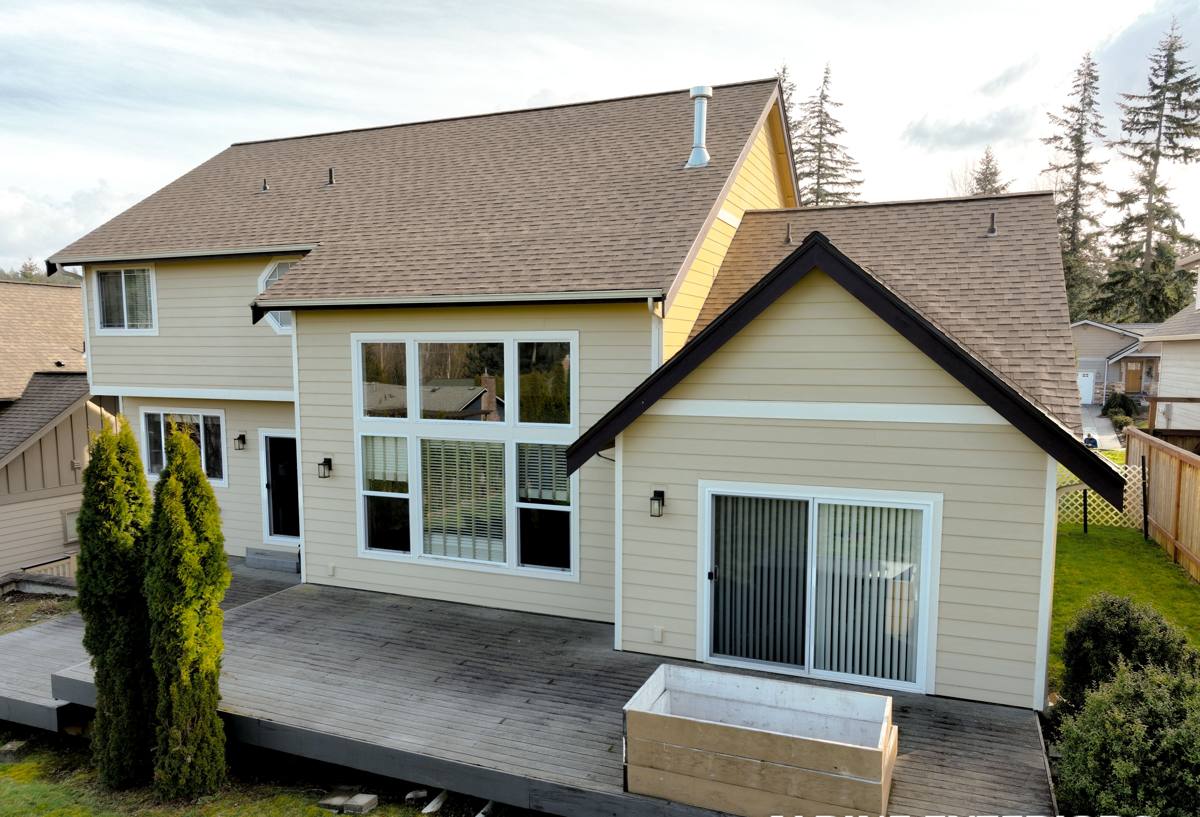
Why Whatcom County Weather Shapes How We Build the Opening
Whatcom County doesn't get hurricanes, but it gets something arguably harder on a building envelope: months of low-intensity, wind-driven rain, salt-laden air moving in off the Sound, and a damp shoulder season long enough to grow moss on anything that holds moisture. None of that shows up as a single dramatic event. It shows up as slow, cumulative wear — caulk that fails a year early, sealant that never fully cures because it never gets a dry stretch, and trim boards that stay wet at the bottom long enough to start rotting from the inside.
That's the backdrop for every new-construction window we set. The frame, the flashing, and the sealant details all get chosen and installed with a Pacific Northwest wall assembly in mind — not a generic install that would work fine in a drier climate but fails here.
What This Means Practically
We plan for water to reach the opening at some point, and we build in a way for it to get back out rather than trying to seal it out completely. That's the core idea behind proper flashing and drainage planes, and it's the piece that gets skipped most often on rushed new-construction jobs.
What a Correct New-Construction Window Install Actually Involves
- A sloped sill pan at the bottom of the rough opening, so any water that gets past the window has a path back out instead of pooling on the framing
- Proper shingle-lap sequencing of flashing tape and the water-resistive barrier — each layer overlapping the one below it, never the reverse
- A back dam or end dams at the sill pan corners so water can't run out the sides
- Correct integration with the house wrap or WRB, so the window becomes part of the drainage plane instead of interrupting it
- Fastening through the nailing fin per the manufacturer's schedule — not just where it's convenient
- Shimming and squaring the unit before fastening, so the sash operates correctly for the life of the window
- Low-expansion foam or backer rod and sealant at the interior gap — never one-part canned foam that can bow the frame
- A final visual and water-path check before siding closes the opening up
Skip any one of these and the window can look perfect for years before a problem shows up. That's exactly why we don't shortcut this list, even when a schedule is tight.
Choosing the Right Window for a Cordata-Area New Build
Frame material matters more in this climate than in a lot of the country, mostly because of how each material handles sustained moisture exposure and temperature swings between damp winters and warmer, drier summers.
| Frame Material | How It Handles This Climate | Maintenance |
|---|---|---|
| Vinyl | Good moisture resistance, no paint to fail, handles temperature swings well | Low — occasional cleaning |
| Fiberglass | Very stable dimensionally, holds up well to sustained damp exposure | Low |
| Wood-clad | Attractive interior wood look, but any breach in the exterior cladding exposes wood to rot risk in a wet climate | Higher — cladding seams need periodic inspection |
| Bare wood | Traditional look, but the most vulnerable to the driving-rain and moss-season combination without disciplined upkeep | Highest — regular paint/finish maintenance |
We're not going to tell a homeowner that a given brand is bad — every manufacturer we work with makes a legitimate product. What we will say plainly is that some frame and cladding choices carry more long-term maintenance burden in a wet coastal climate than others, and we'll walk through that trade-off honestly before you commit to a product for a new build.
Our Process, Start to Finish
- Plan review — we look at the window schedule and rough opening sizes before the framing crew even finishes, so sizing issues get caught early
- Rough opening check — we verify openings are square, plumb, and correctly sized before any window goes in
- Sill pan and flashing — built and taped per manufacturer instructions and the sequencing described above
- Window set and shim — leveled, squared, and fastened through the nailing fin
- Head flashing and WRB integration — tied into the building wrap so the whole wall drains as one system
- Interior air seal — backer rod and low-expansion sealant, not one-part foam
- Final walkthrough — every opening checked before siding crews close it up behind us
Mistakes We Regularly See on New-Construction Sites
Most of the window callbacks we get asked to fix later trace back to a handful of repeat problems: house wrap taped over the nailing fin instead of under it at the top (which traps water instead of shedding it), missing or flat sill pans, canned foam used as the only air seal and bowing the frame, and fastening schedules skipped to save time. None of these are visible from outside once the siding is up — they only show up as a leak, a drafty room, or a window that won't operate smoothly a few years down the road.
We flag these because a homeowner reviewing bids on a new build can ask a contractor directly whether they use sill pans and how they sequence flashing. A straight answer to that question tells you a lot about the crew.
Why Local Experience in Cordata and Sudden Valley Matters
New-construction window work is detail work, and the details that matter shift with the region. A crew that's used to installing in a drier climate can do everything "by the book" and still miss the local nuance — how much lap to build into flashing for sustained wind-driven rain, or how to detail a sill so it sheds water reliably through a long wet season rather than an occasional storm. Working regularly in Cordata and the greater Sudden Valley area means we're not guessing at how the local weather behaves; we've built for it season after season.
Local presence also means straightforward accountability. If a question comes up during a Whatcom County inspection, or a builder wants a walkthrough before siding closes up the wall, we're not driving in from out of the area to handle it.
What Affects the Cost of a New-Construction Window Package
| Factor | Why It Moves the Price |
|---|---|
| Number and size of openings | More glass, more labor and material per opening |
| Frame material | Vinyl generally costs less than fiberglass or wood-clad |
| Glazing package | Upgraded low-E coatings or gas fills add cost but improve comfort and efficiency |
| Opening height and access | Second-story or hard-to-reach openings take longer to flash and set correctly |
| Custom or specialty shapes | Anything outside standard rectangular sizing requires more time and often custom flashing details |
We won't quote a number without seeing the window schedule and the site, but as a general rule, budgeting for correct flashing and installation labor — not just the window units themselves — is what actually protects the investment long term.
Living With New Windows Through a Whatcom County Moss Season
Even a correctly installed window benefits from basic seasonal attention in this climate.
- Rinse pollen, grit, and moss spores off sills and tracks a couple times a year
- Check exterior caulk lines annually for cracking or separation, especially after the first winter
- Keep gutters and downspouts clear so roof runoff isn't dumping extra water onto window heads
- Trim back vegetation that holds moisture against exterior trim near window openings
- Operate sashes periodically so weatherstripping and hardware don't seize up during long stretches of damp weather
None of this is heavy maintenance — it's the kind of upkeep that keeps a correctly installed window performing the way it's supposed to for its full service life.
If you're planning a new build or addition in the Cordata or Sudden Valley area and want a straight assessment of your window plans, we're happy to take a look. Reach out for a free, no-pressure estimate using the form below.