 Sudden Valley Siding
 Siding Installation in Cordata: A Climate Problem First, A Product Problem Second
Homeowners in Cordata often start a siding project by asking which color or style they want. That's the fun part, but it's the second question, not the first. The first question is what your siding has to survive here — and in this part of Whatcom County, that's a specific combination of salt-tinged air, driving rain that comes sideways off storms, and a moss season that can stretch from fall through spring. A siding installation that doesn't account for all three isn't really finished, even if it looks great the day the crew leaves.
This page is about siding installation as a service for Cordata specifically — what the climate demands, what a correct install actually involves underneath the surface, and how we approach it. We install exclusively James Hardie fiber cement siding, and we'll explain why further down, but the bigger point is this: the product matters less than the installation quality behind it. A mediocre install of a great product still fails early.
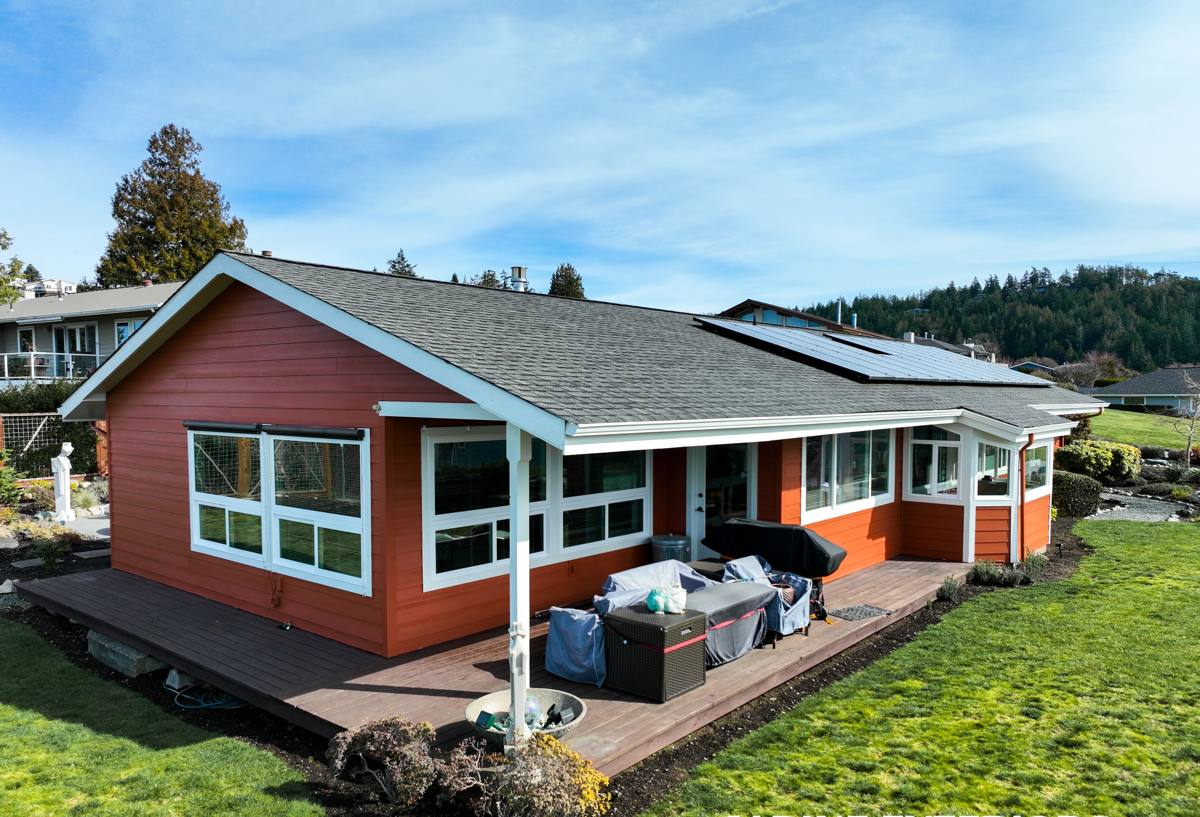
What Driving Rain, Salt Air, and Moss Actually Do to a House
Wind-driven rain finds every gap
Straight-down rain is easy to shed. Driving rain — the kind that comes in at an angle during a Whatcom County storm — pushes water sideways and upward under laps, around trim, and into any seam that isn't properly flashed or caulked. Over years, siding that looks fine from the curb can be hiding moisture damage in the sheathing behind it, especially on walls that face the prevailing weather.
Salt air accelerates corrosion you can't see
Proximity to the Sound and the bay means the air here carries more salt than most inland climates. That salt settles on fasteners, flashing, and trim. Untreated or undersized fasteners corrode faster, and corroded fasteners loosen their grip on siding boards long before the siding itself wears out. It's a slow, quiet failure mode — nothing looks wrong until a board comes loose in a windstorm.
Moss doesn't just look bad — it holds moisture against the wall
A long, wet moss season means organic growth gets a real head start on north-facing and shaded walls. Moss and algae hold moisture against the siding surface for extended periods, which is a problem for materials that absorb water or that rely on paint film alone to stay protected. It also traps debris in laps and joints, which slows drying even further.
What a Correct Installation Actually Involves
The siding itself is maybe a third of what determines whether a wall performs well for the next 30-plus years. The rest is what's behind and around it.
Water-resistive barrier and flashing come first
Before a single piece of siding goes up, the wall needs a continuous water-resistive barrier, properly lapped and taped, with flashing integrated at every window, door, and penetration. This is the layer that actually stops water that gets past the siding — and in a climate with regular driving rain, water will get past the siding eventually. If this layer is rushed or skipped, no siding product will save the wall.
A drainage gap lets the wall dry
Modern installation practice calls for a rain screen or drainage gap between the back of the siding and the water-resistive barrier, so any moisture that does get in has somewhere to go and air can circulate to dry the assembly. In a climate where walls stay damp for long stretches of the year, that ability to dry out matters as much as keeping water out in the first place.
Fastening, clearances, and gaps to spec
Fiber cement has manufacturer-specified nailing patterns, minimum clearances from grade, roofing, and decks, and gap requirements at butt joints and trim. These numbers exist because they were tested for real weather exposure. Shortcuts here — face-nailing where blind-nailing is specified, tight joints with no expansion gap, siding installed too close to grade — are the most common reasons a siding job fails early, and they're invisible to a homeowner once the job is done and painted.
Common installation shortcuts and what they cost you later
- Skipping or under-lapping the water-resistive barrier — leads to hidden sheathing rot within a few years
- Caulking instead of flashing at windows and trim — caulk fails long before flashing does
- No drainage gap on a wall that needs one — traps moisture against the back of the siding
- Standard fasteners in a salt-air environment — accelerated corrosion and loosening boards
- Siding installed with less than the specified clearance to grade, decks, or roofing — constant moisture wicking
- Ignoring manufacturer gap and fastening specs to save time — voids warranty coverage and shortens real service life
Why We Only Install James Hardie Fiber Cement
We get asked why we don't offer vinyl, LP SmartSide, or cedar. The honest answer is that we looked at how each of those products actually performs over decades in a wet, salt-air, moss-prone climate like this one, and we standardized on the one product line we're confident holding our name to.
Vinyl is affordable and low-maintenance in the sense that it doesn't need painting, but it's a thin, flexible material that expands and contracts with temperature and can crack or warp under impact — and it isn't the barrier against moss and organic growth that some homeowners expect. LP SmartSide is a wood-strand product with a resin-saturated shell; it performs reasonably when installation is flawless, but it's more sensitive to moisture intrusion at cut edges and fastener penetrations than fiber cement, which matters a great deal in a climate with this much sustained rain. Cedar is a beautiful, genuinely traditional choice, but it requires ongoing refinishing and is the most vulnerable of the group to moisture, insects, and rot without diligent upkeep — upkeep that a lot of busy homeowners don't keep up with for 20 years straight.
James Hardie fiber cement is non-combustible, dimensionally stable in wet climates, and doesn't feed moss and mildew the way wood-based products can. It comes with a factory-applied ColorPlus finish that's baked on rather than field-painted, which matters in a region where field-applied paint has to cure through cool, damp weather more often than not. Hardie also engineers its products by climate zone — the HZ5 line used in the Pacific Northwest is formulated for regions with more moisture cycling and freeze-thaw exposure, as distinct from the HZ10 line built for hot, humid southern climates. That's a level of climate-specific engineering the other products we mention don't match, and it's backed by a strong transferable warranty when the installation is done to spec.
Our Installation Process for Cordata Homes
- On-site assessment. We look at your current siding, trim, window flashing, and any signs of existing moisture damage before quoting anything, since Whatcom County's rain means hidden damage is common on older homes.
- Removal and sheathing inspection. Once old siding is off, we inspect the sheathing and framing underneath for rot or damage that needs repair before new siding goes up — a step that gets skipped by crews trying to move fast, and one we won't skip.
- Water-resistive barrier and flashing. We install a continuous barrier and properly integrated flashing at every window, door, and penetration, lapped correctly for water to shed downward and outward.
- Rain screen / drainage gap where called for. On walls exposed to driving rain, we build in the drainage space that lets moisture escape rather than sit against the siding.
- James Hardie installation to manufacturer spec. Correct fastener type and spacing, correct clearances from grade and roofing, correct gaps at joints — installed the way Hardie engineered it, not the way that's fastest.
- Trim, caulking, and finish work. Careful attention at corners, transitions, and penetrations, since these are the spots that fail first when rushed.
- Final walkthrough. We walk the finished job with you and point out what maintenance, if any, you'll want to keep an eye on over the coming years.
Choosing a Hardie Product Line for This Neighborhood
James Hardie offers a few distinct product profiles, and the right one depends on your home's style and how much of the wall is exposed to weather.
| Product | Best fit | Climate consideration for Cordata |
|---|---|---|
| HardiePlank lap siding | Most home styles, classic horizontal look | Most common choice; performs well with proper lap and gap spacing in driving rain |
| HardieShingle | Craftsman or cottage-style accents | More seams than lap siding, so flashing and installation precision matter even more |
| HardiePanel (vertical) | Modern styling, board-and-batten looks | Vertical seams need correct batten spacing and drainage detailing to shed rain properly |
| HardieTrim | Corners, window and door surrounds, fascia | Pairs with any of the above; keeps trim from being the weak point in the wall assembly |
ColorPlus finishes are available across these product lines, which matters here because a factory-cured finish holds up better than field paint applied during a wet stretch of weather.
What Affects the Cost of a Siding Installation
| Factor | Why it matters |
|---|---|
| Home size and wall complexity | More corners, dormers, and trim details mean more cutting, flashing, and labor time |
| Condition of existing sheathing | Hidden moisture damage found during tear-off adds repair work before new siding can go on |
| Product line and profile | Lap, shingle, and panel profiles have different material and labor costs |
| Trim and detail work | Craftsman-style trim packages take more time than a simple, clean lap job |
| Access and site conditions | Steep grades, tight lots, or limited equipment access affect labor time |
We give a firm, written estimate after the on-site assessment rather than guessing over the phone, since the sheathing condition alone can change the scope significantly.
Maintaining Hardie Siding in a Wet, Salty, Mossy Climate
- Rinse siding annually, especially on shaded or north-facing walls where moss and algae take hold first
- Keep gutters clear so overflow doesn't run down the wall face repeatedly
- Trim back vegetation and tree cover that keeps walls damp and shaded longer than they need to be
- Inspect caulking at trim and penetrations every year or two and refresh where it's cracked or pulled away
- Watch for any staining or soft spots near ground level, which can signal moisture wicking from below
- Address touch-up needs promptly rather than letting small chips or scratches sit through a wet season
Why Hiring Local Experience Matters in Cordata
A crew that already works in this part of Whatcom County has seen how driving rain behaves against specific home orientations, which walls tend to grow moss first, and where salt air does the most damage to fasteners and flashing. That's not something a crew unfamiliar with the region picks up on the first job. It shows up in small decisions — where to add extra flashing, which walls need a drainage gap even when it's not strictly required, how tight to run a caulk joint — and those small decisions are what separate a siding job that looks good on install day from one that still looks good in fifteen years.
If you're weighing a siding project for your Cordata home, we're happy to walk the property with you, take an honest look at what's there now, and talk through what correct installation looks like for your specific walls and exposure. There's no pressure and no cost to get our take — just fill out the form below to set up a free estimate.