 Sudden Valley Siding
 Custom Decks Built for Columbia's Conditions
Homes in the Columbia area near Sudden Valley sit in one of the more demanding climates in Whatcom County for outdoor structures. A deck here isn't just a place to put a grill and a couple of chairs — it's a structure that has to survive months of driving rain, damp shoulder seasons, and the kind of persistent moisture that turns untreated wood green with moss faster than most homeowners expect. Building a deck that actually holds up in this environment takes different planning than a deck built for a drier inland town, and that's the gap we aim to fill for Columbia homeowners.
We're not talking about exotic engineering. We're talking about getting the fundamentals right in a way that accounts for how much water this region deals with over a typical year, and how much shade and tree cover many Columbia lots have, which slows drying time after every storm.
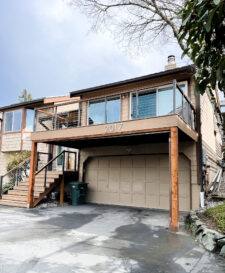
Why Local Climate Changes How a Deck Should Be Built
Three factors define outdoor construction around Sudden Valley and the broader Whatcom County area: sustained rainfall through fall, winter, and spring; humid air that lingers under tree canopy and near the lake; and, depending on lot orientation and exposure, salt-laden air that accelerates corrosion on unprotected metal fasteners and hardware.
Rain and Moisture Load
A deck in this region spends a large share of the year wet or damp. That affects everything from which fasteners we use to how we space deck boards to how we detail the ledger board where the deck attaches to the house. Get any of those wrong and you're looking at trapped moisture, premature rot, or a ledger connection that fails quietly behind the siding.
Moss and Organic Growth
Moss doesn't just look bad — it holds moisture against the deck surface and structural members, which speeds up decay in wood and can make composite surfaces slick and slippery underfoot. Shaded, tree-covered lots common around Columbia are especially prone to this, and a deck built without moss-resistant materials or adequate drainage will need aggressive cleaning within a couple of seasons just to stay safe to walk on.
Salt Air Exposure
Depending on how close and how exposed a given Columbia property is, salt-carrying air can find its way onto fasteners, brackets, and any exposed metal. Standard galvanized hardware can start showing surface corrosion faster than homeowners expect in a coastal-influenced climate. This is a detail that's easy to overlook and expensive to fix later, since fastener failure is a structural issue, not a cosmetic one.
What a Correctly Built Deck Includes
A deck that's going to last in this environment isn't defined by one flashy feature — it's defined by a series of correct decisions stacked on top of each other. Here's what we consider non-negotiable for a Columbia-area build.
- Proper ledger board flashing where the deck meets the house, so water is directed away from the structure rather than into the wall assembly
- Corrosion-resistant fasteners and structural hardware rated for exterior and coastal-influenced exposure
- Joist spacing and blocking sized for the actual decking material used, not a generic minimum
- Gapping between boards that allows for both drainage and the seasonal expansion and contraction wood and composite materials go through in a wet climate
- Footings set below frost depth and sized to the local soil conditions, not a one-size-fits-all pour
- Ventilation underneath the deck structure to reduce trapped moisture and slow mold or mildew growth
- A surface material chosen deliberately for shade level, foot traffic, and how much maintenance the homeowner actually wants to do
Choosing the Right Decking Material for This Area
There's no single "best" decking material — there's a best material for a given lot, budget, and maintenance appetite. In a climate like Columbia's, the tradeoffs between wood and composite decking are more pronounced than they'd be in a drier region.
| Material | Moisture Behavior | Maintenance | Typical Lifespan Here |
|---|---|---|---|
| Pressure-treated wood | Absorbs and releases moisture; needs sealing to resist rot and moss | Annual cleaning and periodic re-sealing | 15–20 years with upkeep |
| Cedar | Naturally rot-resistant but still needs finish maintenance in constant damp | Regular staining or sealing to preserve color and resist decay | 15–25 years with upkeep |
| Composite decking | Doesn't absorb water like wood; resists rot but can stay slick if algae or moss forms on the surface | Periodic washing; no staining or sealing required | 25–30+ years |
We're upfront with homeowners about the tradeoffs. Wood costs less up front but demands consistent maintenance to keep moss and rot at bay in this climate — skip a season of sealing and you can lose ground quickly. Composite costs more initially but removes most of the moisture-related maintenance burden, which is a real factor when you're dealing with a rainy season that runs several months of the year. Neither choice is wrong; it depends on what the homeowner is willing to do every year versus what they want to pay once.
Substructure Details That Matter More Here Than Elsewhere
The visible decking gets all the attention, but the framing underneath is what determines whether a deck lasts one decade or three in a wet climate. A few details we treat as standard practice on every Columbia-area build:
Footings and Frost Depth
Whatcom County's frost depth and soil drainage characteristics mean footings need to be set correctly to avoid frost heave and settling over time. Skimping here is one of the most common causes of a deck that develops an uneven, bouncy feel a few years after installation.
Ledger Attachment
The ledger board — where the deck ties into the house — is the single most important structural connection on most decks, and it's also the point most exposed to water intrusion if flashed incorrectly. We flash this connection to shed water away from the house framing, not toward it.
Joist Protection
In a climate with this much sustained moisture, unprotected joists are a slow-motion liability. We use joist tape or equivalent protection on cut ends and top surfaces to keep water from wicking into the wood grain where it sits hidden under the decking boards.
Railings, Stairs, and Hardware in a Corrosive Climate
Railings and stair stringers see constant weather exposure and constant physical use, so they need to be both structurally sound and resistant to the same corrosion pressures as the rest of the deck. We match hardware grade to exposure level rather than defaulting to whatever is cheapest, and we detail stair stringers so water doesn't pool on horizontal cuts where rot typically starts first. For homes with more direct salt air exposure, we lean toward stainless or heavily coated fasteners over standard galvanized options, since the incremental cost is small compared to what it costs to repair corroded structural connections down the line.
Our Process for a Columbia Deck Project
Every deck we build follows the same disciplined sequence, adjusted for the specific lot and home.
- On-site assessment — we look at drainage, tree cover, sun exposure, soil conditions, and how the deck will tie into the existing structure.
- Material and design conversation — we walk through the wood-versus-composite tradeoffs above in the context of your budget and how much upkeep you want to take on.
- Permitting and engineering — footing depth, structural spans, and railing requirements are confirmed against local code before any digging starts.
- Framing and structural work — footings, posts, beams, and joists are set with the moisture and corrosion protections detailed above.
- Decking, railing, and stair installation — surface materials are installed with correct spacing and fastening for long-term drainage and movement.
- Final walkthrough — we go over maintenance expectations specific to the material you chose, so there are no surprises the first wet season.
Signs an Existing Deck Needs Attention
If you're not building new but wondering whether your current deck is holding up, a few warning signs are worth checking for before they become structural problems.
- Soft or spongy spots underfoot, especially near the ledger board or stair stringers
- Persistent moss or algae that returns quickly after cleaning
- Rust staining around fastener heads or visible hardware
- Gaps or separation where the deck meets the house
- Boards that have cupped, split, or pulled away from framing
- A railing or stair section that feels less rigid than it used to
Any of these can usually be addressed while they're still repairs rather than full rebuilds, but only if they're caught early — which is harder to do in a climate where moisture damage often starts hidden underneath the visible surface.
Why Local Experience Matters for This Job
Deck construction looks similar everywhere on paper, but the details that make a deck last in Columbia are specific to this climate — the rain totals, the shade patterns from mature trees, the humidity that lingers near the lake, and the salt-air exposure that varies by lot. A crew that builds decks primarily in drier or less shaded regions won't necessarily default to the flashing details, fastener grades, or drainage spacing this environment actually requires. We work in Whatcom County conditions regularly, which means these aren't special add-ons we upsell — they're just how we build every deck out here, because that's what keeps a deck standing straight and safe well past the first few wet winters.
If you're planning a new deck or evaluating whether an existing one needs work, we're happy to take a look and talk through what your specific lot and home actually need. Reach out for a free, no-pressure estimate using the form below.