 Sudden Valley Siding
 What Deming's Climate Does to Siding
Deming sits in the kind of Whatcom County weather that's hard on the outside of a house. Homes here take driving rain off and on for months at a stretch, moist air that never really dries out between systems, and long stretches of shade and dampness that let moss and algae get a foothold on anything that holds moisture. Add in the salt-tinged air that reaches inland on a west wind, and you've got a combination that finds every weak seam, every gap in caulk, and every spot where water can sit instead of shed. Siding that's marginal in a drier climate gets exposed fast around Sudden Valley and Deming.
Most of what we get called out for isn't dramatic storm damage — it's slow failure. Paint that chalks and peels years early. Trim that swells and splits at the joints. Panels that cup or buckle because they absorbed water they were never built to handle. Moss mats holding damp against a wall for weeks at a time. None of that is a mystery once you've worked on enough houses in this part of the county — it's what happens when siding material or installation wasn't matched to this specific climate.
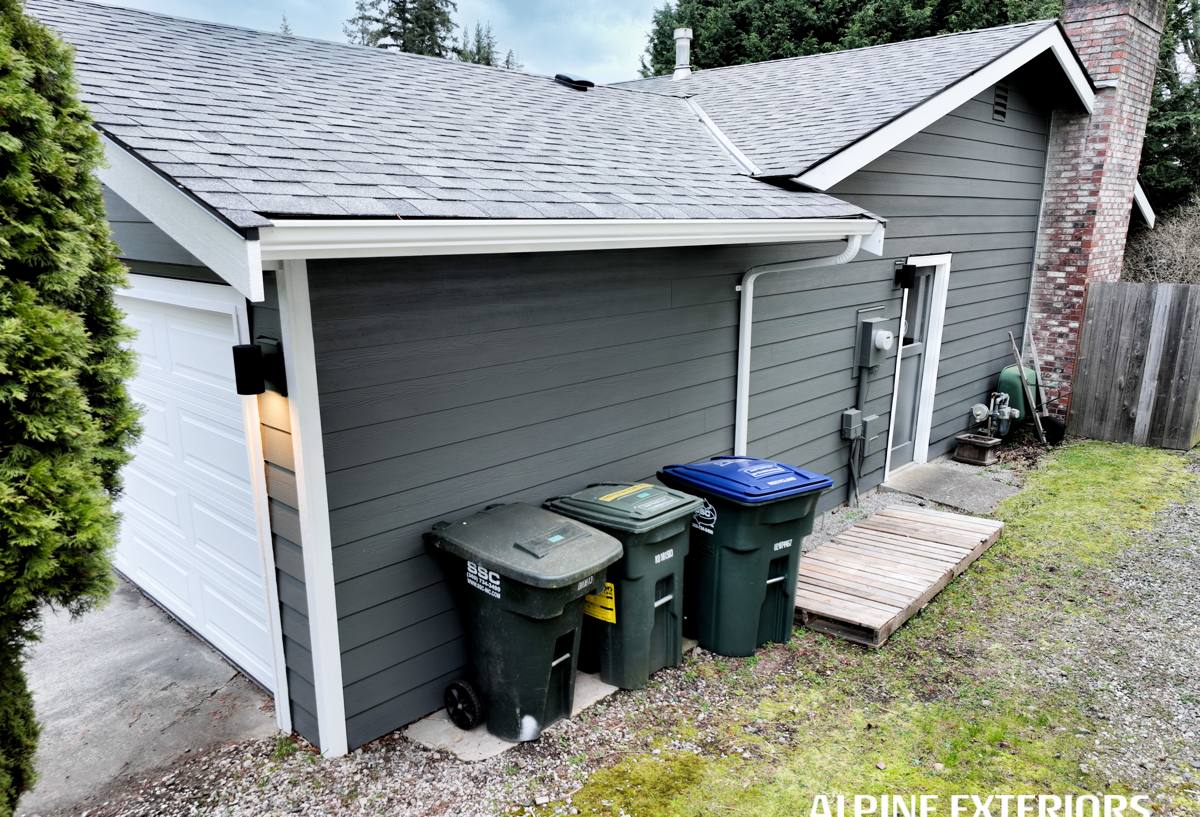
Why We Install Only James Hardie Fiber Cement
We don't install vinyl, LP SmartSide, cedar, primed spruce, or other fiber cement brands. That's not marketing — it's a standard we hold to because we've seen how each of those products actually performs in Whatcom County's wet, mossy conditions over years, not just in the first season. Vinyl can warp and its seams open up under repeated wet-dry cycling. Engineered wood products rely on a resin-treated strand board core that, once a seam or fastener point lets water in, starts to swell from the inside where you can't see it happening. Cedar and primed wood need a maintenance schedule most owners can't realistically keep up with in a climate this damp.
What Fiber Cement Does Differently
James Hardie siding is made from cement, sand, and cellulose fiber, pressed and cured into a plank that doesn't have an organic core to rot and isn't a petroleum-based product that softens or gets brittle with temperature swings. It won't feed moss the way wood fiber does, it holds paint and factory finish far longer because the substrate itself is dimensionally stable, and it's rated non-combustible. None of that makes it maintenance-free, but it removes the biggest failure points we see on older Deming homes.
What a Correct Installation Actually Involves
Fiber cement siding is only as good as the installation underneath it. A rushed or generic install on a house in this climate will fail years before it should, no matter how good the product is. Here's what we won't skip.
Weather Barrier and Flashing First
Before a single piece of siding goes up, the house needs a continuous weather-resistant barrier with properly lapped and taped seams, correctly integrated flashing at every window, door, and roofline intersection, and drainage space where the siding meets grade or a horizontal surface. In a climate that gets driving rain from more than one direction, the water management behind the siding matters more than the siding itself.
Fastening, Gaps, and Clearances
James Hardie publishes specific fastener schedules, minimum clearances above grade, roofing, and decks, and required gaps at butt joints and trim. Skipping these — nailing too close to an edge, butting panels tight with no expansion gap, running siding down to touch a deck or path — is how you get cracked planks and moisture intrusion within a few years, even with the right material.
Caulk and Sealant Choices
Not every sealant is rated for the movement and moisture cycling this climate puts it through. We use products matched to Hardie's own specifications at every joint, not whatever's cheapest at the time, because a failed bead of caulk at a butt joint is one of the most common entry points for water we find on older jobs.
Choosing the Right Hardie Line and Profile
James Hardie makes several plank profiles and product lines, and the right choice depends on the house, not just the budget. HardieZone HZ5 products are engineered for climates like ours — freeze-thaw cycling combined with sustained moisture — and that's the line we spec for Deming and Sudden Valley homes.
| Profile | Exposure / Look | Where It Fits Best |
|---|---|---|
| HardiePlank Lap Siding | Traditional horizontal lap, several exposure widths | Most single-family homes; the standard choice |
| HardieShingle | Staggered or straight-edge shingle look | Accent gables, dormers, craftsman-style detailing |
| HardiePanel | Vertical panel with battens | Modern or farmhouse-style facades, accent walls |
| HardieTrim | Smooth or woodgrain trim boards | Corners, window and door surrounds, fascia |
ColorPlus factory finish is worth the upgrade on almost every job in this climate. It's baked on under controlled conditions rather than field-applied, which means better adhesion and a longer color life than site-painted siding standing up to years of damp, low-light weather.
The Warranty You're Actually Buying
James Hardie backs its fiber cement siding with a substrate warranty measured in decades, not years, plus a separate finish warranty on ColorPlus factory-applied color that covers fading and peeling far longer than a field-applied paint job typically holds up in this climate. Both are transferable if you sell the house within the coverage window, which matters in a market where siding condition shows up in a home inspection. What most homeowners don't realize is that warranty coverage is tied to installation meeting Hardie's specifications — fastening, clearances, flashing — done by a certified installer. A warranty is only worth what's actually enforceable, and that depends on the install being documented and done correctly, not just on which brand of board went up on the wall.
What a Deming Siding Project Costs
Every house is different, but the line items that move the number are consistent. We'll walk through all of these during a free estimate rather than quoting a number over the phone.
| Cost Factor | Why It Matters Here |
|---|---|
| Tear-off and disposal | Removing existing siding, especially wood or vinyl hiding water damage underneath |
| Sheathing and barrier repair | Rot from prior moisture intrusion is common on older homes and has to be fixed before new siding goes on |
| House size and story count | More square footage and scaffolding/lift access on multi-story walls |
| Trim and detail complexity | Gables, dormers, and multiple roof intersections all add flashing and cutting time |
| Product line and finish | ColorPlus factory finish vs. field-painted, plank vs. shingle accents |
As a broad range, full siding replacements on houses this size typically land in the mid five figures, with smaller jobs and accent work costing less. The only way to get a real number is to have someone walk the house and look at what's underneath the existing siding, since hidden moisture damage is what usually moves a quote up from the initial estimate.
Our Process, Start to Finish
We keep the same process for every Deming and Sudden Valley job:
- Walk the exterior and identify existing moisture damage, rot, or failed flashing before quoting anything
- Confirm the weather barrier plan and flashing details specific to that house's roofline and window layout
- Provide a written scope covering product line, profile, finish, and every area of trim and detail work
- Remove old siding and repair any sheathing or framing damage found underneath — not paper over it
- Install weather barrier, flashing, and Hardie siding to manufacturer fastening and clearance specifications
- Walk the finished job with the homeowner before calling it done
Why a Crew That Already Works This Area Matters
A lot of siding problems in Whatcom County trace back to installation habits that work fine in a drier climate and fail here. A crew that already works Deming and Sudden Valley knows to plan around the driving rain pattern, knows which flashing details actually stop water on the roof-to-wall intersections common in this area, and isn't guessing at how much clearance a plank needs above grade in ground that stays damp for months. That local repetition is what keeps small oversights from turning into callbacks two winters later.
Working this area regularly also means knowing which weeks tend to give a long enough dry stretch to tear off and dry-in a house without gambling on the forecast, and which roof-to-wall details show up again and again on homes in this specific area. It means we've already seen how the shade and dampness around the lake and surrounding tree cover affect a house differently than a home on an open, wind-exposed lot a few miles away. None of that comes from a product manual — it comes from doing this work here, repeatedly, and paying attention to what actually holds up.
Living With Hardie Siding in a Wet, Mossy Climate
Even the right product installed correctly still needs basic upkeep in this climate. That means an annual rinse to keep moss and algae from establishing on north-facing walls and anywhere shaded by trees, checking caulk lines at butt joints and trim every year or two, and keeping gutters and downspouts clear so water isn't sheeting down a wall it was never meant to run down. None of that is heavy maintenance — it's the difference between siding that looks good at year fifteen and siding that needed attention at year five.
If you're weighing a siding project on a Deming or Sudden Valley home, we're happy to come take a look, tell you honestly what condition your current siding and sheathing are in, and put together a written estimate — no pressure, no obligation.