 Sudden Valley Siding
 Deck Building in Fairhaven Is Not a Generic Job
Fairhaven sits close enough to Bellingham Bay that salt air is part of daily life, and that changes what a deck needs to survive. Add in Whatcom County's long wet season — driving rain off the water for months at a stretch, followed by a moss season that can run from fall clear into spring — and you've got a set of conditions that punishes decks built to a generic, one-size-fits-all spec. A deck that would hold up fine in a dry inland climate can start showing fastener corrosion, soft spots, and slick moss growth within a couple of seasons out here if it wasn't built with this specific environment in mind.
We're a Whatcom County exterior crew based out of Sudden Valley, and deck building for us runs on the same weatherproofing logic we use on siding and trim: water and salt air are the enemy, and every material and fastening choice either fights them or feeds them. This page is about what that actually looks like for a deck built to hold up in the Fairhaven area specifically.
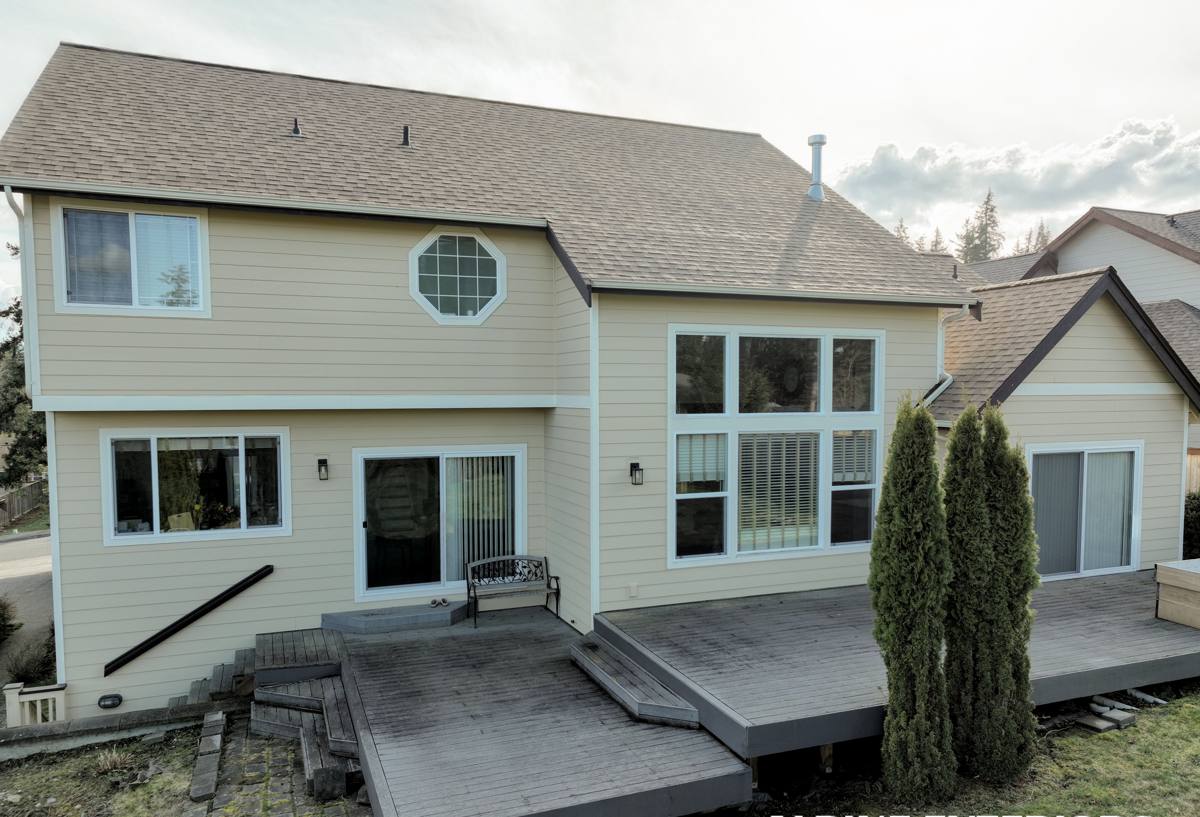
What Salt Air and Moss Actually Do to a Deck
It helps to understand the failure modes before talking about how to prevent them.
Salt Air and Metal
Airborne salt accelerates corrosion on any exposed metal — fasteners, joist hangers, post bases, railing brackets. Standard galvanized hardware can start rusting and staining the wood around it well before the deck itself is worn out. Once a fastener corrodes, it loses holding strength, and a deck is only as sound as the connections holding the frame together.
Moss, Algae, and Trapped Moisture
Long wet seasons mean surfaces that don't dry out quickly stay damp for weeks at a time. That's exactly what moss and algae need to take hold, and it's not just cosmetic — moss holds moisture against the decking surface, which speeds up wood decay underneath it and turns boards slick and dangerous underfoot, especially on stairs and shaded sections of a deck.
Driving Rain and End-Grain Exposure
Rain that comes in sideways off the bay finds every gap, seam, and exposed board end. Cut ends and drilled holes are where wood soaks up water fastest, so how a deck is cut, sealed, and assembled matters as much as what it's built from.
Choosing the Right Decking Material for This Climate
There's no single "best" decking material — every option is a trade-off between upfront cost, maintenance, and how it handles this specific climate. Here's how the common choices compare for a Fairhaven-area deck:
| Material | Upfront Cost | Maintenance | Performance in Salt Air / Moss |
|---|---|---|---|
| Pressure-Treated Pine | Lowest | Needs periodic staining/sealing | Decent if maintained; fasteners are the weak point |
| Western Red Cedar | Mid-range | Regular oiling to prevent graying and moss | Naturally rot-resistant but softer surface can hold moss if neglected |
| Composite / PVC Decking | Highest | Occasional washing, no staining or sealing | Very good; doesn't absorb moisture the way wood does, resists moss staining |
We'll walk you through this trade-off honestly during an estimate rather than pushing whatever has the best margin. A lot of Fairhaven homeowners land on composite decking for the low-maintenance side of the equation, but a well-built cedar deck with a realistic maintenance plan is still a solid, honest choice — it just requires you to actually keep up with the oiling schedule in a climate that's hard on unsealed wood.
Fasteners and Hardware Matter as Much as the Decking Itself
Whatever decking material you choose, we use stainless or coated fasteners and hardware rated for coastal exposure, not standard-grade galvanized. It costs a little more upfront and it's the difference between hardware that lasts and hardware that starts staining and weakening within a few years.
Framing, Fasteners, and Footings — The Part You Don't See
A deck's surface gets all the attention, but the framing underneath it is what actually determines how long the structure lasts and how safe it stays.
- Footings set below frost depth and sized for the soil conditions on the lot, not just poured to a minimum code guess
- Joists and beams sized for the actual span and load, not the smallest allowed spec
- Corrosion-resistant hardware at every structural connection — hangers, post bases, ledger bolts
- A proper ledger board flashing detail where the deck attaches to the house, so water can't get behind the siding
- Air gaps and spacing that let the frame dry out between rain events instead of staying damp
That ledger connection deserves its own mention. It's one of the most common failure points on decks in wet climates — if water gets behind the ledger board and into the house's wall framing, you end up with rot that's expensive to fix and easy to miss until it's serious. We flash that connection the same way we'd flash a window or door opening on a siding job, because it's the same problem with the same consequences.
Drainage, Airflow, and Moss Control by Design
Moss control isn't something you bolt on after the deck is built — it starts with design decisions.
Board Spacing and Airflow
Proper gapping between boards lets water drain through instead of pooling on the surface, and it lets air move underneath the deck so the frame and the underside of the decking can actually dry out between storms.
Grading Underneath
Ground-level decks need the soil underneath graded to shed water away from the footings rather than letting it pool and stay wet season after season, which is exactly the environment moss and rot both prefer.
Shade and Orientation
We can't move the sun, but we can flag which sections of a deck will stay shaded most of the day during the design conversation, since those are the spots that will need more frequent cleaning or a different surface treatment to stay moss-free.
Our Deck Building Process
The process is straightforward, and we don't skip steps to save time:
- Free on-site estimate — we look at the lot, the grade, sun exposure, and how the deck will tie into the house before quoting anything
- Design and material selection — sizing, layout, and an honest walkthrough of material trade-offs for your budget and how much upkeep you want to do
- Permitting — most decks require a building permit depending on height and size; we handle that paperwork as part of the job
- Footings and framing — the structural work that determines everything else, built to the spans and hardware discussed above
- Decking, railing, and finish work — installed with attention to fastener placement, spacing, and end-cut sealing
- Final walkthrough — we go over the finished deck with you, including what maintenance it'll need and when
Permits and Local Considerations
Fairhaven falls within the City of Bellingham, and deck projects there typically go through the city's permitting process, with additional considerations if a property is close to a slope, the shoreline, or has other site-specific factors. Whatcom County properties outside city limits go through the county instead. We sort out which applies to your project and handle the permit application so you're not the one chasing down paperwork or guessing whether an inspection is required.
Keeping a Fairhaven Deck Healthy Season to Season
A well-built deck still needs some seasonal attention in this climate. A simple checklist we give homeowners:
- Sweep debris off the deck regularly, especially in fall when leaves and needles trap moisture against the boards
- Rinse or lightly scrub moss and algae off the surface before it builds up, particularly in shaded corners and on stairs
- Check railing connections and fastener heads once a year for early rust staining or looseness
- Re-oil or re-seal wood decking on the schedule recommended for that specific product — don't wait until it looks gray and dry
- Keep gutters and downspouts near the deck clear so runoff isn't dumping extra water onto or under the structure
- Confirm the gap under the deck stays clear of stored items or dense plant growth that block airflow
Why a Crew That Already Works This Neighborhood Matters
Building a deck that holds up to salt air, driving rain, and a long moss season isn't complicated, but it does require actually accounting for those conditions in the material choices, the hardware, and the framing details — not just following a generic deck spec and hoping it holds. We build decks in this environment regularly, which means the fastener grade, the ledger flashing, and the drainage details aren't afterthoughts; they're standard practice because we've seen what happens when they're skipped.
If you're planning a new deck or need an honest look at whether an existing one is holding up the way it should, we're glad to come take a look. The estimate is free, there's no pressure, and you'll get a straight answer about what your project actually needs.