 Sudden Valley Siding
 Why Deming's Climate Is Hard on Siding
Deming sits in the Nooksack River valley, wrapped in dense evergreen cover and shadowed by the foothills that run up toward Mount Baker. That setting is beautiful, but it's rough on the outside of a house. Tree canopy keeps siding damp long after a storm has passed, valley air holds moisture close to the ground overnight, and the same driving rain that rolls through the rest of Whatcom County hits Deming homes at an angle, driven by wind funneling through the valley. Add in a moss season that can run from fall through spring, and you've got a wall assembly that rarely gets a real chance to dry out.
Homes closer to Bellingham Bay deal with salt-laden air working at fasteners, trim, and paint film. Out here in Deming that salt exposure is lighter, but the underlying problem is the same one that shows up all over the county in different forms: constant moisture cycling. Siding that can't handle sustained dampness — through absorption, swelling, or trapped water behind the cladding — fails early, and it usually fails from the inside out, which means the damage is well underway before anyone sees it from the driveway.
What This Means for a Homeowner
Practically, it means three things matter more in Deming than in a drier climate: the material itself has to resist moisture absorption, the installation has to manage water intentionally rather than just shed it, and the finish has to survive years of shade, mildew pressure, and moss growth without chalking or peeling. Get any one of those wrong and you're repainting, patching, or replacing siding well ahead of schedule.
Why We Install Fiber Cement — and Only James Hardie
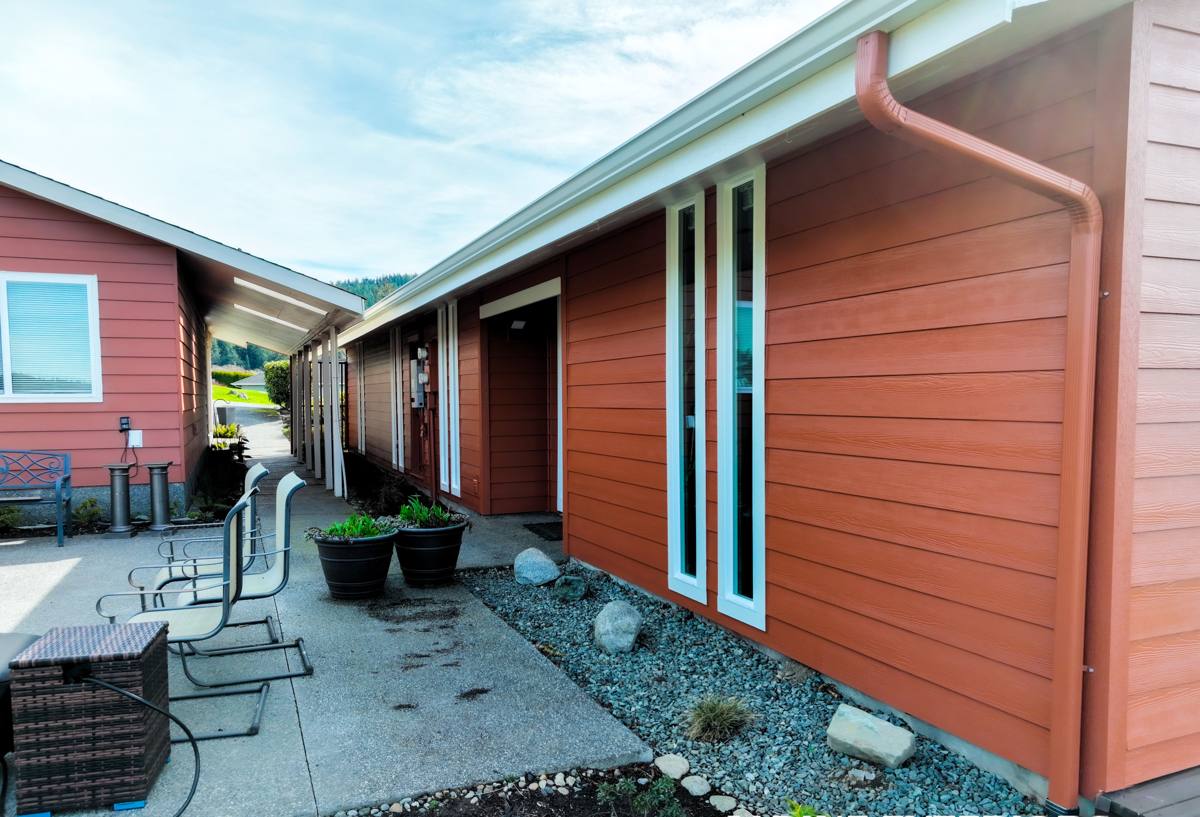
Fiber cement is cement, sand, and cellulose fiber pressed and cured into a dense, stable board. It doesn't absorb water the way wood does, it doesn't expand and contract the way vinyl does in temperature swings, and it's non-combustible — a genuine advantage anywhere close to Whatcom County's wooded interior. That combination is why it's become the standard material for homes that need to hold up in a wet, wooded climate without constant upkeep.
We install James Hardie products exclusively. We don't carry LP SmartSide, vinyl, Cemplank, Allura, or bare cedar or spruce siding, and we're upfront about why. Engineered wood products like LP SmartSide use a resin-treated wood strand core — better than raw wood, but still wood, and still vulnerable if water gets behind it or a seal fails. Vinyl is inexpensive and low-maintenance in the right setting, but it's a thin plastic product that can crack in a hard freeze, deform in heat, and simply isn't built to compete on longevity or fire performance. Other fiber cement brands may look similar on a spec sheet, but we've standardized on Hardie because of the factory-applied ColorPlus finish, the climate-specific HZ5 formulation engineered for wetter regions, and a warranty structure that's been consistent and transferable for decades. When we put our name behind an install, we want the product underneath it to be one we trust completely.
What a Correct Fiber Cement Install Actually Involves
Fiber cement siding is only as good as the assembly it's installed into. A huge share of the siding failures we see on older homes in this area aren't material failures — they're installation failures. Here's what has to happen for the siding to actually perform the way it's designed to:
- Full tear-off and substrate inspection — old siding comes off, and the sheathing underneath gets checked for rot, soft spots, or existing water damage before anything new goes up.
- Weather-resistive barrier — a continuous, properly lapped moisture barrier goes over the sheathing, with every seam and penetration sealed.
- Rainscreen gap — in a climate like Deming's, a drainage gap behind the siding lets bulk water and trapped humidity escape instead of sitting against the back of the board.
- Correct flashing at every penetration — windows, doors, hose bibs, light fixtures, and vents all need step or head flashing that directs water out and down, never into the wall.
- Manufacturer-spec fastening — proper fastener type, spacing, and penetration depth, following James Hardie's published installation guidelines rather than shortcuts.
- Correct joint and butt-seam treatment — sealed or shiplapped per Hardie spec so seams don't become entry points for water.
- Factory-cut edges protected — any field-cut edge gets primed or sealed so raw fiber cement isn't left exposed to moisture.
Skip any one of these steps and you can still end up with a house that looks like it has "good siding" on it while water is quietly working its way into the wall cavity behind it. That's the gap between installing a product and installing a system.
James Hardie Product Lines for Deming Homes
Hardie makes several profiles, and the right one depends on the house style and how exposed a given wall is to weather:
| Product | Best Use | Notes for Deming's Climate |
|---|---|---|
| HardiePlank lap siding | Most homes, traditional lap look | Available in HZ5 formulation engineered for wetter, colder climates like ours |
| HardiePanel vertical siding | Modern facades, accent walls, gables | Fewer horizontal joints for water to track along |
| HardieShingle | Craftsman or cottage-style homes | Staggered or straight-edge shingle profile with the same moisture resistance |
| HardieTrim | Corner boards, window and door trim, fascia | Matches the siding's durability so trim doesn't become the weak point |
All of it can come with the factory-applied ColorPlus finish, which is baked on under controlled conditions rather than field-painted. In a shaded, damp environment like Deming, that matters — a factory finish resists the mildew and fading that field-applied paint tends to show first, and it carries its own finish warranty separate from the substrate warranty.
How Our Process Works
1. On-Site Assessment
We walk the exterior with you, look at the existing siding, check for signs of trapped moisture or rot at trim and penetrations, and talk through which Hardie profile fits the house.
2. Written Scope and Estimate
You get a clear, itemized estimate — product line, quantities, trim work, and what the tear-off and disposal includes. No vague allowances.
3. Tear-Off and Substrate Repair
Old siding comes off, sheathing gets inspected, and any soft or water-damaged wood is repaired or replaced before we move forward. We don't install new siding over a compromised substrate.
4. Barrier, Rainscreen, and Flashing
This is the stage that determines whether the house stays dry for the next 30 years. It's also the stage that's invisible once the siding goes up, which is exactly why it has to be done right the first time.
5. Installation to Manufacturer Spec
Siding, trim, and flashing go up following James Hardie's fastening and clearance requirements, including proper ground clearance and roofline clearance for this region's rain and snow load.
6. Final Walkthrough
We go around the house with you, check seams, caulking, and trim, and answer any questions about care before we consider the job finished.
Cost Factors for a Deming Fiber Cement Project
Every house is different, so a real number only comes from an on-site estimate, but the same factors move the price on almost every project in this area:
| Factor | How It Affects Cost |
|---|---|
| Tear-off complexity | Multiple layers of old siding or extensive rot repair adds labor before install even starts |
| Home shape and trim detail | More corners, gables, and window/door openings mean more cutting and flashing |
| Product line and profile | Panel vs. lap vs. shingle profiles carry different material and labor costs |
| Access and site conditions | Steep driveways, tree cover, or tight lot lines common in Deming can affect staging and scaffolding |
| Color and finish | Factory ColorPlus finishes cost more up front than primed board but eliminate a future paint job |
Living With Fiber Cement in a Moss-Prone Climate
Fiber cement is low-maintenance compared to wood, but "low-maintenance" isn't "no-maintenance" — especially under tree cover. A few habits go a long way toward getting the full lifespan out of the material:
- Rinse siding once or twice a year to keep organic growth from establishing, especially on north-facing and shaded walls.
- Keep gutters clear so overflow doesn't run down the face of the siding.
- Trim back branches and shrubs that keep siding shaded and damp longer than the rest of the house.
- Check and re-caulk joints around windows, doors, and trim every few years — caulk fails before the siding does.
- Have any impact damage or nail pops repaired promptly rather than left to become a water entry point.
Why It Matters That We Already Work in Deming
A crew that regularly works this part of Whatcom County already knows what tends to go wrong on homes out here — where moss builds up fastest, which wall orientations take the worst of the driving rain, and how the valley's damp microclimate differs from a job in town. That familiarity shows up in small decisions during install: where extra flashing attention pays off, how much rainscreen gap actually makes sense given the tree cover, and what maintenance advice is worth giving versus what's boilerplate. It also means straightforward logistics — material delivery, scheduling, and follow-up don't depend on someone driving in from outside the area for the first time.
We also stand behind the work with the same standard on every Deming project: correct substrate prep, correct water management, and a Hardie product installed to spec — not a rushed re-clad that looks fine until the first wet winter finds the gaps.
Questions Worth Asking Before You Hire Anyone
- Will you inspect and repair the sheathing before installing new siding, or install over what's there?
- What weather-resistive barrier and rainscreen approach do you use, and why?
- Are you a certified or experienced James Hardie installer, and can you explain their fastening spec?
- What's included in the written estimate — trim, flashing, disposal, cleanup?
- What does the warranty actually cover, and is it transferable if you sell the home?
If your Deming home needs new siding, we're happy to take a look and give you a straight answer on what it needs and what it'll cost — no pressure, no upsell. Reach out for a free estimate using the form below.