 Sudden Valley Siding
 Why Happy Valley Decks Face a Tougher Job Than Most
A deck in Happy Valley isn't just an outdoor platform — it's a structure that has to stand up to everything Whatcom County weather throws at it, year after year. Between the moisture rolling off Lake Whatcom, the salt-tinged air that drifts inland from the Sound, and stretches of driving rain that can last for days, this is not a climate that forgives shortcuts. Add in a moss season that can run from early fall through late spring, and you've got a combination that punishes any deck built with generic, one-size-fits-all methods.
We've built and repaired decks across Sudden Valley long enough to know exactly where things go wrong. It's rarely the decking boards themselves that fail first — it's the framing underneath, the fasteners holding it together, and the places where water gets trapped instead of draining away. A deck built for a dry-summer climate somewhere else simply isn't built for what happens here.
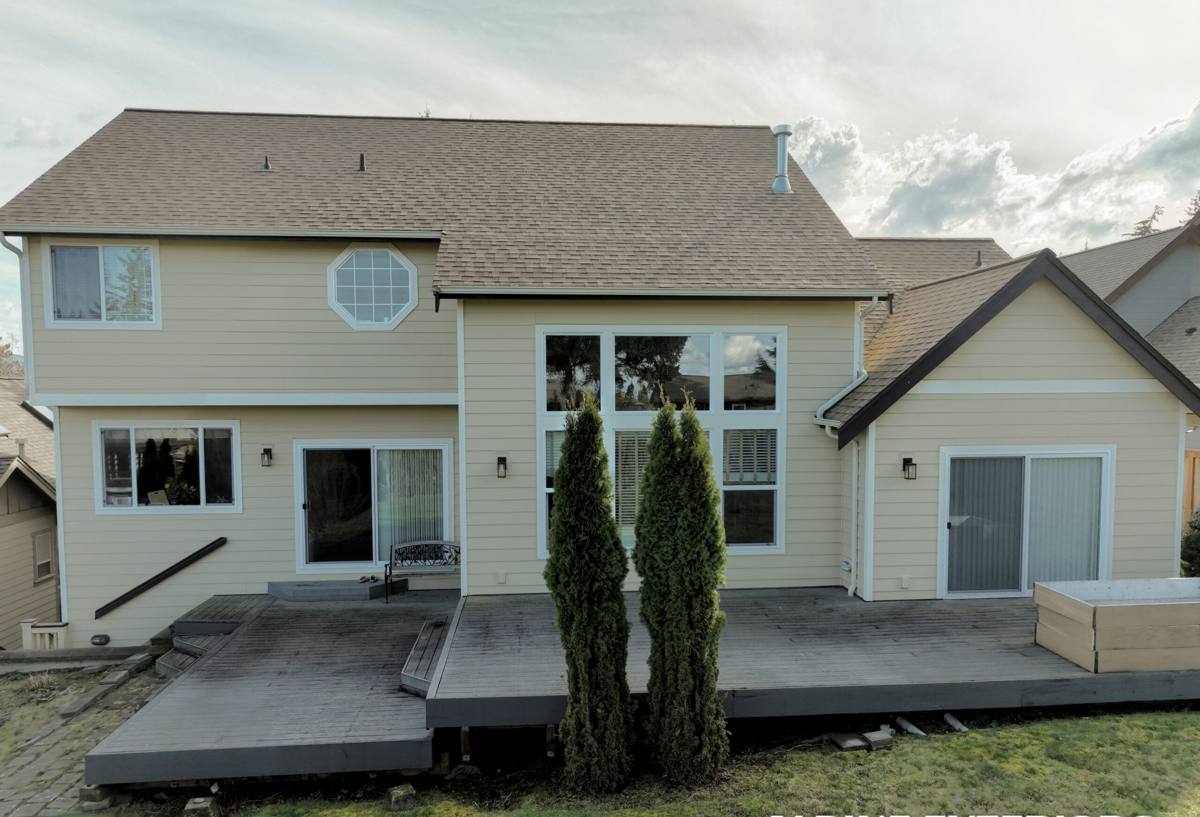
What "Built Right" Actually Means Here
A correctly built deck for this area starts with decisions most homeowners never see: footing depth, joist spacing, ledger attachment, and how water is directed off every horizontal surface. Get those wrong and you won't notice for a year or two — but you'll notice eventually, usually as soft spots, rust streaks, or a railing that's gone spongy at the post base.
The Non-Negotiables
- Footings poured below the frost line and sized for the actual load, not the minimum code allows
- Joist spacing tight enough to prevent bounce and premature board wear
- A ledger board properly flashed and separated from the house sheathing, not just lag-bolted and caulked
- Fasteners and hardware rated for ground contact and coastal-adjacent moisture exposure
- Decking gaps sized to shed water and debris instead of trapping them
None of this is exotic. It's just done consistently, every time, instead of skipped when nobody's looking.
Choosing Materials That Actually Hold Up to Moss Season
Every decking material on the market will look good on installation day. The real test is how it performs after five winters of standing water, shade, and moss spores looking for a foothold. There's no universally "best" material — it depends on how much upkeep a homeowner actually wants to do and what budget they're working with.
| Material | Moss & Moisture Behavior | Maintenance Needed | Typical Lifespan Here |
|---|---|---|---|
| Pressure-treated wood | Absorbs moisture, needs airflow underneath to dry out between rains | Annual cleaning, re-staining every 2–3 years | 10–15 years with upkeep |
| Cedar or other natural wood | Naturally rot-resistant but still needs sealing to resist mildew staining | Cleaning plus sealant every 1–2 years | 15–20 years with diligent care |
| Composite decking | Doesn't absorb water into the board, but surface film and grain grooves can hold moss if not cleaned | Periodic washing, no staining or sealing | 20–25+ years, varies by product line |
| PVC decking | Sheds water well, least prone to organic growth on the surface | Lowest — occasional rinse | 25+ years |
We'll walk through this table honestly with every homeowner. Wood costs less upfront but asks for real annual attention in a climate like this — skip a year of maintenance and moss gets a head start that's hard to undo. Composite and PVC cost more initially but trade ongoing labor for a higher purchase price. Neither choice is wrong; it depends on whether you'd rather spend a weekend a year with a scrub brush or spend more at the outset.
Our Standard on Product Selection
We don't install every product on the market. If a decking line has a track record of trapping moisture in its grooves, or a warranty structure that puts the burden of proof on the homeowner after a failure, we'll say so plainly and steer toward something with better moisture behavior and a cleaner warranty. That's a professional judgment call on our part, not a knock on any single manufacturer — it's about matching the product to this specific climate.
The Structural Work You Won't See — But Will Eventually Feel
Framing is where a deck's real lifespan gets decided. In a high-moisture environment, the joists, beams, and posts underneath the decking are doing all the actual work, and they're also the parts most exposed to standing water and slow rot if they're not detailed correctly.
Footings and Posts
Post bases need to sit above grade on proper hardware, not buried in soil or sitting directly on a slab where water collects. Footings need to be sized and set at a depth appropriate for the load and the local frost conditions, not just poured to the minimum code allows.
Ledger Attachment
The ledger board — where the deck ties into the house — is the single most common failure point we find on older or poorly built decks in this region. It needs proper flashing that directs water away from the house band board, plus a gap or drainage plane so moisture doesn't get trapped between the deck and the siding. A ledger that was just bolted on without flashing is a slow-motion problem, even if it looks fine for the first several years.
Fasteners and Hardware
Standard fasteners corrode faster in coastal-adjacent, high-moisture air. We use hardware rated for exterior and ground-contact exposure — stainless or coated fasteners at connection points that see the most water, and structural connectors instead of relying on nails or screws alone to carry structural loads.
Drainage: The Detail That Determines Whether Moss Takes Hold
Moss doesn't grow because of bad luck — it grows wherever moisture sits still. A deck built with proper slope, gapping, and under-deck airflow dries out between storms. One built flat, tight, or shaded without ventilation stays damp for days after every rain, and that's exactly the environment moss needs.
- Decking boards spaced and installed with a slight slope away from the house
- Enough gap between boards to let water and debris pass through rather than pool
- Under-deck skirting, if used, vented rather than sealed tight to the ground
- Gutter or downspout routing kept clear of the deck footprint so runoff isn't dumped directly underneath
On shaded or low-clearance decks — common in wooded areas around Sudden Valley — we sometimes recommend added ventilation gaps or a slightly higher deck elevation specifically to keep airflow moving underneath. It's a small design choice that makes a real difference by the third or fourth wet season.
Railings, Stairs, and Code Requirements
Railings and stairs are where safety code and weather durability intersect. Any deck more than a modest height off grade needs code-compliant railing height and baluster spacing, and stair stringers need to be sized to avoid flex over time. In this climate, railing posts are also a common moisture entry point if they're notched into the frame without flashing or sealant at the connection. We detail these connections the same way we detail the ledger — assuming water will find its way there eventually, and building so it can't get trapped.
Our Process, Start to Finish
We keep the process straightforward so homeowners know what to expect at each stage.
- On-site assessment — we look at grade, drainage patterns, sun exposure, and how the deck ties into the existing structure before recommending a design or material.
- Honest material walkthrough — we go over the trade-offs in the table above based on your budget and how much upkeep you want to take on.
- Permitting — we handle the permit process where required, sized correctly for footings, framing, and railings.
- Framing and structural work — footings, ledger flashing, joists, and hardware, done to hold up through repeated wet-dry cycles, not just pass a one-time inspection.
- Decking, railing, and stairs — installed with proper spacing and slope for drainage from day one.
- Final walkthrough — we go over basic care for whatever material you chose, so you know what upkeep actually looks like going into the first wet season.
A Realistic Maintenance Checklist for Local Conditions
Even the best-built deck needs some seasonal attention in this climate. Here's what actually matters:
- Clear leaves and debris from between boards before fall rains settle in
- Scrub visible moss or algae off the surface early, before it spreads into grooves or seams
- Check under-deck areas for standing water or blocked drainage paths at least once a year
- Inspect ledger flashing and post connections for gaps or deterioration every couple of years
- Re-seal or re-stain wood decking on the schedule appropriate to the product — don't wait until it's visibly gray or cracking
- Tighten or replace any corroding fasteners as soon as you spot rust staining
Why Hiring a Crew That Already Works Happy Valley Matters
A deck built by a crew unfamiliar with this specific mix of rain, humidity, and moss season is a deck built on assumptions from a different climate. We've seen what happens when ledger flashing gets skipped, when fastener choice doesn't account for the moisture here, or when a deck is built flat with no drainage plan. Those mistakes don't show up on installation day — they show up two or three winters later, and by then the fix is a lot more involved than it would have been to do it right the first time.
Working in Sudden Valley and the surrounding Whatcom County area day in and day out means we're not guessing at how a deck will perform here — we're building to conditions we deal with on every job. That's the difference between a deck that needs real work again in a decade and one that just needs the maintenance you'd expect.
If you're planning a new deck or need an honest look at one that's showing its age, we're happy to come take a look. Fill out the form below for a free, no-pressure estimate — we'll walk the site, talk through material options, and give you a straight answer on what your Happy Valley deck actually needs.