 Sudden Valley Siding
 Yew Street's Siding Problem Isn't What Most Homeowners Think
Homes along Yew Street and the surrounding Sudden Valley neighborhoods don't fail because of one big storm. They fail slowly, from months of low-grade dampness that never fully dries out between rain events. Whatcom County sits under a marine-influenced weather pattern most of the year: driving rain off Lake Whatcom, humid air pulling in from the coast, and short winter days that don't give wet siding much chance to dry before the next system rolls through. Add tree cover — common on Yew Street lots backing up to wooded slopes — and you get siding that stays shaded and damp longer than siding on an open, sun-exposed lot even a few streets over.
This is a moisture-and-organic-growth problem more than a wind-and-impact problem. The siding that holds up here is the siding that resists water absorption, doesn't feed mold and moss, and keeps its paint film intact through repeated wet-dry cycles year after year.
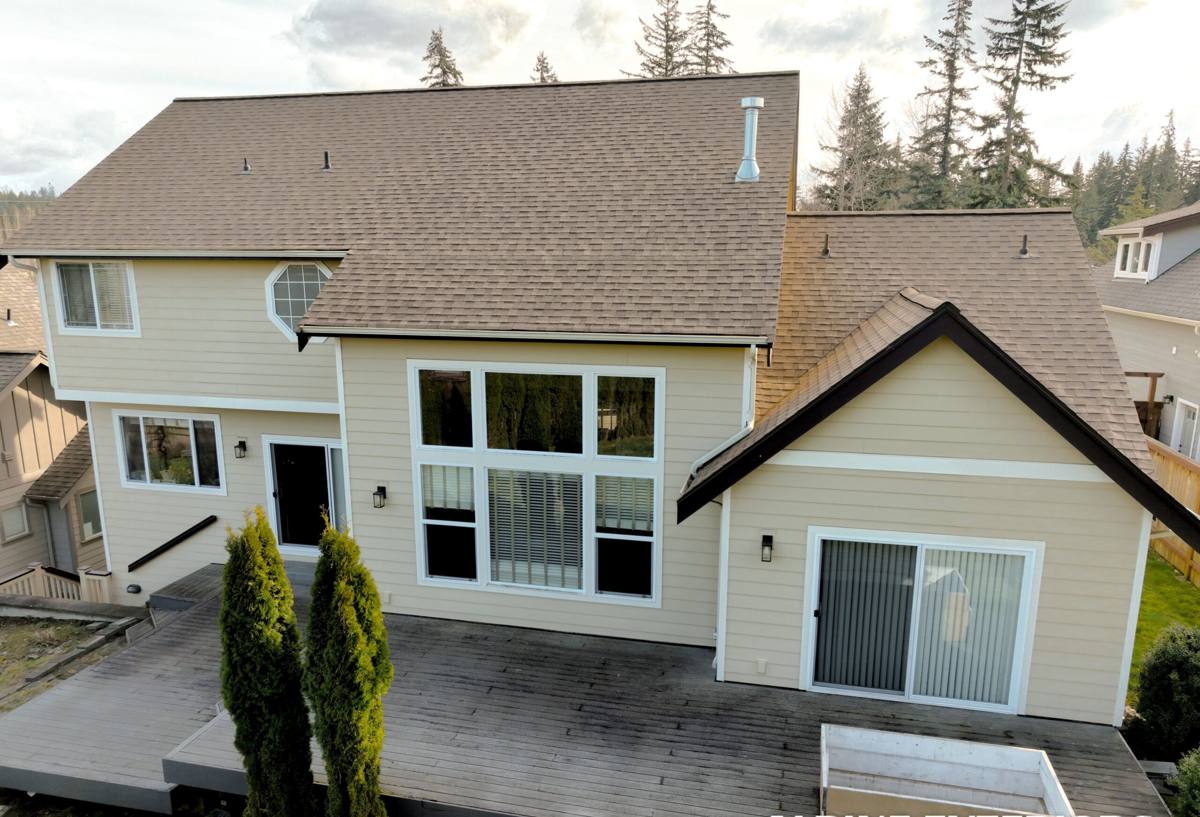
What "Salt Air, Driving Rain, and a Long Moss Season" Actually Does to Siding
Moisture Load
Wood-based siding products — cedar, primed spruce, and engineered wood like LP SmartSide — are wood at their core. Wood swells when it absorbs water and shrinks as it dries. Do that enough times in a Whatcom County winter and you get warping, joint separation, and eventually rot at the bottom courses, corners, and anywhere caulk has started to fail. Even well-maintained wood siding needs recaulking and repainting on a schedule most homeowners underestimate.
Moss and Algae
Shaded, damp siding is exactly what moss and algae need to take hold. Once organic growth establishes itself on a porous or textured surface, it holds moisture against the substrate and accelerates whatever decay process is already underway. Pressure washing removes the surface growth but does nothing for water that's already worked its way into seams and end cuts.
Salt-Tinged Air
Sudden Valley isn't oceanfront, but the broader Puget Sound and Bellingham Bay air carries enough salt influence to accelerate corrosion on fasteners and metal trim, and it adds to the general moisture burden on any exterior material. Combined with driving rain that hits west- and south-facing walls directly, the wall assembly is under near-constant low-level stress.
Why We Install James Hardie and Nothing Else
We standardized this company on James Hardie fiber cement siding, full stop. We don't install vinyl, LP SmartSide, Cemplank, Allura, primed spruce, or cedar — not because those products don't have a place somewhere, but because after years of servicing homes in this specific climate, Hardie is the only siding system we're willing to put our name behind here.
- Fiber cement composition: Hardie board is cement, sand, and cellulose fiber — it doesn't rot, and it isn't a food source for moss, algae, or insects the way wood-based products are.
- Non-combustible: It carries a noncombustible rating, which matters in Washington's wildfire-aware insurance environment even on the wetter west side of the state.
- ColorPlus factory finish: The color is baked on in a controlled factory process rather than field-applied, which gives a more consistent, longer-lasting finish than job-site painted wood siding — especially relevant when repainting means renting scaffolding on a wooded Yew Street lot.
- HZ5 engineering for this region: Hardie's HZ10 product line is engineered for the Pacific Northwest's moisture exposure specifically, not a generic all-climate spec.
- Transferable warranty: A real, documented warranty on both the substrate and the finish, which follows the house if it sells.
We're honest about the trade-off: Hardie board is heavier, requires specific fastening and clearance details, and costs more upfront than vinyl or engineered wood. We think that cost is the correct trade for a material that isn't fighting a losing battle against moisture from day one.
What a Correct Hardie Installation Involves on a Lot Like This
The material is only half the equation. Most siding failures we get called out to inspect — regardless of brand — trace back to installation shortcuts, not product defects. On shaded, moisture-heavy lots like much of Yew Street, these details matter more than average:
Clearance and Drainage
Hardie's own installation instructions call for minimum clearances from grade, roofing, and decking — typically 6 inches from soil and 2 inches from horizontal surfaces like roofs and decks. On sloped, wooded lots where grading isn't always straightforward, we adjust flashing and clearance details rather than forcing a standard reveal that traps water against the bottom course.
Rainscreen or Proper Weather Barrier Drainage
Given the volume of driving rain this area sees, we pay close attention to how water that gets behind the siding is meant to escape — correct WRB (weather-resistive barrier) lapping, flashing at every penetration, and drainage at the bottom of the wall assembly rather than relying on the siding alone to keep water out.
Fastening
Corrosion-resistant fasteners, correctly set (not overdriven, not underdriven), at the spacing Hardie specifies. Overdriven nails crack the board's fiber cement edge and create a moisture entry point that shows up as a problem years later, not on move-in day.
Caulking and Sealant Joints
Panel and trim joints get a quality sealant rated for exterior exposure, tooled properly rather than smeared on as an afterthought. This is one of the most commonly rushed steps on lower-bid jobs.
Painted Cut Edges
Every field-cut edge of Hardie board gets sealed with Hardie-approved touch-up or edge sealer before installation. An unsealed cut edge is the one spot on an otherwise moisture-resistant board where water can wick in.
Our Process for a Yew Street Project
- On-site assessment: We look at your specific exposure — how much of the wall is shaded, where water currently sheds off the roofline, and whether existing siding shows signs of moss, staining, or soft spots that indicate trapped moisture.
- Tear-off and sheathing check: Once old siding is off, we inspect sheathing and framing for hidden rot before anything new goes up. This is often where a "just re-side it" job turns into a "we found a problem" conversation — better to find it now than in five years.
- Weather barrier and flashing: Correct WRB installation and flashing at windows, doors, and penetrations, sequenced so water always drains outward, never behind the barrier.
- Hardie installation: Product installed to manufacturer spec — clearances, fastening, joint treatment — by crews who've done this specific climate's details repeatedly, not for the first time.
- Final inspection and walkthrough: We check reveals, caulk lines, and trim before calling the job done, and walk the exterior with you.
Why a Crew That Already Works This Neighborhood Matters
Siding installation isn't one-size-fits-all across Whatcom County. A crew that mostly works drier, more open sites doesn't always adjust their habits for a shaded, sloped Yew Street lot with heavier moss pressure and longer drying times. Familiarity with this specific microclimate — how much clearance to leave, where extra flashing attention pays off, which wall orientations take the worst of the driving rain — comes from doing the work here repeatedly, not from a generalized installation manual alone.
We also know what Sudden Valley homes tend to look like from the inside of a siding job: original wood siding from decades back, some past patch-and-paint work, and roofline details that don't always match current best practice. Knowing what we're likely to find before we tear into a wall lets us plan the job more accurately and avoid change-order surprises.
Cost Factors to Understand Before You Get a Quote
| Factor | Why It Moves the Price |
|---|---|
| Tear-off condition | Rotted sheathing found underneath old siding adds repair cost not visible from the outside |
| Wall complexity | Dormers, multiple gables, and cut-ins around windows and trim increase labor time |
| Siding profile chosen | Lap width, shingle-style panels, and board-and-batten each have different material and labor costs |
| Trim and accessory scope | Corner boards, window trim, and fascia work done at the same time affects total project cost |
| Site access | Sloped, wooded lots with limited staging area can add setup and material-handling time |
| Color and finish | Standard ColorPlus colors versus custom field-painted finishes carry different costs |
We don't quote off a phone call for this reason — an accurate number requires seeing the actual walls, the actual access, and what's likely underneath the existing siding.
Signs Your Yew Street Home May Need Attention Now
- Moss or dark staining that returns quickly after cleaning, especially on north- or west-facing walls
- Paint that's peeling, bubbling, or chalking rather than just fading evenly
- Soft or spongy spots when you press on siding near the bottom courses or under windows
- Visible gaps opening up at panel joints or corner boards
- Caulk that's cracked, shrunk, or pulled away from joints
- A musty smell near exterior walls inside the home, which can indicate moisture intrusion
If you're on Yew Street or elsewhere in Sudden Valley and want a straight answer about what your siding needs — whether that's a full replacement or just a smaller repair — we'll come take a look and give you a free, no-pressure estimate.