 Sudden Valley Siding
 Why Lake Whatcom Homes Wear Out Their Siding Faster Than Most
Homes around Lake Whatcom take a different kind of beating than a house ten miles inland. You've got moisture coming from two directions at once: the lake itself, which keeps humidity high on the water-facing side of a home for most of the year, and the marine air rolling in off the Salish Sea through Whatcom County, which carries a fine salt content that settles on exterior surfaces and never fully rinses off in our rain. Add in driving rain that comes sideways during winter storms, and a moss season that can run six to eight months in shaded, north-facing yards, and you have an exterior envelope that's under near-constant pressure.
Siding that isn't built for this combination shows it early. Vinyl gets brittle and cracks at the seams faster near the water. Wood-based products swell, hold moisture in the fiber, and give moss a foothold in the grain. Caulk joints fail sooner because they're wet more often than they're dry. If you own a home in or near Sudden Valley, the siding decision isn't cosmetic — it's the single biggest factor in whether your walls stay dry for the next 20 to 30 years.
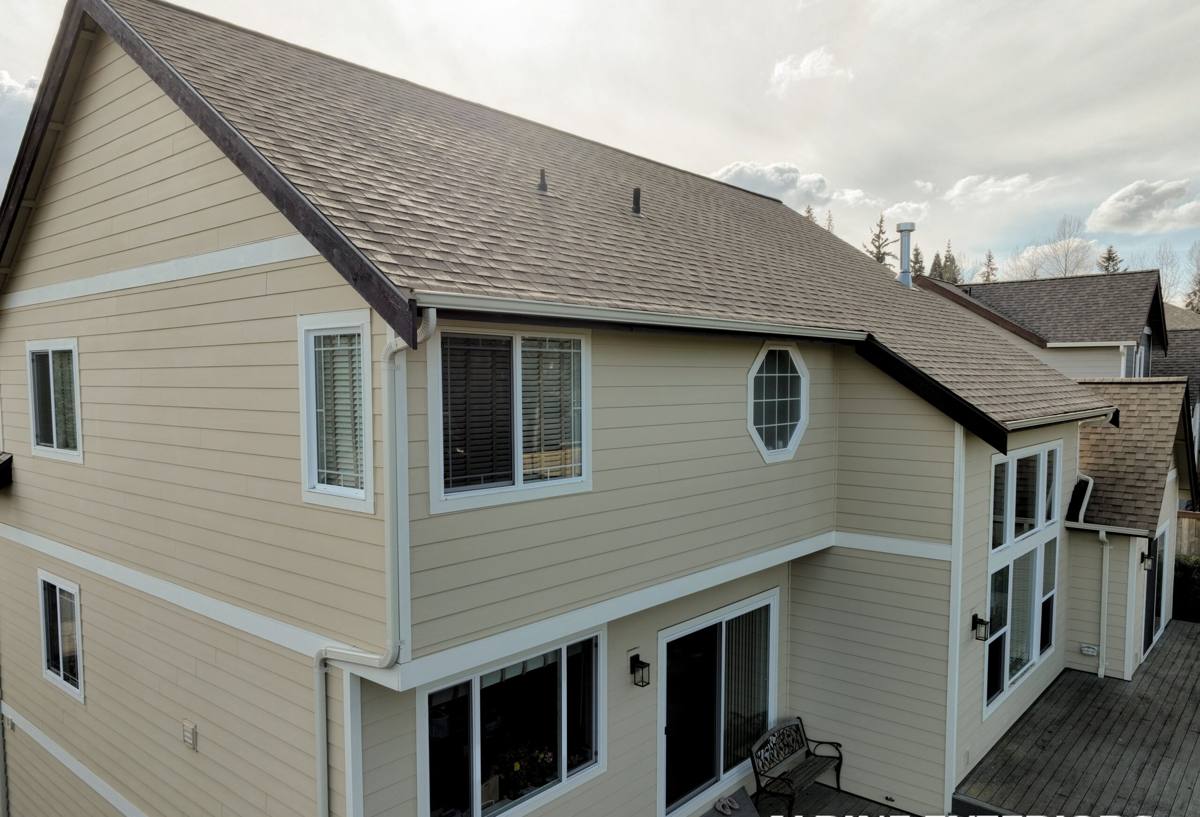
What "Correct" Siding Replacement Looks Like Here
A siding replacement job in this area has to solve for moisture management first and appearance second — though with James Hardie's ColorPlus finishes, you don't have to choose between the two. A correct job includes:
- Full tear-off and inspection of the wall sheathing underneath — not just a re-side over existing problems
- Repair or replacement of any sheathing that's already showing rot, soft spots, or water staining
- A new weather-resistive barrier installed with proper shingle-lap overlap, so water is directed out, not in
- Correct flashing at every window, door, and roof-to-wall transition — this is where the vast majority of siding failures actually start
- Rainscreen or drainage gap detailing on wall sections that get direct wind-driven rain, which is common on lake-facing elevations
- Fastener placement, gapping, and caulking done to the manufacturer's written spec, not "close enough"
Skipping any one of these steps doesn't show up on day one. It shows up in year three or four, when water that should have been directed back out gets trapped behind the cladding instead.
Moss and Algae: The Slow, Quiet Damage
Moss doesn't just look bad — it holds moisture directly against a surface, extends the amount of time siding stays wet after a storm, and can work into seams and fastener holes over time. In shaded areas around Lake Whatcom, especially under mature tree cover, moss and algae growth is close to a year-round condition rather than a seasonal one. This is one of the practical reasons we install fiber cement rather than wood-based siding: fiber cement doesn't feed moss growth the way organic wood fiber does, and it holds up to periodic cleaning without degrading.
Why We Only Install James Hardie Fiber Cement
We made a decision years ago to standardize on one product system rather than offer a menu of siding types, and Lake Whatcom's climate is a big reason why. James Hardie's fiber cement is engineered specifically for wet, coastal-influenced climates like ours — it's dimensionally stable when it takes on moisture, it's non-combustible, and the ColorPlus factory finish is baked on and warranted against fading and peeling in a way that field-applied paint simply isn't.
We don't install LP SmartSide, vinyl, Cemplank, Allura, primed spruce, or cedar. Each of those has a legitimate use case somewhere — but for a home sitting near a lake in Whatcom County, dealing with salt-tinged air, sideways rain, and long stretches of shade and moisture, we don't think they hold up as well over a 20-30 year window as Hardie's HZ5 product line, which is engineered for exactly this climate zone. That's a professional standard we hold ourselves to, not a knock on every product we don't carry.
What HZ5 Actually Means for This Property
James Hardie's climate-specific engineering means the HZ5 formulation is built for regions with more moisture exposure and freeze-thaw cycling than the desert Southwest sees. For a home near Lake Whatcom, that translates to siding that resists moisture-related warping and cracking better over the long run, holds its ColorPlus finish longer in a UV-and-moisture environment, and carries a manufacturer warranty that's transferable if you sell the home — a detail buyers and their inspectors increasingly ask about.
Our Process for Lake Whatcom Projects
- On-site assessment — we walk the exterior, check the lake-facing and shaded elevations separately since they usually have different moisture histories, and look at trim, flashing, and any existing moss or staining
- Sheathing and moisture check — where we suspect hidden damage (usually near old flashing points or ground-level areas), we open up a section to confirm before quoting the full job
- Written scope and product selection — profile (lap, shingle, or panel), color, and trim package, all Hardie ColorPlus products
- Tear-off and prep — old siding removed, sheathing repaired as needed, new weather barrier installed
- Installation to manufacturer spec — correct fastening, gapping, flashing, and caulking at every penetration
- Final walkthrough — we go over the finished job with you before we consider it done
Cost Factors for a Lake Whatcom Siding Replacement
Every home is different, but the line items that move the price up or down are consistent. Rather than quote a number that doesn't apply to your specific house, here's what actually drives the cost:
| Factor | Why It Matters Here |
|---|---|
| Sheathing condition | Homes with long-term moisture exposure near the lake sometimes need sheathing repair or replacement before new siding goes on — this is common enough locally that we always budget time to check |
| Home size and wall complexity | More corners, gables, and window/door penetrations mean more flashing detail work, which is where quality and cost both go up |
| Siding profile choice | Lap, shingle, and panel styles from the Hardie lineup carry different material and labor costs |
| Trim and accent work | Fascia, trim boards, and accent bands add to both material and labor time |
| Access and site conditions | Sloped lots and lake-adjacent properties with limited staging area can affect labor time |
| Existing moss/algae remediation | Heavily affected surfaces may need additional prep before tear-off begins |
Signs Your Lake Whatcom Home Needs Siding Replacement Now
- Soft or spongy spots when you press on the siding, especially near the bottom courses or under windows
- Persistent moss or dark staining that comes back within weeks of cleaning
- Visible gaps, warping, or buckling at seams and corners
- Paint that's peeling or bubbling rather than just fading
- Musty smell or visible staining on interior walls that back up to exterior siding
- Siding that's original to a home built more than 20-25 years ago with non-fiber-cement material
Why Local Experience in Sudden Valley Matters
A crew that's worked homes around Lake Whatcom before already knows which elevations catch the worst of the driving rain, which yards hold shade and moisture long enough to grow moss year-round, and where flashing tends to fail first on homes built in this area's common styles and eras. That's not something you can fully substitute with a generic checklist — it comes from having done the work here, on this lake, in this county, repeatedly.
It also matters for warranty follow-through. If a flashing detail or a caulk line needs attention down the road, a local company that knows the property and the area can respond quickly, rather than treating it as a one-off service call in an unfamiliar neighborhood.
What to Expect After Installation
New Hardie fiber cement siding, correctly installed, needs very little from you. Periodic rinsing to clear pollen, salt residue, and moss spores is reasonable in this climate, especially on shaded elevations. The ColorPlus finish is designed to hold its color without repainting for many years, which matters here specifically because repainting job-site-applied finishes in a wet climate is its own ongoing maintenance burden — one of the main reasons we moved away from field-painted products in the first place.
If your Lake Whatcom home is showing signs of wear, or you're just planning ahead before a small problem becomes a big one, we're happy to come take a look. The estimate is free, there's no pressure, and you'll get a straight answer about what your home actually needs — use the form below to get started.