 Sudden Valley Siding
 Fairhaven's Roofs Work Harder Than Most
Fairhaven sits close enough to Bellingham Bay that salt-laden air is a fact of daily life, not an occasional nuisance. Add in the driving, wind-pushed rain that rolls off the water during fall and winter storms, plus the deep tree canopy that shades much of the neighborhood, and you've got a combination that ages roofing faster than it would inland. We see the same pattern on nearly every Fairhaven roof we're called out to: fasteners and metal flashing corroding sooner than the manufacturer's spec sheet would suggest, shaded north- and west-facing slopes staying damp for days after a storm, and moss taking hold in the granule beds of asphalt shingles or the shaded troughs of cedar shake.
None of that means Fairhaven homes need exotic repairs. It means the repair has to account for what's actually attacking the roof, not just patch the visible symptom. A granule-loss spot repaired without addressing the moss colony above it, or flashing replaced with the wrong-grade metal for a salt-air environment, is a callback waiting to happen.
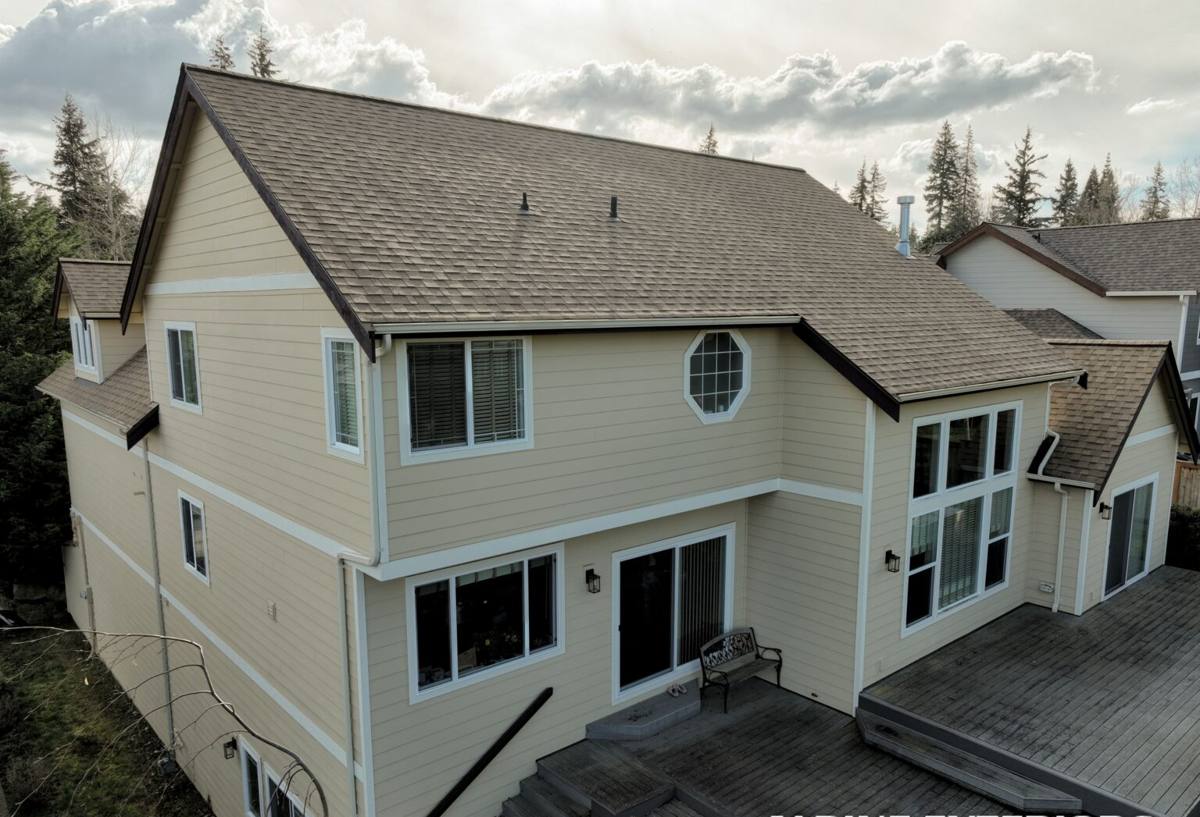
What Salt Air, Rain, and Moss Actually Do to a Roof
Salt Air
Airborne salt accelerates corrosion on any exposed metal — nails, drip edge, step flashing, valley metal, vent boots with metal collars. Once corrosion starts, it doesn't stay cosmetic. Corroded fasteners lose their grip on shingles and underlayment, and corroded flashing thins out until it develops pinholes that let water in behind the roofing material where you can't see it.
Driving Rain
Wind-driven rain doesn't just run downhill the way roofing systems are designed to shed it — it gets pushed sideways and even slightly uphill under shingle edges, ridge caps, and flashing laps. Repairs that rely purely on gravity to keep water out (a bead of caulk instead of properly lapped metal, for example) tend to fail during exactly the storms when a roof needs to perform best.
Moss and Algae
Shaded, moisture-retentive spots on a Whatcom County roof are prime moss territory. Moss holds water against the roofing surface far longer than open sun-exposed areas dry out, which softens shingle mat, rots the wood underneath cedar shake, and works its rhizoids under shingle tabs and shake courses, physically lifting them. A roof that looks fine from the ground can already have moss working under the surface on the shaded slope.
Signs a Fairhaven Roof Needs Repair
- Granule buildup in gutters or at downspout outlets — a sign shingles are wearing faster than they should
- Dark streaking or thick moss mats, especially on north-facing or tree-shaded slopes
- Curling, cupping, or lifted shingle tabs, particularly near valleys and eaves
- Rust staining running down from nail heads, vent boots, or flashing
- Soft or spongy decking felt underfoot in the attic near valleys or chimneys
- Water stains on interior ceilings that appear only during wind-driven storms, not steady rain
- Daylight visible through the roof deck at ridge or gable vents
- Shake or shingle pieces found in the yard after a windstorm
Any one of these is worth a look. Several together usually mean the roof has multiple small problems compounding — exactly the situation where a targeted repair, done right, can buy years before a full replacement is needed.
Table: Common Roofing Materials in Fairhaven & Repair Considerations
| Material | Typical Weak Point Locally | Repair Consideration |
|---|---|---|
| Asphalt composition shingle | Granule loss and moss colonization on shaded slopes | Match existing shingle line where possible; treat moss at the source, not just the visible mat |
| Cedar shake / shingle | Moisture retention and rot under moss, especially in valleys | Replace individual shakes rather than resurfacing; check decking condition underneath |
| Metal roofing/flashing | Corrosion from salt air at fasteners and seams | Use fastener and flashing grades rated for coastal exposure, not standard inland-spec hardware |
| Built-up or low-slope sections | Ponding water combined with debris from tree cover | Clear drainage paths as part of the repair, not as an afterthought |
What a Correct Repair Actually Involves
A roof repair that holds up in Fairhaven's climate goes beyond swapping out the shingles or shake pieces that are obviously damaged. Here's what we check and address on every repair call:
- Diagnose the actual water path. The stain on your ceiling is rarely directly below the failure point — water travels along decking and rafters before it drips. We trace it back to the source before opening anything up.
- Inspect the decking, not just the surface material. If moss or a slow leak has been active for a while, the plywood or plank decking underneath may be soft or delaminating. Patching over compromised decking doesn't hold.
- Address the moss and organic growth at the root. That means removing growth, evaluating why that section stays wet (shade, poor airflow, debris buildup), and treating the surface — not just brushing off what's visible.
- Replace flashing and fasteners with coastal-grade materials where corrosion is present, matched to the existing roofing system so the repair doesn't create a new weak point.
- Match materials for appearance and performance. On a visible slope, we try to source shingles or shake that blend with the existing roof rather than leaving an obvious patch.
- Verify the fix under real conditions. We check that flashing laps, valley metal, and shingle courses are oriented to shed wind-driven rain, not just standing water.
Repair vs. Replacement: How We Help You Decide
| Factor | Favors Repair | Favors Replacement |
|---|---|---|
| Age of roof | Under roughly 60–70% of expected material lifespan | Near or past expected lifespan for the material |
| Extent of damage | Isolated to one or two areas (a valley, a vent penetration, a wind-lifted section) | Widespread granule loss, multiple leak points, or moss/moisture across several slopes |
| Decking condition | Solid, no soft spots | Soft, delaminated, or rotted decking found in more than a small area |
| Material availability | Matching shingle or shake still reasonably available | Discontinued product with no close match, making patches visually obvious |
We'll always tell you honestly which side of that table your roof falls on. Broad ranges for repair work vary a lot depending on access, material, and how much decking (if any) needs replacing — we won't quote a number until we've actually seen the roof, but we'll walk you through the reasoning behind whatever we recommend.
Our Process for a Fairhaven Roof Repair Call
We start with a full roof inspection, not just a look at the spot you called about — a repair call is a good opportunity to catch a second problem before it becomes its own emergency. We'll show you what we find, explain what's causing it (age, moss, corrosion, storm damage), and give you a straightforward recommendation. If it's a repair, we schedule the work, source matching materials when possible, and complete it with attention to how the fix performs against wind-driven rain specifically — not just how it looks when it's dry outside. If we find something bigger, like widespread decking damage, we'll tell you plainly rather than patching over a problem that's going to resurface.
Why Local Experience with Fairhaven Roofs Matters
A crew that only works dry, inland areas of Whatcom County can miss what's specific to a bay-adjacent, tree-shaded neighborhood like Fairhaven — the corrosion pattern on coastal-exposed flashing, the specific slopes where moss takes over first, the way wind-driven storms off the bay stress a roof differently than straight-down rain does. We've worked on roofs throughout this area long enough to recognize these patterns quickly instead of treating every call as a first-time diagnosis. That local familiarity shortens the time between "something's wrong" and "here's exactly what's wrong and what it'll take to fix it right."
Maintenance That Extends the Life of a Repair
A good repair lasts longer with a little upkeep on your end:
- Keep gutters and valleys clear of needles and leaves, especially heading into fall storm season
- Have moss treated before it spreads across a full slope, not after
- Trim back branches that keep a section of roof shaded and damp longer than the rest
- Schedule a roof check after any major windstorm, even if you don't see obvious damage from the ground
- Address small leaks immediately — decking damage compounds quickly once water gets underneath roofing material
If you're seeing moss, granule loss, a stain on the ceiling, or you just want a second opinion on a roof that's due for a look, we're happy to come out to your Fairhaven home for a free, no-pressure estimate — no obligation, just an honest read on what your roof actually needs. Use the form below to get started.