 Sudden Valley Siding
 Why Sehome Homes Take a Different Kind of Beating
Homes in Sehome sit in a stretch of Whatcom County where the weather doesn't do anything halfway. You get salt-laden air moving in off the water, long stretches of driving, wind-blown rain that hits siding at an angle instead of straight down, and a moss season that can run most of the year in shaded, north-facing exposures. None of that is unusual for this part of Washington, but it adds up differently on a house than it does on paper. Siding here isn't just a weather barrier — it's the thing standing between your framing and a slow, expensive moisture problem that often isn't visible until it's advanced.
Salt air is corrosive to fasteners, trim metal, and any finish that isn't engineered to hold up under it. Driving rain finds every gap, seam, and undersized flashing detail a siding job has. And moss doesn't just look bad — it holds moisture against a wall assembly for weeks at a time, which is exactly the condition that rots wood-based siding products and lifts poor-quality paint. A siding system for a Sehome home has to be chosen and installed with all three of those conditions in mind at once, not just one of them.
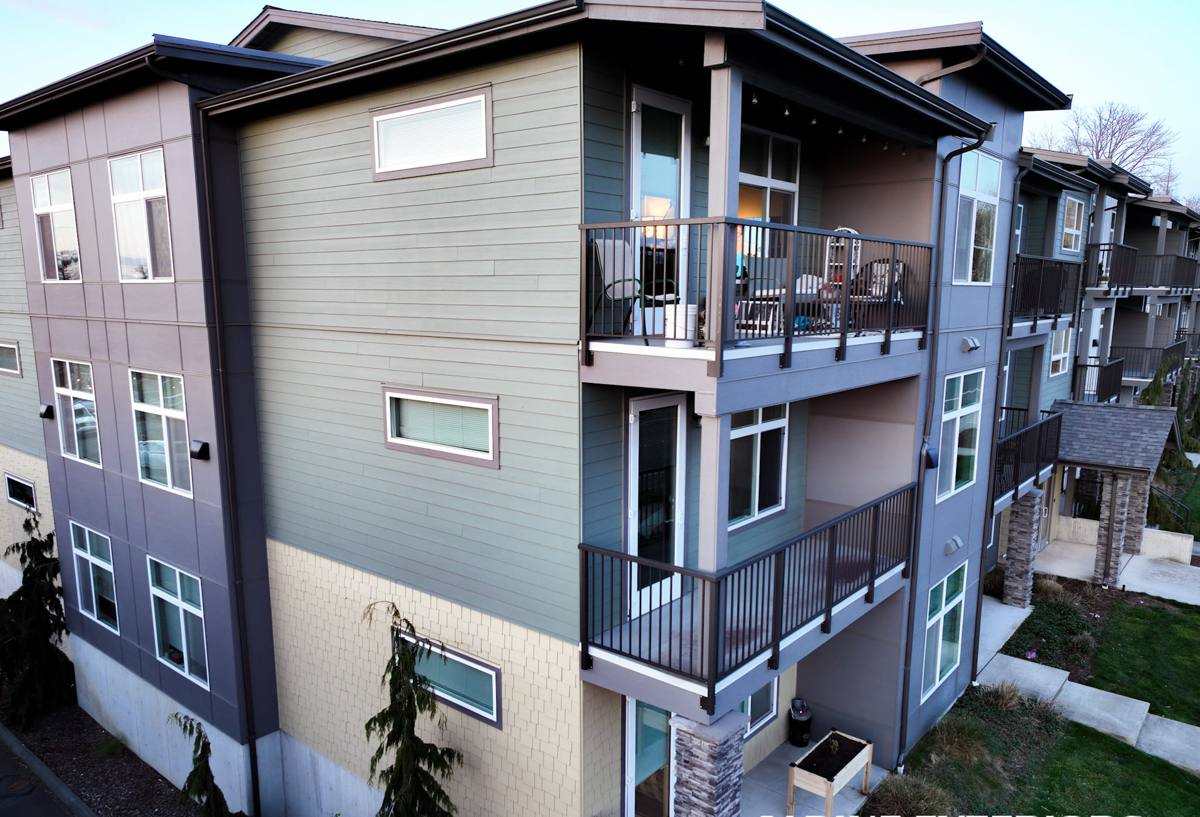
Why We Install Only James Hardie
We don't install LP SmartSide, vinyl, Cemplank, Allura, primed spruce, or cedar. That's not a marketing line — it's a standard we set because of what we've seen these products do over time in exactly the conditions Sehome deals with. Wood-based and engineered wood sidings depend on paint and caulking staying perfect for decades to keep moisture out; in a climate with this much rain and shade-driven moss, that's a maintenance burden most homeowners don't sign up for and don't keep up with. Vinyl flexes, fades, and can crack in cold snaps, and it doesn't hold up to the intense freeze-thaw and impact demands the same way fiber cement does. Cedar is beautiful but needs real upkeep — refinishing, moss treatment, and vigilant caulking — to avoid the rot risk that comes with any wood product exposed to sustained wet weather.
James Hardie fiber cement is non-combustible, dimensionally stable in wet-dry cycling, and comes from the factory with a baked-on ColorPlus finish that's built to outlast field-applied paint. It's engineered specifically for regional climate zones, backed by a strong transferable warranty, and when it's installed to manufacturer spec, it performs for decades with minimal upkeep. That combination is why we standardized on it and don't deviate, even when a customer would rather have a lower up-front bid on a lesser product.
What Homeowners Give Up With the Alternatives
- LP SmartSide / engineered wood: relies on an intact factory or field coating to resist moisture; edge and cut-end sealing is critical and easy to miss
- Vinyl: lower material cost but limited impact resistance, visible fading over time, and a look that doesn't match the market for higher-end homes
- Cemplank / Allura: other fiber cement brands with different engineering, warranty terms, and finish systems — we standardized on Hardie for the depth of its regional product lines and finish warranty
- Primed spruce or cedar: real wood, real charm, but real maintenance — repainting cycles, moss treatment, and caulking that has to be caught early
The Right James Hardie Product Line for This Climate
James Hardie engineers its siding by climate zone, and that matters more here than in drier parts of the country. Whatcom County falls into the wetter, cooler HZ5 climate engineering zone, which is formulated to resist moisture intrusion and hold its finish under sustained damp conditions — the exact profile of a Sehome winter. Using the correct HZ-rated product isn't optional if you want the performance the warranty is actually built around.
Within that HZ5 line, homeowners typically choose between a few board profiles and textures — lap siding in various exposures, shingle-style panels for accent areas, and vertical board-and-batten for modern or mixed-material looks. The right choice depends on the home's architecture, how much wall area sits in shade or gets direct wind-driven rain, and what look fits the neighborhood. We walk through those options on site rather than defaulting to one product for every house.
What a Correct Installation Actually Involves
Fiber cement siding is only as good as the installation behind it. Most of the failures we get called out to inspect on other contractors' work trace back to a handful of installation shortcuts, not the material itself.
The details that matter most in this climate
- Proper gapping and clearance: Hardie boards need specific gaps at butt joints, trim, and window/door openings so the material can move without trapping water
- Correct flashing at every penetration: windows, doors, hose bibs, vents, and light fixtures are where driving rain finds a way in if flashing is skipped or undersized
- A functioning water-resistive barrier: house wrap or building paper installed and lapped correctly behind the siding, not just present
- Fastener spec: corrosion-resistant fasteners driven at the correct depth — over-driven nails crack the board's edge and create a moisture entry point that isn't visible from the ground
- Factory-cut caulking and touch-up: field cuts need sealed edges and matched ColorPlus touch-up, not generic paint
- Ground clearance and grade slope: siding held to proper clearance above grade, decks, and roof lines so it isn't sitting in standing moisture
Any one of these done wrong won't necessarily show up in year one. It shows up in year five or eight, usually as a soft spot, a stain, or a section that's started to separate — right around the time it's a real repair instead of a five-minute fix.
Salt Air, Rain, and Moss: What Each One Actually Does to a Wall
| Climate Factor | What It Does Over Time | What the Siding System Needs |
|---|---|---|
| Salt-laden air | Accelerates corrosion of exposed metal, trim, and fasteners; can dull weaker finishes | Corrosion-resistant fasteners and flashing, a factory finish rated for the exposure |
| Driving, wind-blown rain | Pushes water sideways into seams, gaps, and under-flashed penetrations | Correct gapping, full flashing at every opening, a properly lapped water-resistive barrier |
| Extended moss season | Holds moisture against shaded wall sections for long stretches, promoting rot in susceptible materials | A non-organic, moisture-stable material and adequate clearance/airflow at grade and trim |
Our Process From Estimate to Finished Job
We keep the process straightforward because homeowners are usually dealing with siding as a once-a-decade decision, not something they do often.
- On-site assessment: we look at current siding condition, moisture damage, trim, flashing, and the specific exposure of each elevation — shaded sides get evaluated differently than the sides that take direct rain
- Product selection: we walk through HZ5 board profiles, textures, and ColorPlus color options based on the home's architecture and exposure
- Written scope and estimate: a clear breakdown of what's being removed, what's being repaired underneath (sheathing, framing, flashing), and what's being installed
- Prep and tear-off: old siding removed, substrate inspected for hidden rot or moisture damage before anything new goes on
- Water-resistive barrier and flashing: installed and inspected before a single board goes up — this step is the one that determines whether the job lasts
- Installation to manufacturer spec: correct gapping, fastening, and trim detailing at every seam, corner, and penetration
- Final walkthrough: we go over the finished job with the homeowner and flag anything that needs future attention, like landscaping too close to a wall
Cost Factors Homeowners Should Understand
Every siding job is priced around the same handful of variables. Knowing them helps you compare estimates honestly instead of just comparing a bottom-line number.
| Factor | Why It Moves the Price |
|---|---|
| Substrate condition | Hidden rot or moisture damage found during tear-off means repair work before new siding goes up |
| Board profile and texture | Lap, shingle-style, and board-and-batten profiles have different material and labor costs |
| Trim and detail complexity | Homes with more windows, corners, and rooflines take more flashing and cutting labor |
| Color and finish | Factory ColorPlus finishes vs. field-painted primed board affect both cost and long-term maintenance |
| Access and site conditions | Multi-story sections, tight lot lines, or landscaping close to the house add labor time |
What to Check Before You Hire Anyone
Siding failures are almost always installation failures, which means the contractor matters as much as the product. Before hiring anyone for a Hardie job in this climate, it's worth confirming a few basics.
- Are they installing the correct HZ5-rated product for this climate zone, or just whatever's in stock?
- Will they show you the flashing and water-resistive barrier detail before it's covered up?
- Do they carry manufacturer-recognized installation credentials for James Hardie products?
- Is the estimate itemized enough to show tear-off, substrate repair, and installation separately?
- Do they have experience specifically with the exposure conditions in this part of Whatcom County — salt air, driving rain, and heavy shade/moss areas?
Why Local Experience in Sehome Specifically Matters
A crew that already works in this area knows which elevations on a typical Sehome-area home take the worst of the wind-driven rain, which yards hold shade long enough to grow moss year-round, and how salt air behaves differently a few blocks apart depending on exposure and tree cover. That's the kind of judgment that doesn't come from a spec sheet — it comes from doing the work here, repeatedly, and seeing what holds up and what doesn't after a few Pacific Northwest winters. It's also why we don't treat every house the same way: two homes on the same street can need different flashing details or board orientation depending on how they sit relative to prevailing wind and rain.
Get a Straight Answer for Your Home
If your current siding is showing gaps, soft spots, persistent moss staining, or paint that won't hold, it's worth having someone look at it before it turns into a bigger repair. We'll walk your home, tell you honestly what condition your siding and substrate are in, and put together a clear, no-pressure estimate for James Hardie siding built for Sehome's climate. Use the form below to request a free estimate.