 Sudden Valley Siding
 Why Sehome-Area Siding Takes More Damage Than People Expect
Homes near Sudden Valley and the broader Sehome area deal with a combination of conditions that few siding products handle well over the long term. Whatcom County sits close enough to the water that salt-laden air reaches painted and wood-based exteriors, slowly breaking down finishes and accelerating corrosion at fasteners and trim. Add in the driving, wind-pushed rain that comes through this part of the Pacific Northwest for much of the year, and you get moisture pressure against siding seams, laps, and penetrations that drier climates simply don't experience.
Then there's moss. Whatcom County's mild, wet winters create a moss season that can run for months, not weeks. Moss holds water against a wall long after the rain has stopped, and on the wrong siding material that constant damp contact is exactly the setup for softening, delamination, or paint failure. A repair that doesn't account for all three of these factors — salt exposure, wind-driven rain, and prolonged moss contact — tends to fail again within a few years.
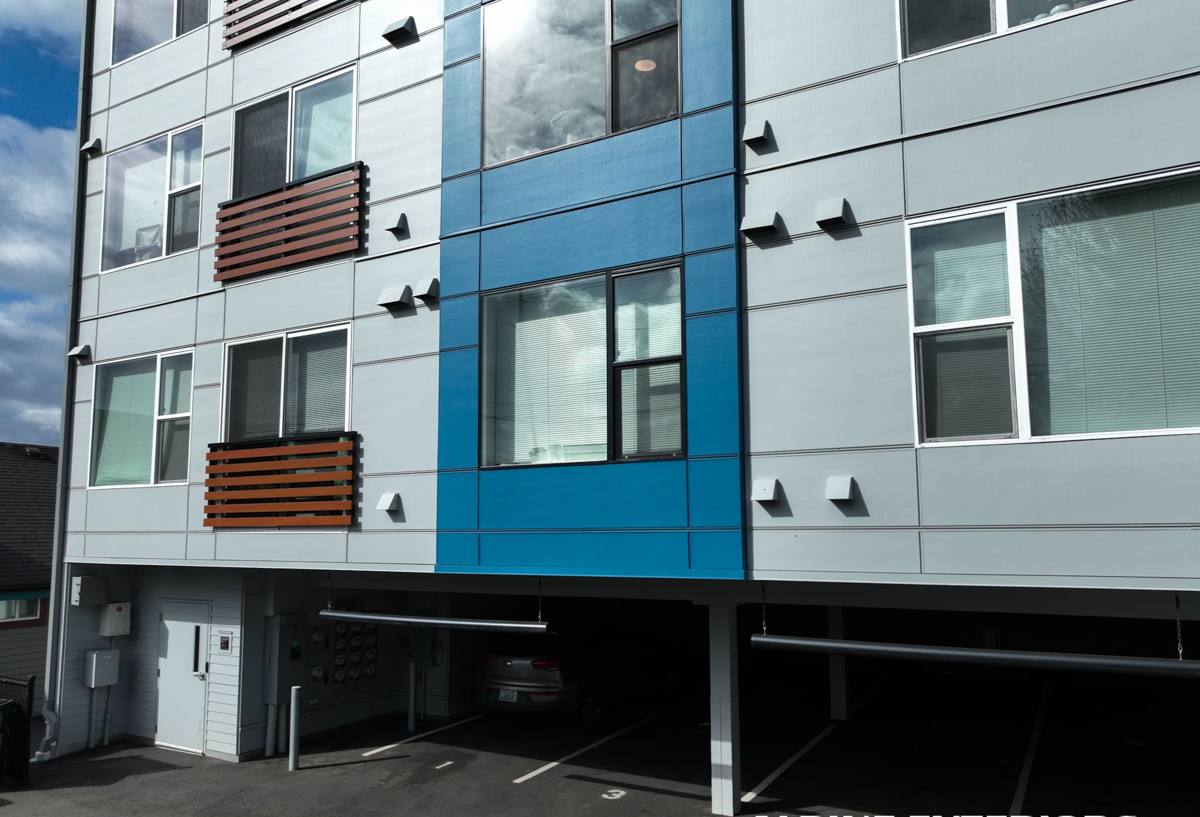
Warning Signs Worth Calling a Contractor About
Most siding repair calls in this area start with one of these symptoms. Catching them early usually means a smaller, cheaper repair instead of a section that has to be opened up and rebuilt.
- Soft or spongy spots when you press on the siding, especially near the bottom courses or under windows
- Visible moss or persistent green streaking that doesn't wash off and keeps coming back in the same spot
- Paint or finish that's bubbling, peeling, or chalking unevenly across a wall
- Warping, cupping, or boards that no longer sit flat against the wall
- Gaps opening up at seams, corners, or where siding meets trim, windows, or doors
- Staining or discoloration running downward from a nail head, seam, or flashing line
- Any soft spot in the wall sheathing itself when you tap or press near a damaged siding section
None of these are cosmetic issues you can put off indefinitely. Moisture that's gotten behind siding keeps working even when the surface looks stable, and the longer it sits, the more of the wall assembly ends up needing attention.
What a Correct Siding Repair Actually Involves
Diagnosing the cause, not just patching the symptom
A repair that just covers a damaged board without figuring out why it failed is a repair that fails again. Before any siding comes off, we look at what's actually driving the damage — a flashing detail that's letting water in, a grading or gutter issue pushing splashback onto the wall, a spot where moss has been sitting against the surface for years, or simple fastener corrosion from salt air. If the underlying cause isn't addressed, a new piece of siding in that same spot is just a countdown to the next repair.
Checking what's behind the siding
Once the damaged section is opened up, we check the water-resistive barrier, flashing, and sheathing underneath. In this climate, it's common to find that visible siding damage is smaller than what's happening behind it — a little surface staining can mean a much larger area of wet sheathing. A correct repair addresses everything that's actually compromised, not just the piece you can see from the driveway.
Matching the finish, not just the material
Because we only install James Hardie fiber cement, repairs on Hardie siding can be matched using the same product line and ColorPlus factory finish that's already on the house, so the repaired section weathers the same way as the rest of the wall instead of aging differently and standing out. That's a real advantage over materials where an exact color or texture match gets harder to find a few years after the original install.
Repair or Replace? How We Make That Call
Not every damaged section needs a full re-side, and not every repair is worth doing on its own. The right call depends on a few factors we walk through with the homeowner before recommending anything.
| Factor | Repair Usually Makes Sense | Full Replacement Usually Makes Sense |
|---|---|---|
| Extent of damage | Isolated to one or two wall sections | Spread across multiple elevations |
| Age of existing siding | Siding is mid-life and otherwise sound | Siding is near or past its expected service life |
| Sheathing condition | Sheathing underneath tests dry and solid | Sheathing is soft, delaminated, or rotted |
| Underlying cause | Cause is a single, fixable detail (flashing, grading) | Cause is systemic across the whole exterior |
| Cosmetic match | Repair material can be matched closely | Existing siding is discontinued or badly faded |
We'd rather tell a homeowner honestly that a repair will hold up than sell a bigger job than the house needs. On the flip side, we won't recommend patching a wall where the damage is really a sign the whole elevation needs attention — that just delays a bigger cost and risks more sheathing damage in the meantime.
Why We Only Repair With James Hardie Fiber Cement
We don't install vinyl, LP SmartSide, Cemplank, Allura, primed spruce, or cedar, and that standard applies to repair work too. It's not that these products can't be installed correctly — it's that in a climate with this much sustained moisture, salt exposure, and moss, the maintenance burden and failure modes of those materials show up faster than they would in a drier region. Wood-based products need consistent repainting and are vulnerable to moisture intrusion at cut edges and seams. Vinyl can warp, fade unevenly, and doesn't hold paint if a homeowner ever wants to change the color. None of that is a knock on the products in general — it's why we made a professional decision to standardize on one system we can stand behind for the long term.
James Hardie fiber cement is non-combustible, holds its factory ColorPlus finish far longer than field-applied paint, and is engineered in climate-specific HZ product lines built for exactly the kind of wet, coastal exposure Whatcom County gets. When we repair Hardie siding, we're working with a material that was designed for this weather in the first place, not one we're just hoping holds up.
Our Process for a Sehome-Area Repair Call
1. On-site inspection
We look at the damaged area and the surrounding wall, check for moisture behind the surface where accessible, and identify what actually caused the failure.
2. Honest scope and estimate
You get a clear explanation of what needs to be repaired, what caused it, and a written estimate before any work starts — including whether we think a repair or a larger scope is the right call.
3. The repair itself
Damaged material comes off, anything compromised underneath gets addressed, and the section is rebuilt with properly flashed, correctly fastened James Hardie fiber cement matched to your existing siding line and finish.
4. Cleanup and a straightforward warranty conversation
We walk the job with you when it's done and explain what warranty coverage applies to the repaired section, both from the manufacturer and from our own workmanship.
Why It Matters That We Already Work in Sehome and Sudden Valley
Siding repair is very site-specific. A crew that regularly works this area already has a feel for which elevations take the worst wind-driven rain, how fast moss builds back up on a shaded wall, and how salt air exposure tends to show up first at fasteners and trim rather than the field of the siding. That's the kind of pattern recognition that only comes from repeated, local work — it's not something you get from a general contractor who does one siding job a year in a completely different climate. It also means faster response times and a crew that isn't guessing about how this specific stretch of Whatcom County weather behaves.
Keeping a Repair From Turning Into a Repeat Call
A good repair should be close to a non-event for years afterward. A few habits help keep it that way in this climate:
- Keep gutters clear so overflow doesn't run down the wall face repeatedly
- Trim back vegetation and branches that keep a wall section shaded and damp
- Rinse off moss and organic buildup before it gets a chance to hold moisture against the surface long-term
- Have caulking and sealant at trim and penetrations checked every couple of years, since that's often where water gets in first
- Walk your exterior after a hard windstorm and note any new soft spots, gaps, or staining while they're still small
If you're seeing soft spots, persistent moss staining, or a section of siding that just doesn't look right anymore, we're glad to take a look and give you a straight answer about what it needs. Reach out for a free, no-pressure estimate — there's a form below to get started.