 Sudden Valley Siding
 Building a Deck That Actually Holds Up on South Hill
A deck in South Hill has to do more than look good for one dry August. It has to shed water off a sloped or wooded lot, survive months of driving rain without trapping moisture in the framing, and resist the moss and algae that creep across every shaded surface in Whatcom County by late winter. We've built and repaired decks throughout the Sudden Valley area long enough to know which details separate a deck that's still solid in ten years from one that's already spongy and slick.
This page is about one job, done right, in one area: custom deck construction for South Hill homes. Not a generic overview of decking products, but the specific choices that matter when the site sits on a slope, under tree cover, and inside a climate that stays damp for most of the year.
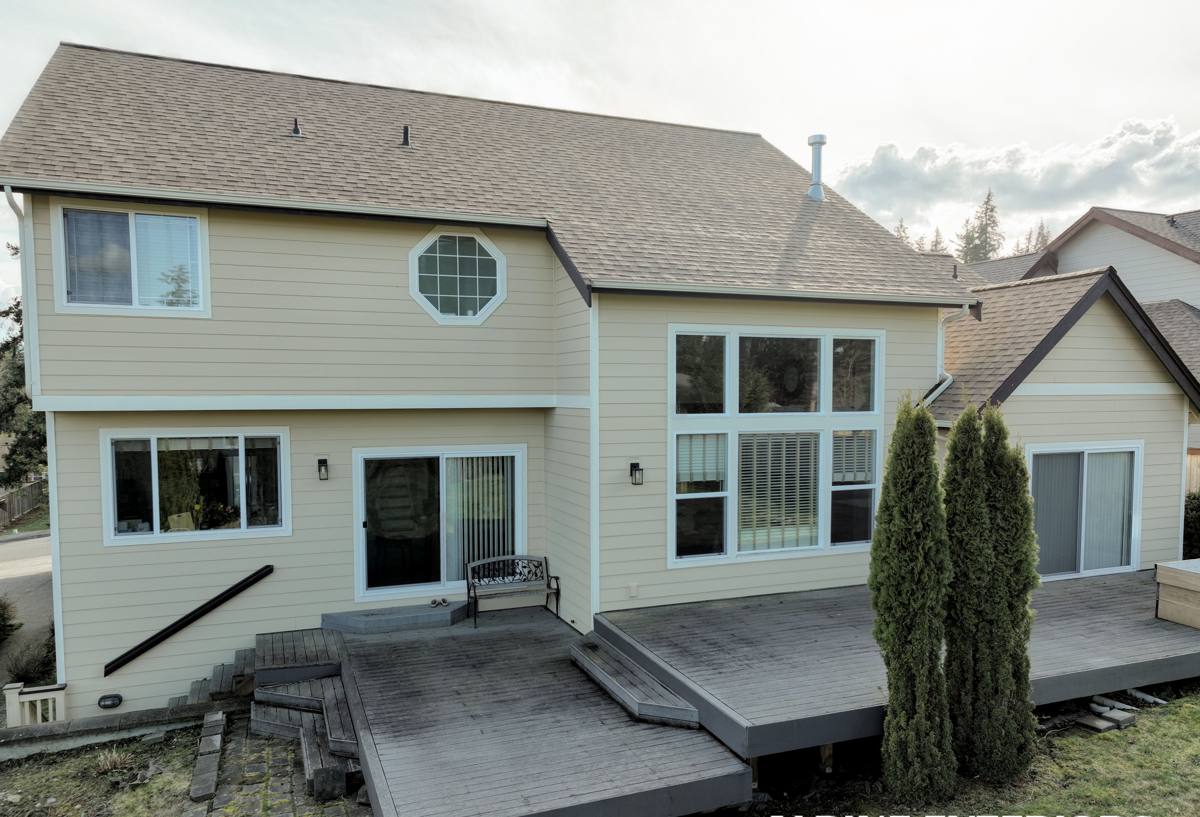
What South Hill's Terrain and Weather Actually Demand
Many South Hill lots aren't flat. Homes are set on grade changes, with decks that need to bridge a slope, cantilever toward a view, or step down in levels to meet the yard. That changes the engineering before a single board goes down — footing depth, post height, and lateral bracing all have to account for the actual contour of the lot, not a textbook flat pad.
Layer on the climate: long stretches of driving rain that comes in sideways off the wind, heavy tree canopy in many yards, and a moss season that can run from fall through spring. Any deck surface that stays wet and shaded for weeks at a time will grow moss and algae if it isn't built and finished to shed water and let air move underneath.
The three problems we design around
- Standing water on the surface — from flat framing, tight board spacing, or decking installed without enough slope
- Trapped moisture underneath — from low clearance, poor ledger flashing, or joists that never fully dry between rain events
- Moss and biological growth — from shaded, low-airflow spots where water sits longest
Choosing Decking Material for a Shaded, Wet Lot
There's no single "best" decking material — there's a best material for a given lot, budget, and how much upkeep the homeowner actually wants to do. On a sunny, open South Hill lot, more options work well. On a shaded lot with tree cover, some materials fight the moss problem better than others.
| Material | Moss/Algae Resistance | Maintenance | Typical Lifespan |
|---|---|---|---|
| Pressure-treated wood | Low — porous surface holds moisture and organic debris | Annual cleaning and re-sealing/staining | 10-15 years with upkeep |
| Cedar | Moderate — naturally rot-resistant but still needs cleaning in shade | Periodic cleaning, oil or sealer every 1-2 years | 15-20 years with upkeep |
| Capped composite | High — solid cap sheds surface debris, doesn't absorb water | Occasional washing, no staining/sealing | 25-30+ years, manufacturer-backed |
| Uncapped/early-generation composite | Low-moderate — some older composite is porous enough to stain and grow algae | Regular cleaning to prevent staining | 15-20 years |
On heavily shaded South Hill lots, we lean homeowners toward capped composite or well-detailed cedar over uncapped composite or bare pressure-treated boards left unsealed — the difference in how fast moss takes hold on a north-facing, tree-covered deck is significant. That's a judgment call based on trade-offs in moisture behavior and upkeep, not a knock on any one product; every material listed here can work if it's matched to the site and maintained.
Fasteners and hardware
Whatever decking goes on top, what's underneath has to survive damp framing year-round. We use corrosion-resistant, code-rated fasteners and connectors rated for treated lumber contact, and we favor hidden fastening systems on composite decking so there are fewer exposed screw heads for water to sit against. Cutting corners on hardware is one of the most common causes of early deck failure we see on repair calls — it doesn't show until the fasteners start bleeding rust or the connections start to loosen.
Structure: Footings, Framing, and Ledger Attachment
This is the part of a deck nobody sees once it's finished, and it's the part that determines whether the deck is still safe in fifteen years.
Footings on sloped ground
On a graded South Hill lot, footing depth and post height often vary across the same deck. We set footings below frost depth and size them to the actual soil conditions on site rather than using a one-size footing plan, especially where a deck steps down a slope or cantilevers past the foundation line.
Ledger board attachment
Where a deck attaches to the house, the ledger connection and its flashing are the single most important waterproofing detail on the whole structure. Done wrong, it's the number one way water gets into a rim joist or wall framing behind the siding — and in a climate with this much rainfall, that damage can go on quietly for years before it's visible. We flash every ledger connection to shed water away from the house, not toward it.
Airflow underneath
Low-clearance decks and skirted decks are common on sloped lots because they hide the structure below, but low airflow is exactly what lets moss and rot get a foothold. Where clearance is tight, we plan venting and drainage so the space underneath isn't a permanently damp pocket.
Our Process for a South Hill Deck Project
- Site walk and grade assessment — we look at slope, drainage paths, tree cover, and how water currently moves across the lot before we design anything
- Design and material selection — layout, footing plan, and decking material matched to sun/shade exposure and how the homeowner wants to maintain it
- Permitting — we handle the permit application with the local building department; if the property is inside an HOA with design or setback guidelines, we account for that during design, not after
- Framing and structural inspection — footings, posts, beams, and ledger attachment built and flashed, then inspected before decking goes on
- Decking, railing, and stairs — installed with proper board spacing and slope for drainage
- Final walkthrough — we go over care and maintenance for the specific material installed, so there are no surprises the first wet winter
Railings, Stairs, and the Details That Fail First
Railings and stair stringers take more direct weather exposure than the deck field itself, and they're usually the first thing to show wear on an older deck. Post bases that sit in standing water, railing baluster connections that trap moisture, and stair stringers cut from the wrong grade of lumber are common failure points we run into on repair jobs around the area. We build these components to shed water the same way we treat the ledger — sloped surfaces, gapped connections, and hardware rated for wet exposure.
Maintenance That Keeps a South Hill Deck Looking Good
Every deck, regardless of material, needs some seasonal attention in this climate. What changes is how much.
- Sweep leaves, needles, and organic debris off the deck surface regularly, especially in fall — trapped debris is where moss starts
- Rinse or wash the surface at least once or twice a year to interrupt algae and moss growth before it sets in
- Check and clear gaps between boards so water and debris keep draining rather than backing up
- Inspect fasteners, railing connections, and stair stringers annually for movement, rust staining, or soft spots
- Re-seal or re-stain wood decking on the schedule the product calls for — skipping a cycle in a wet climate shortens lifespan fast
- Keep gutters and downspouts near the deck clear so roof runoff isn't dumping extra water onto or under the structure
What we watch for on shaded lots specifically
On decks under heavy tree cover, moss can return within a season even after cleaning. That's not a sign of bad work — it's a sign the deck needs a bit more frequent attention than one built in full sun, or it's a case for choosing a lower-maintenance capped material on the next rebuild.
Why Hire a Crew That Already Works This Area
A deck built without accounting for South Hill's slopes, tree cover, and the region's rainfall pattern can look fine on install day and start showing problems within a couple of wet seasons — trapped moisture, moss on the walking surface, or a ledger connection that's letting water into the house. We've spent enough time working on homes in and around Sudden Valley to know how the local terrain and climate actually behave on a jobsite, not just in a spec sheet. That shows up in footing depth on sloped lots, in how we flash a ledger board, and in which decking materials we'll actually recommend for a shaded yard versus a sunny one.
We're licensed, insured, and handle the permitting process as part of the job — you're not left coordinating between a designer, a builder, and the county on your own.
Get a Free Estimate for Your South Hill Deck
If you're planning a new deck or replacing one that's showing its age, we'll come take a look at your lot, talk through material options for your site's sun and shade exposure, and give you a straightforward estimate — no pressure, no sales script. Use the form below to get started.