 Sudden Valley Siding
 Siding in Acme Has a Different Job to Do
Acme sits in the wooded, rural stretch of Whatcom County where the foothills start climbing toward Mount Baker. That location gives homes here a specific set of problems that a coastal subdivision or a dry inland town doesn't deal with in the same combination. Marine air moving in off the Puget Sound region collides with the terrain and drops a lot of moisture on this part of the county. Add heavy tree canopy, narrow valleys that hold shade most of the day, and a rainy season that stretches for months, and you get siding conditions that are genuinely tough: driving rain that gets pushed sideways into wall assemblies, humidity that never fully clears between storms, and a moss and algae season that can run eight or nine months a year on the shaded sides of a house.
None of that is unique to any one street in Acme — it's the character of this whole corner of Whatcom County. But it matters a lot when you're choosing a siding product and a crew, because materials and installation details that work fine in a drier climate can fail quietly here for years before the damage shows up.
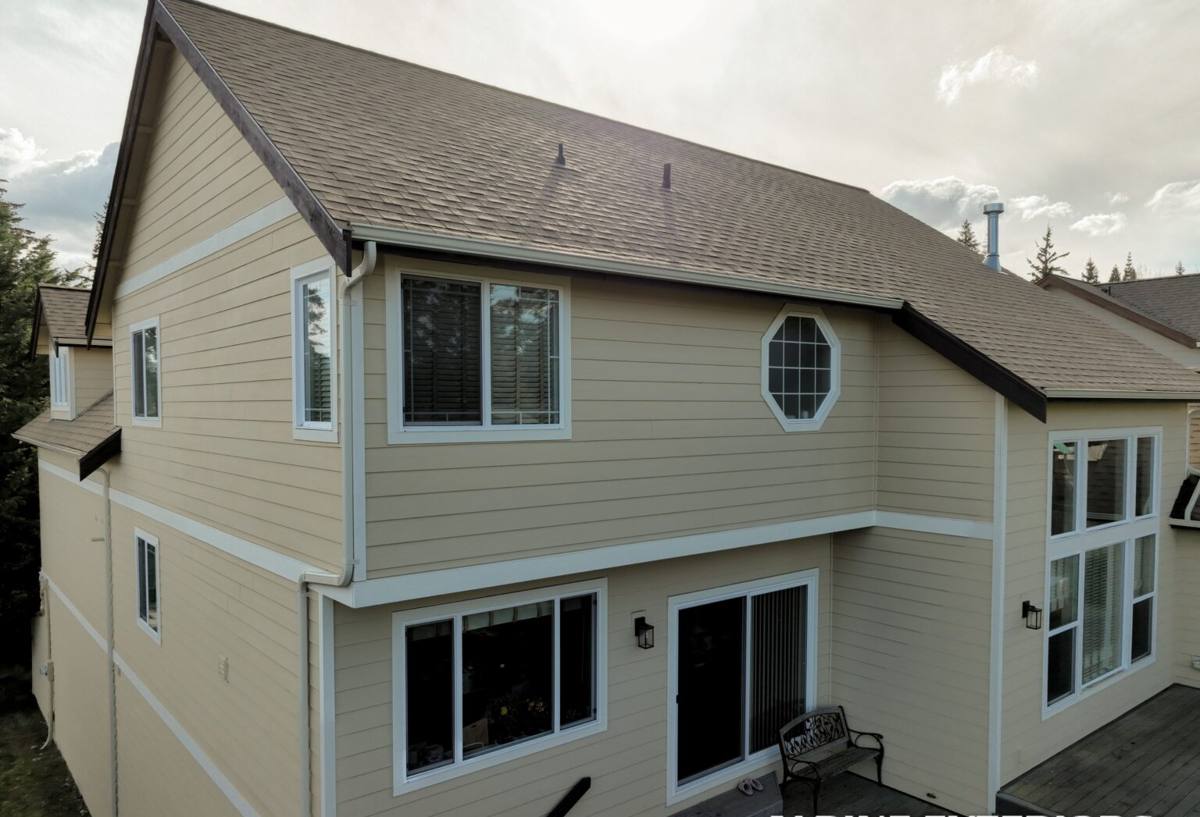
Why We Only Install James Hardie Fiber Cement
We don't install vinyl, LP SmartSide, primed wood, or cedar on Acme homes, and it's not because those products don't have a place somewhere. It's because we've standardized on one product system that we can stand behind in this specific climate, and James Hardie fiber cement is it.
It doesn't feed the moisture cycle
Fiber cement is made from cement, sand, and cellulose fibers, so it doesn't rot, doesn't delaminate, and isn't a food source for the mold and mildew that show up fast in shaded, damp conditions. Wood and wood-composite sidings can hold moisture inside the material itself; fiber cement doesn't behave that way when it's installed correctly.
It's engineered for exactly this climate
James Hardie builds region-specific formulations under its HZ5 and HZ10 engineered-for-climate system. The HZ5 line, used across the Pacific Northwest, is formulated to resist moisture damage and freeze-thaw stress in wet, humid conditions — which is precisely what a house in Acme deals with for most of the year.
The factory finish holds up under moss and algae exposure
ColorPlus finish is baked on in a factory-controlled process, not sprayed on site. That finish resists fading and is far easier to keep clean when moss and algae start colonizing a north-facing wall, compared to field-applied paint that can chalk and absorb organic growth faster.
Non-combustible core
Fiber cement doesn't support flame spread the way wood-based siding can. That's a genuine safety consideration for any home sitting close to the tree line, which describes a lot of properties around Acme.
What Actually Makes a James Hardie Installation Correct
The board itself is only part of the equation. Most siding failures we get called out to inspect — on any brand — trace back to installation shortcuts, not the material. James Hardie publishes detailed installation specifications, and in a wet climate like this one, following them isn't optional.
The drainage plane behind the siding
Fiber cement siding needs a proper water-resistive barrier and, in most wall assemblies here, a drainage gap so any moisture that gets behind the cladding has somewhere to go instead of sitting against the sheathing. Skipping or shortcutting this layer is the single most common reason siding jobs fail early in wet regions, regardless of what material is on the outside.
Clearances and gaps
James Hardie specifies minimum clearances from grade, roofing, decks, and other transitions, along with gap widths at butt joints and around penetrations. Those numbers exist because tight, caulked-shut gaps trap water instead of letting it drain and dry.
Fastening
Board needs to be fastened per the manufacturer's pattern and into solid framing — not just into sheathing — with corrosion-resistant fasteners driven correctly, not overdriven. Overdriven or misplaced fasteners crack the board's edges and create entry points for water, which is a slow failure you often don't see until years later.
Flashing at every transition
Windows, doors, roof lines, and any place two building planes meet need proper flashing integrated with the water-resistive barrier — installed in the correct order, not caulked over as an afterthought. This is where driving, wind-pushed rain finds its way in if it's done wrong.
How a James Hardie Project Runs on an Acme Home
Our process is the same core sequence on every job, adjusted for the specific house and what we find once the old siding comes off.
- Walkthrough and assessment. We look at the existing siding, trim, and the condition of the sheathing and framing where we can access it, and talk through what the house actually needs.
- Tear-off and inspection. Removing the old siding is when hidden moisture damage, rot, or missing flashing shows up. We flag it before covering anything back up.
- Sheathing and barrier repair. Any compromised sheathing gets replaced, and the water-resistive barrier and flashing get installed or corrected to current standards before a single board of Hardie goes up.
- Installation to manufacturer spec. Fastening pattern, clearances, gaps, and flashing integration follow James Hardie's published requirements, not shortcuts.
- Trim, caulking, and finish details. Corners, trim boards, and joints get finished so water sheds away from the wall instead of pooling at transitions.
- Final walkthrough. We go over the finished work with the homeowner before calling the job done.
Comparing Options for This Climate
Homeowners in Acme sometimes come to us already set on a product because of price or something they read online. Here's an honest look at how the common choices actually perform in a wet, shaded, moss-prone climate like this one.
| Material | Moisture behavior here | Moss/algae resistance | Typical lifespan (installed correctly) |
|---|---|---|---|
| James Hardie fiber cement | Does not rot or absorb moisture into the material itself | Factory finish resists staining and organic growth better than field-painted surfaces | 30+ years, backed by a transferable warranty |
| Vinyl | Doesn't rot, but can warp or buckle with temperature swings and traps moisture behind it if installed too tight | Traps grime and moss in seams and laps; harder to clean without damage | 15–25 years, more variable |
| Cedar / primed wood | Absorbs and holds moisture; needs a working paint or stain film to stay protected | Prime feeding ground for moss and mildew in constant shade | Highly dependent on repainting schedule, often 10–15 years between major refinishing |
| LP SmartSide (engineered wood) | Better than solid wood but still wood-based; edge sealing and caulking maintenance is critical | Can support surface growth if maintenance lapses | Manufacturer-rated but sensitive to installation and upkeep quality |
What It Actually Costs
We don't publish fixed prices because every Acme property is different — a single-story home on a slab and a two-story home with steep, wooded access don't cost the same to side, even with identical square footage. The factors that move the number most are:
| Cost factor | Why it matters |
|---|---|
| Amount of tear-off and disposal | More layers of old siding, or siding over sheathing that needs replacing, adds labor |
| Hidden moisture or rot damage | Found during tear-off; repairing sheathing and framing is priced separately from siding itself |
| House shape and trim detail | Corners, dormers, and multiple roof transitions all add flashing and cutting time |
| Siding profile chosen | Lap, shingle, and panel James Hardie products differ in material and labor cost |
| Site access | Steep lots, tree cover, and limited staging space (common around Acme) affect scaffolding and material handling |
Keeping James Hardie Siding Looking Right in a Moss-Prone Climate
Fiber cement is low-maintenance compared to wood, but "low-maintenance" doesn't mean "no maintenance" in a climate that grows moss on roofs, decks, and fences alike. A little seasonal attention keeps it looking good for the life of the warranty.
- Rinse siding with a garden hose and soft brush once or twice a year, focusing on shaded, north-facing walls where moss and algae take hold first
- Avoid pressure washing directly at joints and caulk lines — high pressure can force water behind properly installed trim
- Keep gutters clear so overflow doesn't run down the siding face during heavy rain events
- Trim back tree limbs and shrubs that keep a wall surface shaded and damp longer than the rest of the house
- Check and re-caulk gaps around windows, doors, and trim every few years — caulk fails long before the siding does
- Walk the exterior after major windstorms to check for any loose or damaged boards near roof and deck transitions
Why Local Experience Matters for This Job
A crew that mostly works drier climates learns siding installation from a manual. A crew that works Whatcom County learns it from callbacks — from seeing which details actually hold up through a real Pacific Northwest wet season and which ones fail quietly behind the wall. That difference shows up in things you won't notice until years later: how the drainage plane was detailed, how much clearance was left at grade and at the roofline, and whether flashing was lapped correctly for water moving downhill in a driving rain.
Working regularly in and around Acme and the greater Sudden Valley area also means knowing the practical stuff — how tree cover and terrain affect where moisture collects on a given lot, what permitting looks like in the county, and how to schedule work around the wetter months so a house isn't left exposed mid-project when a storm rolls through.
Get a Straight Answer on Your Siding
If you're weighing a siding replacement on an Acme home, we're glad to come take a look, tell you honestly what condition your current siding and sheathing are in, and walk you through what a correct James Hardie installation would involve for your specific house. There's no pressure and no obligation — just a straight assessment from a crew that installs this product and only this product, in this climate, every day.