 Sudden Valley Siding
 Happy Valley's Climate Puts Real Stress on Siding
Homes in Happy Valley sit close to Lake Whatcom, inside the broader Sudden Valley area of Whatcom County, and that location comes with a specific set of weather problems for exterior siding. Moist air off the lake, driving rain that comes in sideways during fall and winter storms, and a moss season that can run eight months or longer all work against whatever material is on your walls. None of this is unique to one street or one house — it's the baseline condition for siding anywhere in this part of the Pacific Northwest, and it's why siding here fails in different ways than siding in a drier climate.
Salt-tinged, humid air keeps siding surfaces damp longer after every rain event, which slows drying time and gives moisture more opportunity to work into seams, fastener holes, and trim joints. Add in wind-driven rain that hits walls at an angle instead of falling straight down, and water gets pushed into places it was never meant to reach. Then there's moss and algae, which thrive in the shaded, damp conditions common on north- and west-facing walls here — left unchecked, they hold moisture against the siding surface and speed up whatever decay process has already started.
None of that means your siding is doomed. It means repairs in this area have to account for how moisture actually moves through a wall, not just patch what's visibly broken.
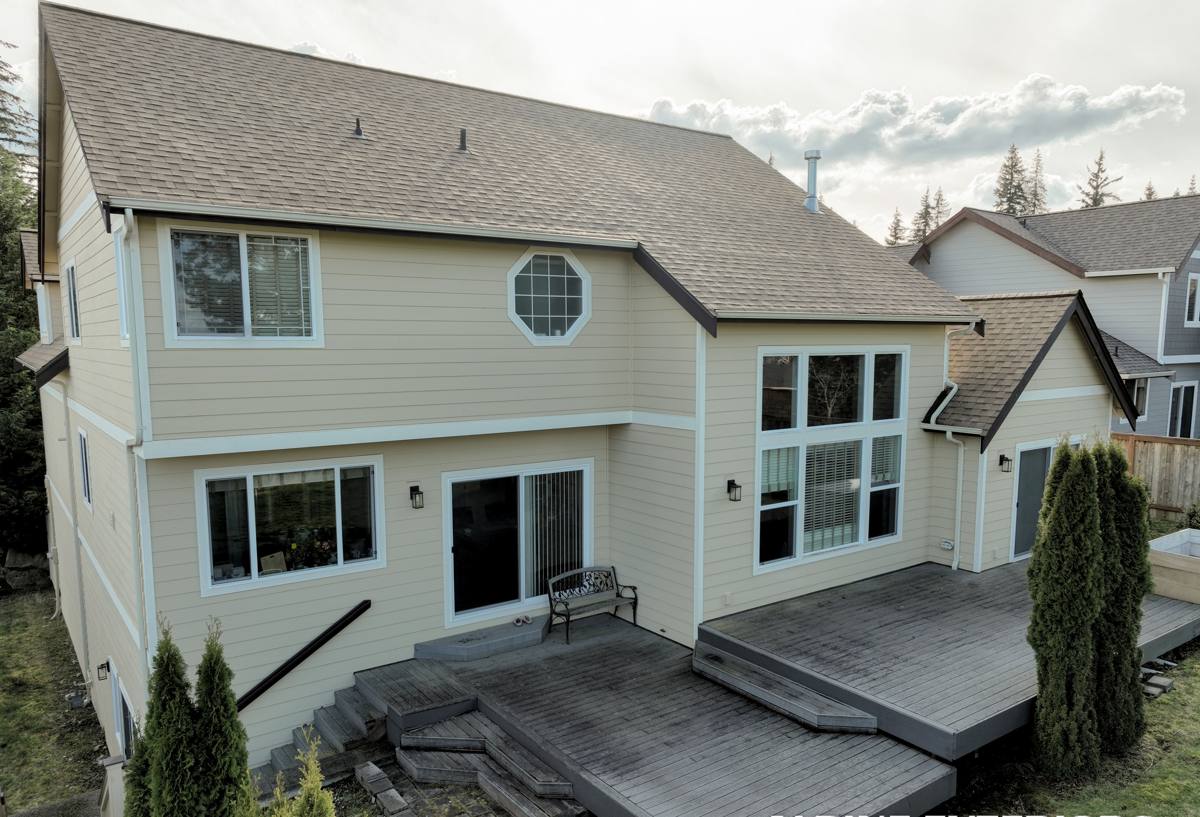
Signs Your Happy Valley Home Needs Siding Repair
Most siding problems don't announce themselves as a hole in the wall. They show up as smaller signs that get written off as cosmetic until the damage underneath has spread. Walk your home's exterior — especially the sides that face prevailing wind and get the least sun — and look for:
- Soft or spongy spots when you press on the siding by hand
- Boards that have visibly cupped, bowed, or pulled away from the wall
- Paint that's peeling, bubbling, or failing faster than the rest of the house
- Dark streaking or persistent green-black moss and algae growth in shaded areas
- Gaps or cracks around window and door trim, corner boards, or siding seams
- Visible rot, delamination, or crumbling along the bottom edge of siding boards
- A musty smell or discoloration on interior walls that back up to exterior siding
Any one of these on its own might be minor. Several of them together, especially in the same area of the house, usually mean water has been getting behind the siding for a while and the damage isn't just cosmetic.
What a Correct Siding Repair Actually Involves
A siding repair that only replaces the board you can see is a temporary fix, not a real repair. Getting it right means understanding why that spot failed before anything goes back on the wall.
Diagnosing the Real Problem, Not Just the Symptom
Before we remove anything, we want to know what let water in — a missing or misaligned flashing detail, a fastener pattern that gave moisture a path behind the panel, a caulk joint that failed years ago and was never caught, or moisture wicking up from a grade or gutter problem at the base of the wall. In a climate that stays damp as long as Whatcom County's does, fixing the visible symptom without finding the entry point usually means the same repair fails again within a season or two. We open the affected area enough to see the sheathing and house wrap underneath, check for hidden rot beyond the visible boundary, and confirm the water management details are correct before we close anything back up.
Matching the Material — or Knowing When Not To
Many homes in Happy Valley were built or last resided with cedar, vinyl, or one of the engineered wood products that were common choices for years. When a repair is genuinely small and cosmetic and the surrounding material is otherwise sound, matching what's already there can make sense. But when a section needs to come off because of rot, moisture damage, or repeated failure, we don't patch it back in with the material that let the problem happen, and we don't reach for vinyl or engineered wood siding to fill the gap either. We rebuild that section in James Hardie fiber cement — the only new siding material we install, on repairs or full replacements — because it holds up to this area's moisture and freeze-thaw cycling without the maintenance burden of what it's replacing.
Flashing, Trim, and Water Management
Most of the repeat siding failures we see trace back to flashing and trim details, not the siding panels themselves. Window and door flashing installed short, corner boards without proper end caps, kick-out flashing missing where a roofline meets a wall, or caulk used as a substitute for flashing instead of a supplement to it — these are the details that let driving rain into a wall assembly in the first place. A repair that puts new siding back over the same flawed flashing just delays the next failure. Correcting the water management detail is part of the repair itself, not an upsell.
Repair or Replace? How We Make That Call
Not every siding problem in Happy Valley calls for full replacement, and not every problem is a quick patch. We look at how much of the wall is affected, how many separate trouble spots there are, the age and condition of the siding overall, and whether the damage points to a systemic moisture problem or an isolated event.
| Situation | Usually Means |
|---|---|
| One or two damaged boards, isolated cause, siding otherwise sound | Targeted repair |
| Rot or moisture damage clustered around one wall or corner | Section replacement with corrected flashing |
| Recurring problems in the same spots after past repairs | Underlying water management issue — repair plus detail correction |
| Damage scattered across multiple walls, siding original and aging | Full siding replacement likely more cost-effective long term |
| Moss, staining, or paint failure only — no soft spots or rot | Cleaning and maintenance, not repair |
We'll tell you honestly which category your home falls into, including when the answer is that you don't need us yet.
Why We Repair — and Rebuild — With James Hardie Fiber Cement
We install and repair with James Hardie fiber cement exclusively. We don't carry LP SmartSide, vinyl, Cemplank, Allura, primed spruce, or cedar as options, and that's a deliberate standard, not a limitation of what we know how to work with.
Fiber cement is non-combustible and dimensionally stable in a way wood-based and engineered wood products aren't — it doesn't swell, cup, or delaminate the way an LP or cedar board can when it stays damp for extended stretches, which matters directly in a climate where siding rarely gets a long stretch to fully dry out. Hardie's ColorPlus factory finish is baked on under controlled conditions rather than field-painted, which gives repaired sections a better chance of holding color and resisting the peeling and fading we see on older painted siding in this area. James Hardie also backs its products with a strong, transferable warranty — worth something to a homeowner who might sell the house before the siding's service life is up.
For repairs specifically, this matters because whatever goes into a damaged wall becomes the new baseline for that section. Filling a repair with a lower-durability product just relocates the next failure a few years down the road. We'd rather tell you honestly that a repair section will be Hardie fiber cement, even if the rest of the house is a different material, than install something we know won't hold up to a Whatcom County wet season.
Our Process for Happy Valley Repair Calls
Every repair starts with an honest look at the problem before we talk about a fix. In practice, that looks like:
- Site visit and hands-on inspection of the affected area, including probing for soft spots beyond what's visible
- Opening the wall enough to check sheathing, house wrap, and flashing condition before quoting the fix
- A written scope that separates what's cosmetic from what's structural, with an honest repair-or-replace recommendation
- Correcting the underlying water management detail — not just replacing the visible siding
- Installing James Hardie fiber cement to match the existing siding where possible, or a clean transition detail where it isn't
- A final walk-through so you can see exactly what was done and why
Why Local Experience in Happy Valley Matters
A repair crew that only sees this neighborhood occasionally is guessing at what caused the damage. A crew that works Happy Valley regularly already knows which wall orientations take the worst weather, how long moss tends to build up on lake-adjacent, tree-shaded lots before it starts holding moisture against siding, and which flashing shortcuts show up again and again in homes built or resided in a particular era. That pattern recognition shortens the diagnosis step and means fewer surprises once a wall is opened up.
It also means we're realistic about scheduling — timing exterior repair work around this area's wet months instead of promising a rain-or-shine timeline we can't actually keep.
What Siding Repair Typically Costs
Repair costs vary enough by scope that a number without context isn't useful. What actually drives the price is:
| Cost Factor | Why It Matters |
|---|---|
| Size and number of damaged areas | More sections mean more material, labor, and matching work |
| Hidden damage behind the visible siding | Rot found in sheathing or framing adds scope once the wall is open |
| Flashing or trim correction needed | Fixing the water management detail, not just the siding, adds labor |
| Wall height and access | Second-story or steep-lot walls take longer and need more equipment |
| Matching existing siding vs. new Hardie sections | Blending materials or colors can add time versus a clean replacement |
We won't quote a number over the phone with no inspection — too many of these factors only show up once we've actually looked at the wall. What we will do is give you a straight answer about what we find and what it will take to fix it properly.
If you're noticing soft spots, moss buildup, or siding that just doesn't look right on your Happy Valley home, it's worth having someone look at it before a small problem becomes a bigger one. We offer free, no-pressure estimates — use the form below to schedule a look at your home.