 Sudden Valley Siding
 Why Siding Replacement Looks Different in Sehome
Sehome sits inside the Whatcom County climate belt that gives Northwest siding contractors the most work: damp marine air carrying salt off the Sound, long stretches of driving rain angled sideways by wind, and a moss season that can run from October through May in a bad year. None of that is exotic weather. It's just relentless, and relentless is what breaks siding down over time. A siding replacement in Sehome isn't a cosmetic project — it's a decision about which material and which installation details will actually hold up against years of that pattern repeating.
Homes here don't fail because of one big storm. They fail because water finds a seam, a gap, or a piece of caulk that gave up two winters ago, and it keeps finding that same spot every time it rains. Add salt-laden air that accelerates corrosion on fasteners and trim, plus moss and algae that hold moisture against the wall longer than it would otherwise sit, and you have a climate that punishes shortcuts. That's the lens we use for every siding replacement quote we write for a Sehome property.
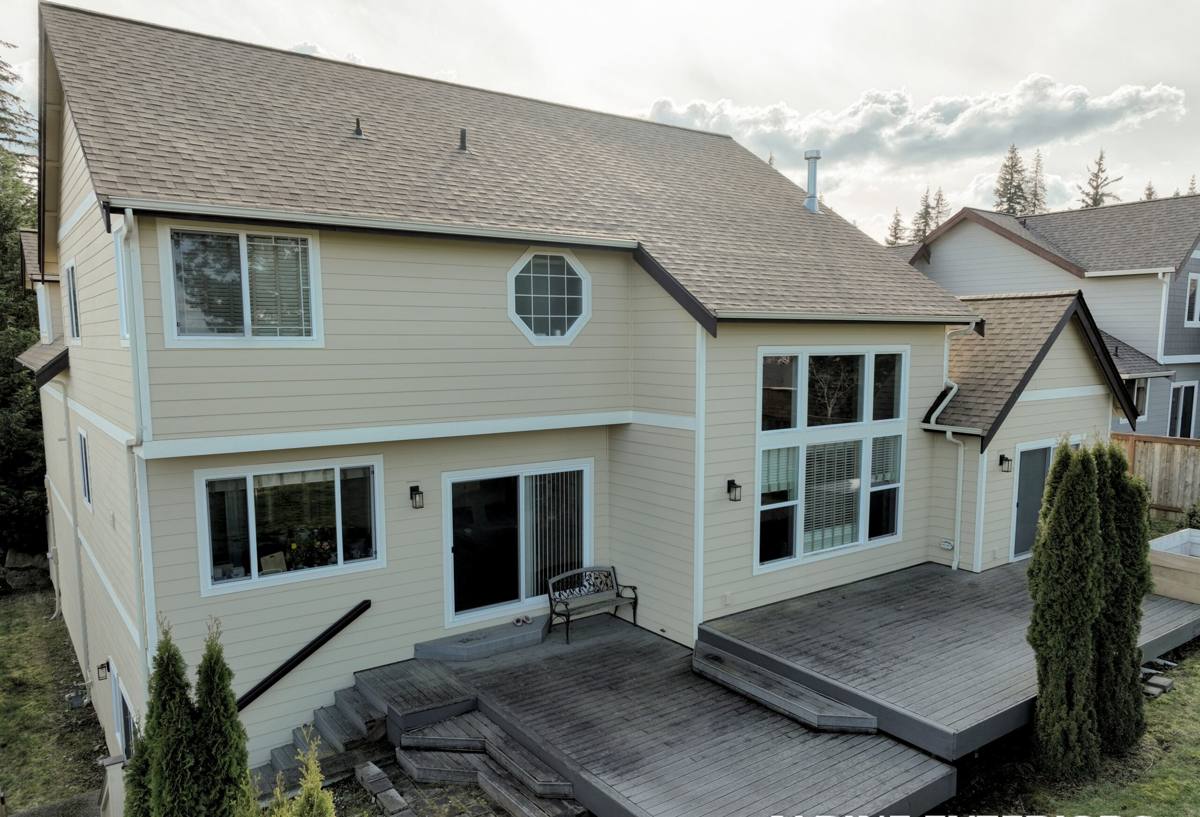
Signs a Sehome Home Needs Siding Replacement, Not Just Repair
Moisture and Structural Signs
- Soft, spongy, or bubbling spots when you press on the siding, especially near the bottom courses and around windows
- Visible warping, buckling, or boards that no longer sit flat against the wall
- Paint that keeps failing in the same spots every year or two, no matter how often it's repainted
- A musty smell near exterior walls, or interior drywall staining that traces back to an exterior wall
- Persistent moss or dark algae streaking that comes right back a few months after cleaning
Age and Performance Signs
Older wood and low-grade composite sidings in this area often start showing their age around the 12-20 year mark, well before their expected service life, because the local climate accelerates whatever weaknesses the product already had. If your siding is original to a home built in the 1990s or early 2000s and you're repainting or recaulking more than once every five years just to keep water out, that's a sign the material itself is the problem, not your maintenance habits.
Why We Only Install James Hardie Fiber Cement in This Area
Sudden Valley Siding Company installs James Hardie fiber cement siding exclusively. We don't install vinyl, LP SmartSide, Cemplank, Allura, primed spruce, or cedar, and we think Sehome homeowners deserve an honest explanation of why — not just a sales pitch for the product we sell.
Vinyl
Vinyl is affordable and low-maintenance in mild climates, and it has real strengths: it doesn't rot, and it's easy to install quickly. But it's a thin plastic product that expands and contracts significantly with temperature swings, which opens and closes seams over time, and it can become brittle and crack in sustained cold snaps. In a wind-driven rain environment, those seams are exactly where water gets behind the wall.
LP SmartSide and Other Wood-Composite Products
Engineered wood siding has improved a lot over the decades, and it holds paint well when new. The trade-off is that it's still a wood-based product at its core — its long-term performance depends heavily on caulking, flashing, and paint maintenance staying perfect, year after year, in a climate that doesn't give you many dry stretches to do that maintenance in. Miss a cycle and moisture exposure adds up fast.
Cedar and Primed Spruce
Real wood siding is beautiful and has a long tradition in the Pacific Northwest, but it demands the most upkeep of any option — regular refinishing, vigilant caulking, and active moss and mildew control — to keep salt air and rain from working into the grain. For homeowners who want that upkeep, it's a legitimate choice. It's just not the standard we build our installations around.
Why James Hardie
James Hardie fiber cement is engineered from cement, sand, and cellulose fiber — it doesn't rot, it's non-combustible, and it holds its factory-applied ColorPlus finish far longer than field-applied paint typically lasts. Hardie also makes climate-specific HZ formulations engineered for exactly the moisture and temperature patterns found in the Pacific Northwest, backed by a strong transferable product warranty. It's not maintenance-free, but the maintenance it needs is periodic washing and inspection, not a repaint-and-recaulk cycle every few years.
What a Correct Siding Replacement Actually Involves
Tear-Off and Wall Inspection
Every proper replacement starts with full removal of the old siding, not installing over it. That's the only way to see what's actually happening behind the wall — rot, mold, compromised sheathing, or failed flashing that's been hidden for years. Any damaged sheathing or framing gets repaired before anything new goes up; siding over a compromised wall just hides the problem for another decade.
Weather-Resistive Barrier and Flashing
A correctly installed weather-resistive barrier, properly lapped and sealed, is what actually keeps bulk water out of the wall assembly — the siding itself is the first line of defense, not the only one. Flashing around windows, doors, and every roof-to-wall intersection has to be detailed correctly, because those transitions are where the vast majority of siding failures start in this climate.
Installation to Manufacturer Spec
James Hardie siding has specific requirements for fastener type, spacing, clearances above rooflines and decks, and gaps at butt joints and trim — all of which matter for both performance and warranty coverage. Installing it like a generic siding product, rather than to Hardie's actual spec, is one of the most common ways a good material still ends up performing poorly.
Trim, Caulking, and Paint Details
The finishing details — corner trim, caulking at penetrations, and touch-up paint on cut edges — are small line items that determine whether water gets a foothold in year three or stays out for decades. We treat them as part of the installation, not an afterthought.
Our Process for Sehome Homeowners
- On-site assessment. We walk the exterior, check for the moisture and damage signs above, and look at how your home is currently detailed around windows, roof lines, and grade.
- Straightforward quote. You get a clear scope of work and price range — no vague allowances, no pressure to decide on the spot.
- Scheduling around the weather. We plan tear-off and installation in manageable sections so your home isn't left exposed to a surprise system rolling in off the Sound.
- Installation to spec. Removal, sheathing repair if needed, weather barrier, flashing, and Hardie installation, done in the sequence that actually protects the wall.
- Final walkthrough. We go over the finished work with you directly and make sure the site is cleaned up before we consider the job done.
Comparing Siding Materials for This Climate
| Material | Moisture Resistance Here | Maintenance Demand | Typical Longevity |
|---|---|---|---|
| James Hardie Fiber Cement | Strong — engineered HZ lines for PNW conditions | Periodic washing, occasional caulk checks | Multiple decades with correct install |
| Vinyl | Moderate — seams are the weak point in wind-driven rain | Low, but seams can fail with age and cold | Variable, shorter in harsh coastal exposure |
| LP SmartSide / Wood Composite | Moderate — dependent on paint and caulk integrity | Regular repainting and caulk maintenance | Shorter without diligent upkeep |
| Cedar / Primed Spruce | Lower without constant upkeep | High — refinishing, moss and mildew control | Shortest without frequent maintenance |
Why Local Installation Experience Matters
A crew that already works throughout Sudden Valley and the surrounding Whatcom County communities, including neighborhoods like Sehome, has already seen how this specific climate treats siding installations over time — which details hold up and which ones don't. That means we know to prioritize flashing at roof-wall intersections, keep clearances correct near grade and decks where splashback and standing moisture are common, and choose fastening details that account for salt-air corrosion over the long run. It also means we're a known, reachable local business if a warranty question or a follow-up question comes up years down the road — not a crew that did one job in your neighborhood and moved on.
Keeping New Siding Performing Long-Term
Even the right material needs some basic upkeep in this climate. A light annual wash to knock back moss and algae buildup, especially on north-facing and shaded walls, keeps organic growth from holding moisture against the surface longer than it should. Keeping gutters clear and grade sloped away from the foundation reduces the splashback and standing water that stress the bottom courses of any siding. None of this is heavy labor — it's the difference between siding that looks and performs like new for decades and siding that starts showing stress a few years early.
If you're seeing early signs of trouble on your Sehome home, or your siding is simply reaching the end of its useful life, we're happy to take a look and give you a straightforward, no-pressure estimate. Use the form below to get started.